



Molecular modelers often face the challenge of efficiently modifying molecular structures while maintaining consistency with physical laws. Whether it's creating or breaking bonds or handling complex topological changes, these tasks can be tedious and computationally intensive. Thankfully, SAMSON's Interactive Modeling Universal Force Field (IM-UFF) offers an efficient and intuitive solution to this problem.
Revolutionizing Molecular Design
The IM-UFF interaction model is an extension of the well-known Universal Force Field (UFF). Unlike the static UFF, IM-UFF enables dynamic topological changes during real-time modeling. This makes it particularly suited for tasks such as bond breaking and formation, bond order modification, and atom retyping. These features are invaluable for researchers and modelers seeking to modify molecular structures without the need for constant recalculations or tedious pre-definitions.
Here are some standout features of IM-UFF:
- Allows creation and breaking of covalent bonds dynamically.
- Facilitates changes in bond orders and atom types seamlessly.
- Adapts the topology of molecular systems in real time to better reflect physical organization.
- Guides users with physically-based interatomic forces, enabling highly intuitive molecular manipulations.
Simplifying Interactive Modeling
Using IM-UFF is straightforward. To set it up in SAMSON:
- Open a molecular system document in SAMSON.
- Navigate to Edit > Simulate > Add simulator or use the shortcut
Ctrl+Shift+M(orCmd+Shift+Mon Mac). - Choose Interactive Modeling Universal Force Field as the interaction model.
- Select your preferred state updater, such as FIRE, for simulation.
- Press OK to activate the IM-UFF parameters window.
The parameter window for IM-UFF offers customization for interactive modeling options. For instance:
- Switch between standard UFF (static topology mode) and interactive IM-UFF mode.
- Enable or disable Van der Waals interactions for manipulated atoms to make structural adjustments more intuitive.
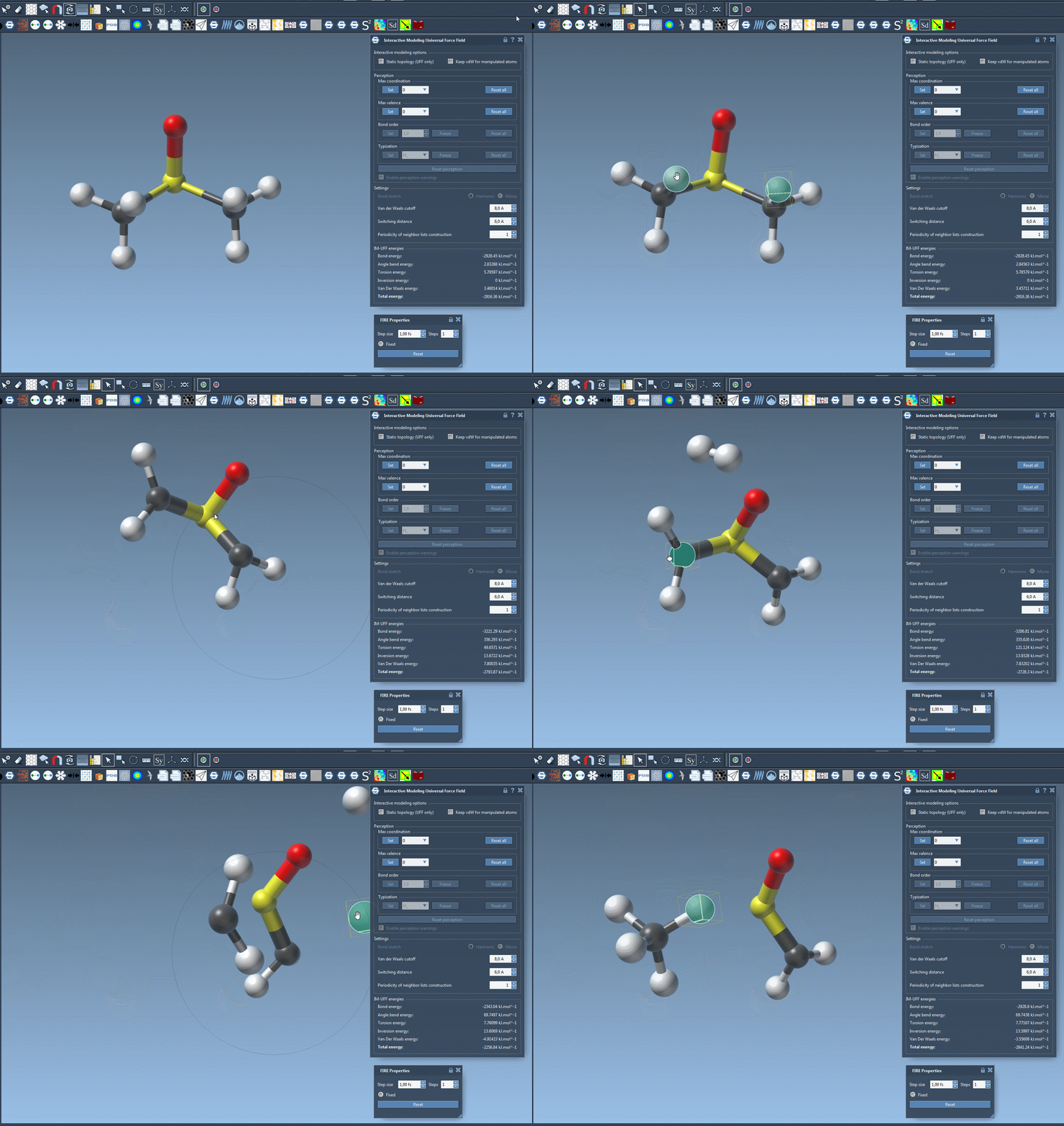
IM-UFF is particularly effective when working on smaller or medium molecular systems. By exploring its functionality, you'll notice how bonds form or break as atom positions dynamically adjust, reflecting chemical principles. Here's an example showcased in the GIF below:
Enhance Your Workflow
IM-UFF not only simplifies molecular editing but also provides a smooth and interactive interface for dynamically altering systems. This makes it a valuable tool for molecular modelers working on complex chemical systems, who need to explore various structural possibilities without getting bogged down by static methods.
To delve deeper and master IM-UFF for your molecular design projects, visit the full tutorial at SAMSON's documentation.
Note: SAMSON and all SAMSON Extensions are free for non-commercial use. Get SAMSON today at samson-connect.net.