



For molecular modelers, understanding shape changes in structures during simulations is a common yet complex task. With complex biomolecules, how can you effectively track how far a group deviates from a simple spherical shape without resorting to oversimplified metrics? Enter Asphericity Analysis—a tool that provides a clear perspective on shape anisotropy along molecular trajectories.
What is Asphericity?
Asphericity is a measure that assesses the deviation of a group—composed of atoms—from a spherical shape. Rather than representing a structure with just a single distance like the radius of gyration, asphericity offers a more refined insight into how isotropic or anisotropic the shape is while the system evolves during simulations.
This approach is particularly helpful in cases where spherical approximations fail to represent actual molecular shape changes over time. For example, if you are investigating shape fluctuations in polymers, protein folding mechanisms, or conformational changes in large complexes, asphericity offers a reliable method to track and visualize these alterations systematically.
How to Use Asphericity in SAMSON
The integration of Asphericity Analysis in SAMSON’s Path Analyzer makes it incredibly straightforward to incorporate into your workflow. Here’s a quick guide to set it up:
- Open the Path Analyzer on the SAMSON platform.
- Select Asphericity under Observable.
- Specify the Path you wish to analyze.
- Define the molecular Group (of atoms) for your analysis.
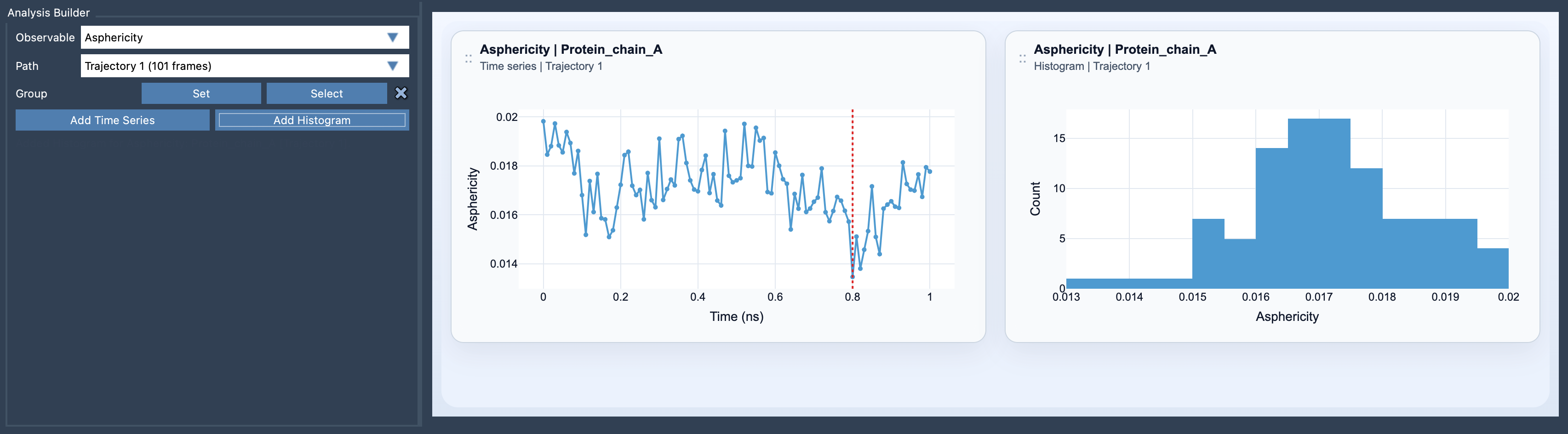
- Finally, either visualize it over time through Add Time Series or analyze distributions using Add Histogram.
Both the time-series and histogram views are valuable for quantitative and qualitative insights. You can monitor the evolution of the shape descriptor through time or examine the distribution of values collected along a sampled trajectory.
Why Combine Asphericity with Other Metrics?
While asphericity provides meaningful detail about shape anisotropy, combining it with other descriptors like the radius of gyration and shape parameter gives you an even richer picture of how structures evolve. This multi-descriptor approach ensures you capture both isotropic size changes and deviations in symmetry—a key consideration when studying phenomena like compaction or unfolding.
Practical Tip
If you find that radius of gyration is too simplistic for your problem, incorporating asphericity might offer better insights. Whether you’re modeling supramolecular assemblies or natural polymers, understanding shape anisotropy will create meaningful interpretations of your system’s structural behavior.
To explore more about asphericity analysis, check out the original documentation page at this link.
SAMSON and all SAMSON Extensions are free for non-commercial use. You can get SAMSON at https://www.samson-connect.net.