



When working on protein modeling, one of the persistent challenges is ensuring that the conformations of amino acid residues are energetically favorable. The Ramachandran Plot has long been a core element in this process, giving molecular modelers a visual representation of backbone dihedral angles (ψ vs. φ) and highlighting both allowed and disallowed regions. But how can one efficiently manipulate and refine protein structures using this tool? That’s where the Interactive Ramachandran Plot in SAMSON comes in.
What makes interactive Ramachandran plots essential?
Traditional Ramachandran plots provide excellent insights into whether residues are in energetically stable configurations, but they often require external tools or scripts for any meaningful editing. The SAMSON Interactive Ramachandran Plot Extension bridges this gap by allowing you not only to visualize the information but also to directly edit and refine conformations within the platform itself. Whether you’re a researcher looking to prepare structures for simulations or refine a homology model, this extension simplifies the process and integrates seamlessly into existing workflows.
How does it work?
Starting with the extension is easy:
- Log into SAMSON Connect.
- Navigate to the Interactive Ramachandran Plot Extension page and click Add.
- Restart SAMSON, ensuring the extension is loaded and ready to use.
- Load a protein structure (e.g., PDB ID
1YRF), and you can begin using the plot immediately.
Interactive Editing: A closer look
Once your protein is loaded, the Ramachandran Plot app can be launched via Home > Apps > Biology > Ramachandran plot. Generating a plot gives you a detailed overview of residue conformations, with yellow areas marking energetically favorable regions and white areas showing unfavorable ones. Using the app, residues can be sorted and filtered into categories like General, Glycine, Proline, and Pre-proline. For precision, you can zoom in on specific residues and select them directly on the plot.
If a residue needs adjustment, there are two intuitive ways to edit:
Option 1: Dragging points in the plot
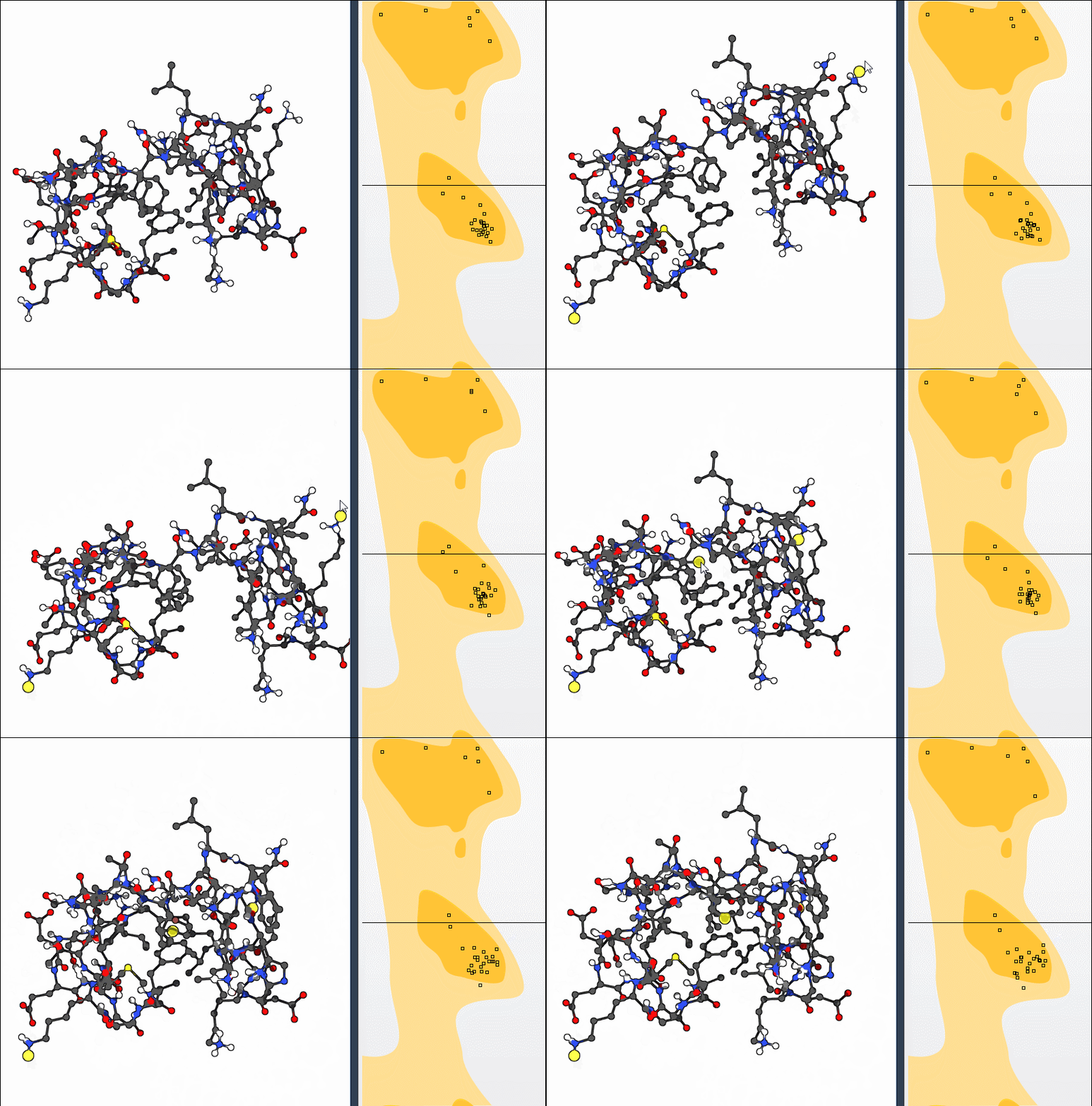
- Simply drag points on the Ramachandran plot to adjust dihedral angles in real time.
- The changes automatically reflect in the 3D structure, offering instant feedback.
- If you’re unsatisfied, you can use Ctrl/Cmd + Z to undo.
Option 2: Using the Twister Editor
The Twister Editor allows for more intricate 3D manipulation:
- Activate the Twister Editor via the left-hand viewport menu.
- Rotate or twist the protein backbone while observing real-time updates in the Ramachandran plot.
Why this matters for protein modeling
Interactive capabilities simplify reworking problematic residues and help you understand conformational flexibility, particularly in critical regions like active or binding sites. The Ramachandran Plot extension is especially useful for:
- Fixing strained residues prior to simulations.
- Refining homology models by addressing outlier conformations.
- Exploring local optimizations in conjunction with global motions, such as normal mode analysis.
Conclusion
The Interactive Ramachandran Plot in SAMSON is a must-have tool for molecular modelers who need to inspect and refine protein backbone conformations efficiently. Its editable plots and seamless integration with 3D structures make it both intuitive and powerful.
To discover more about this feature and learn how to integrate it into your workflows, visit the official documentation page at this link.
SAMSON and all SAMSON Extensions are free for non-commercial use. Get SAMSON at https://www.samson-connect.net.