



Building a polymer model often involves more than repeating a fragment. You may need to combine different monomers, repeat blocks, choose bond types, and keep track of which atoms connect. Doing those steps manually can make a chain tedious to assemble—and easy to mis-specify.
SAMSON’s Polymer Builder offers a way to define the building blocks and sequence first, then generate the polymer from an expression. The useful idea is to separate what the polymer is made of from how many times each part appears.
Start with fragments you can reuse
Open Polymer Builder from Home > Apps > Assembly > Polymer Builder, or find it using Find everything… with Shift + E. To register a monomer, select its molecular fragment in the document or viewport and click Register monomer from selection.
The app assigns each registered monomer a unique letter, such as A or B. It automatically chooses start and end atoms at opposite ends of the fragment. Since those atoms determine how fragments connect, check the choices: use S to set an atom from your current selection, or P to choose one from a list. The V control can help highlight the structure or atoms while checking them.
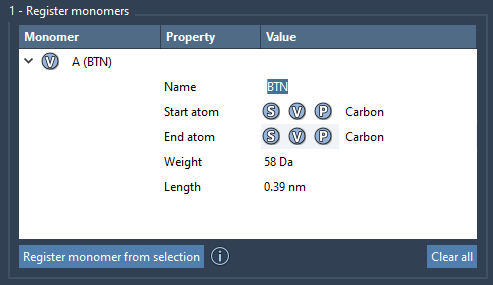
The monomer table reports molecular weight and the distance between its start and end atoms. You can edit registered monomers in the table. Keep in mind that changing a monomer’s structure in SAMSON—for example, adding or removing an atom—deregisters it, so register it again if you still need it in the polymer.
Turn recurring blocks into sequences
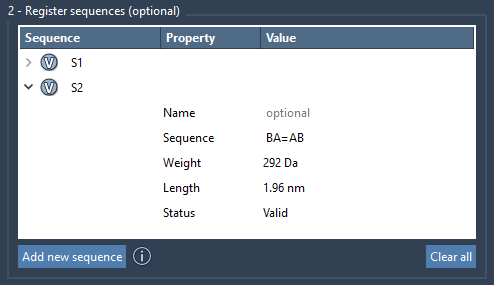
If a section of your polymer uses the same monomer pattern repeatedly, register it as a sequence instead of typing the pattern over and over. Click Add new sequence and enter monomer IDs, such as ABBA. Sequences receive identifiers such as S1 and S2. Their status indicates whether the expression is valid; use the sequence’s V button to highlight the monomers it contains.
You can also specify the bond between monomers in a sequence. A single bond is the default; = denotes a double bond and # a triple bond. For example, A=B describes A connected to B by a double bond, while A#B uses a triple bond. A sequence can be given a name if you want its monomers grouped under a common parent structural group in the generated polymer.
Write the architecture as an expression
Once your monomers and sequences are registered, combine their identifiers in the polymer expression. For instance, 2*AB means two repeats of the sequence AB, producing ABAB. If S1 and S2 are registered sequences, 2*S1 + 2*S2 requests two repeats of each. You can also specify a bond between blocks: AB=BA connects AB to BA with a double bond, and AB#BA uses a triple bond.
This notation is especially useful when comparing designs: keep the same registered building blocks and change the expression to describe a different arrangement or repeat count. Before generating, review the predicted molecular weight and length shown by the app. Treat them as estimates for planning, rather than a substitute for checking the resulting structure.

Generate, inspect, then refine
Click Generate polymer to create the structure. Its initial shape follows the directions between the start and end atoms of the monomers, and excess hydrogens at connection sites are removed. The optional Adjust Hydrogens on connection atoms setting adjusts hydrogens based on valence and their positions. Adjust for clashes tries to avoid steric overlaps while connecting monomers, which may introduce slight curvature.
Generation gives you a structure to inspect and refine; it does not remove the need to check whether the result suits your modeling task. SAMSON’s built-in Edit > Minimize command can be used to minimize the polymer with the Universal Force Field. You can also use a generated polymer as a monomer for a larger block copolymer or extended chain.
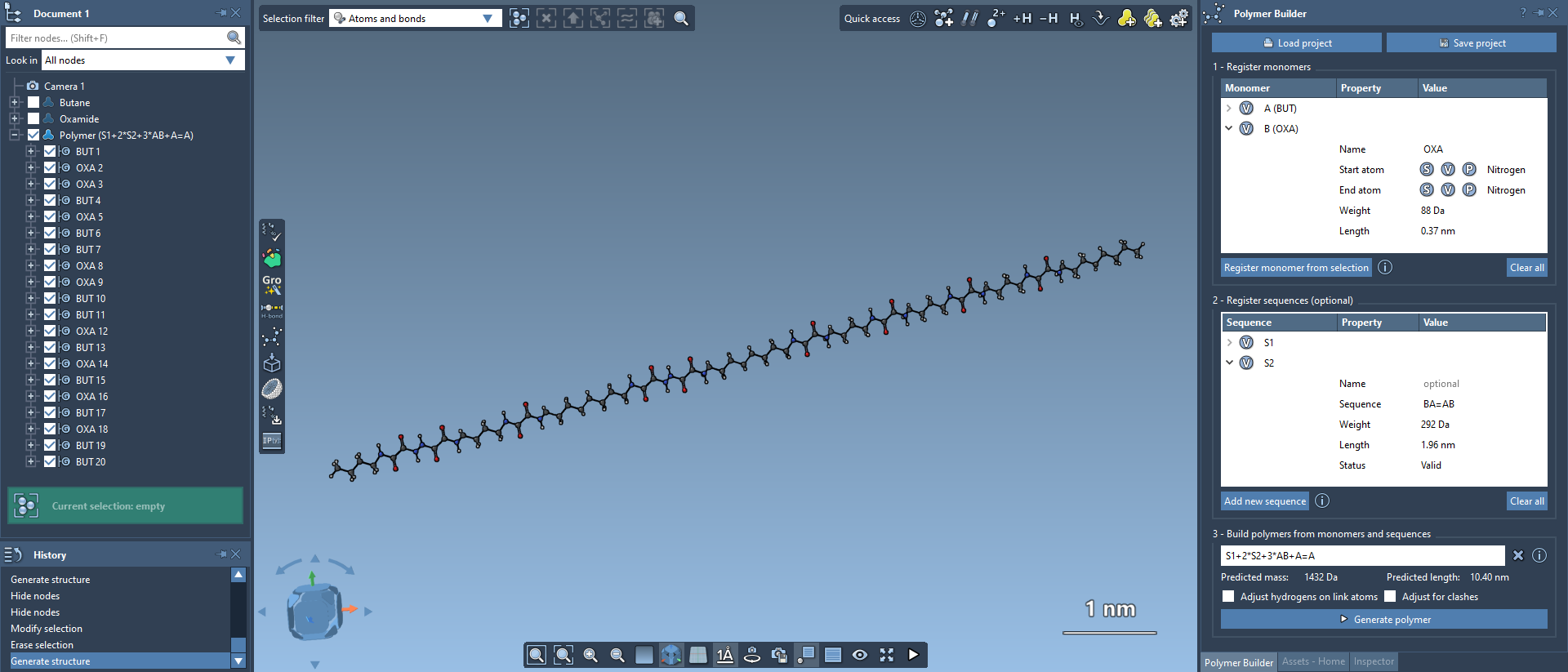
To keep your work reusable, save the full project to preserve the monomer and sequence tables. To export just the resulting polymer, select it and choose Home > File > Save selection as….
For the complete walkthrough, see the Polymer Builder documentation.
Note: SAMSON and all SAMSON Extensions are free for non-commercial use. Get SAMSON.