



A molecular structure can look plausible and still need careful refinement. But when you are exploring alternatives, waiting for a high-accuracy calculation at every step can interrupt the work. UMA Force Field in SAMSON offers a way to interactively evaluate energies and forces while adjusting a structure. The key is to use that feedback for what it is good for: rapid exploration and refinement, not an automatic substitute for a reference method.
This distinction helps with a common modeling problem: getting useful feedback early without treating an initial energy value—or a visually tidy structure—as proof that a model is correct. Here is a practical way to set up UMA, choose the relevant controls, and interpret what you see.
Start with the system, not the biggest model
Before opening the simulator, check that the UMA Force Field and Python Scripting extensions are installed and up to date. On first use, UMA prepares a dedicated Python environment and may request access to its models. That setup can take time. If prompted, follow SAMSON’s instructions; once it is complete, you may need to create the interaction model again.
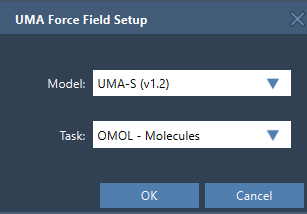
When adding a simulator, select UMA Force Field and choose a state updater, such as FIRE. In the setup window, select both a model and a task. A useful default is UMA-S (2.3 GB, v1.2), which is intended for the default fast workflow. UMA-S (1.1 GB, v1.1) is a lighter legacy option, while UMA-M (11.7 GB, v1.1) is the larger option when you want more capacity. Choosing the largest model by default is not necessary for every exploratory task.
The task should match the kind of system you are evaluating:
- OMOL – Molecules: molecular systems. This is the task whose interface uses total charge and spin multiplicity.
- OMAT – Inorganic materials: bulk inorganic materials workflows.
- ODAC – MOFs: MOF and direct-air-capture-style adsorption workflows.
- OC20 – Catalysis: catalytic surfaces and adsorbates.
- OMC – Molecular crystals: molecular-crystal systems.
Make the first evaluation a deliberate check
After the environment and model are ready, start the simulation using Edit > Simulate > Start. The properties window may initially report that energy is unavailable. Wait for the first evaluation to complete before interpreting the display; the total energy appears after a successful evaluation.
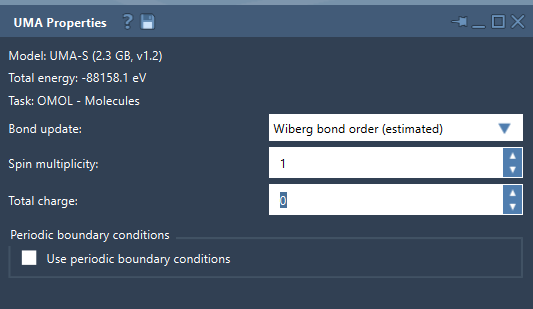
For a molecular system using OMOL, check the total charge and spin multiplicity in the properties window and set values that match the system you intend to model. These settings are part of the request sent to UMA, so an incorrect choice can undermine an otherwise careful exploration.
Know what the interactive controls are showing
The bond-update setting determines how SAMSON handles the bond graph during the simulation. Covalent recomputes covalent bonds from the current structure. Off leaves the existing graph unchanged. The estimated Wiberg and Mayer bond-order options use a deep-learning model to estimate bond orders. They can help with interactive visualization, but they are estimates—not a reason to treat a bond-order display as definitive evidence. Confirm important conclusions with your reference method.
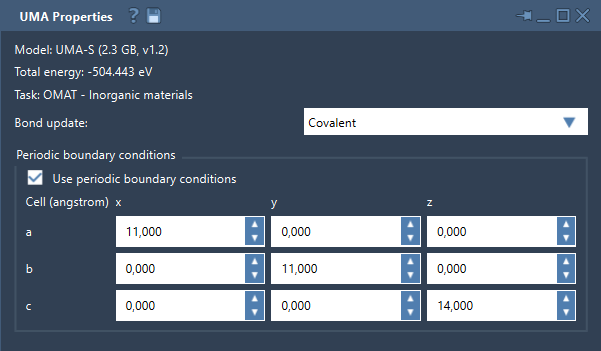
For periodic workflows, check whether periodic boundary conditions are enabled and inspect the 3 × 3 cell matrix, given in angstroms. A cell that does not represent the system you intend to study can make the result difficult to interpret. Treat the boundary-condition setting and the cell as part of the model setup, not as incidental interface details.
A practical way to use the result
- Choose the task that matches the system.
- Begin with UMA-S for rapid feedback.
- For OMOL, verify charge and spin multiplicity.
- For periodic systems, inspect the cell and boundary-condition setting.
- Use the energy and forces to guide interactive screening, refinement, and exploration.
- When a conclusion matters, confirm it with a higher-accuracy reference method as appropriate.
This workflow separates two jobs that are easy to conflate: using fast feedback to decide what to inspect next, and establishing confidence in a final result. UMA can make the first job more interactive; the second still depends on suitable validation for your scientific question.
For setup details and the complete tutorial, read the UMA Force Field documentation.
Note: SAMSON and all SAMSON Extensions are free for non-commercial use. Get SAMSON.