



A molecular group can look different along a trajectory even when a single measure of its overall size does not tell the full story. Radius of gyration is useful for tracking how spread out a group is, but it can be too coarse when the question is about shape: does the group remain roughly spherical, or does it become more elongated or otherwise depart from a spherical shape?
Asphericity offers a complementary way to monitor that change. In SAMSON’s Path Analyzer, it reports how far a selected group deviates from a spherical shape along a path or trajectory. That makes it useful when you want to follow shape anisotropy over time, rather than summarize the group with a single distance.
Start with a clear analysis question
Before adding a plot, decide which atoms define the object whose shape you want to follow. A selection that is too broad may combine regions with different motions; one that is too narrow may leave out the structural feature you care about. The documentation requires one atom-containing selection. Keeping the group definition consistent is also important when comparing values along a path: otherwise, changes in the selection could be confused with changes in shape.
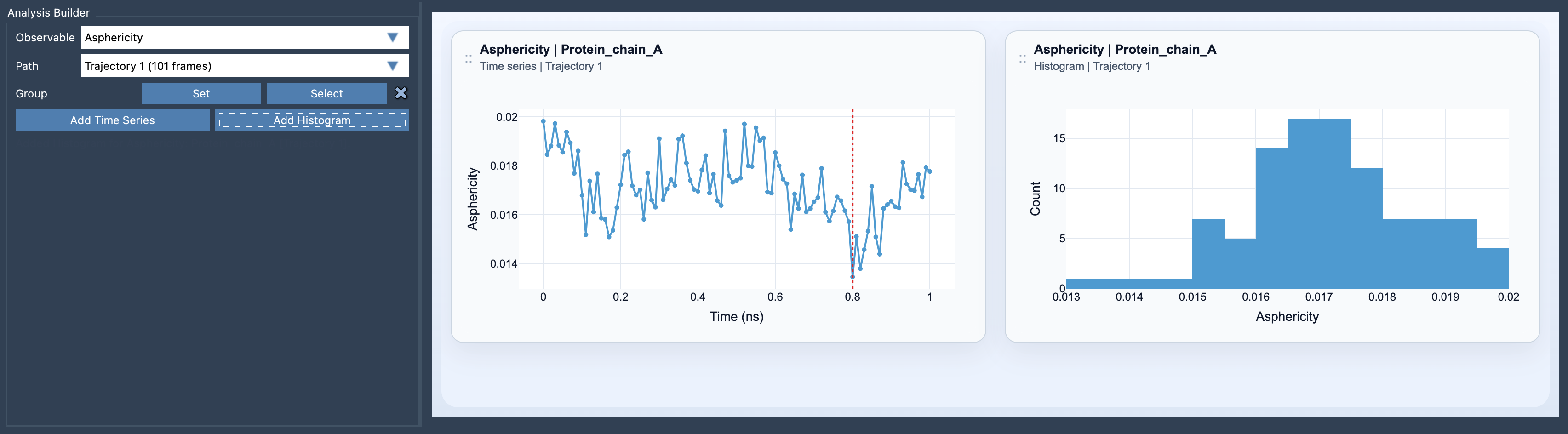
Then open Path Analyzer, choose Asphericity as the observable, select a path, and define the group. Add either a time series or a histogram, depending on the question you want to answer.
Choose the view that fits the question
- Time series: follow the shape descriptor along the path. This view helps you locate when the selected group’s shape changes, and whether a change appears brief or persists across part of the trajectory.
- Histogram: inspect the range of sampled values. This view is useful for seeing how values are distributed across the path, rather than focusing on their order in time.
These views answer different questions. A histogram can summarize the values but does not show when they occurred. A time series preserves their order but may make the overall range less immediately apparent. If both the timing and distribution matter, examining both views can provide a more complete picture.
Use asphericity alongside size
Asphericity is most informative when it addresses a specific limitation in your current analysis. If radius of gyration alone is too coarse for the shape change you are investigating, add asphericity rather than treating it as a replacement for every other descriptor. The Path Analyzer documentation also suggests pairing it with Radius of gyration and Shape parameter for a fuller picture of global shape changes.
Reading these measures together helps keep the interpretation focused: one can report how the selected group’s shape descriptor varies, while the companion analyses provide additional context about size and shape. Avoid treating a single plotted value as a complete description of a molecular motion. The plot describes the selected group along the chosen path; it does not, by itself, explain why the change occurred.
Asphericity is therefore a practical addition when your modeling question concerns shape anisotropy, not just how spread out a group is. Define the group carefully, choose a time series or histogram to match your question, and use complementary descriptors when you need a broader account of global shape change.
Learn more in the Asphericity documentation.
Note: SAMSON and all SAMSON Extensions are free for non-commercial use. Get SAMSON.