



A molecular structure can change substantially without any single local measurement telling the whole story. It may expand, collapse, or rearrange into a different overall shape. When you need a quick way to track that global size change across a path or trajectory, the radius of gyration is a useful place to start.
Radius of gyration summarizes the overall compactness of a selected group of atoms. In practical terms, it helps answer a simple question: does this group become more compact or more spread out as the structure moves along the path? It is a broad diagnostic, not a description of every structural detail—which is exactly why it can be helpful early in an analysis.
Start with a question, not just a plot
Before adding the analysis, decide what group you want to follow. For example, are you interested in the compactness of the entire molecule, or of a particular atom-containing region? The result describes the group you select, so changing that selection changes what the plot means. Keep the group consistent when comparing paths or interpreting changes; otherwise, a difference in the plotted value may come from a different selection rather than a structural change.
Set up the analysis
- Open Path Analyzer.
- Choose Radius of gyration under Observable.
- Select the Path you want to inspect.
- Define an atom-containing Group.
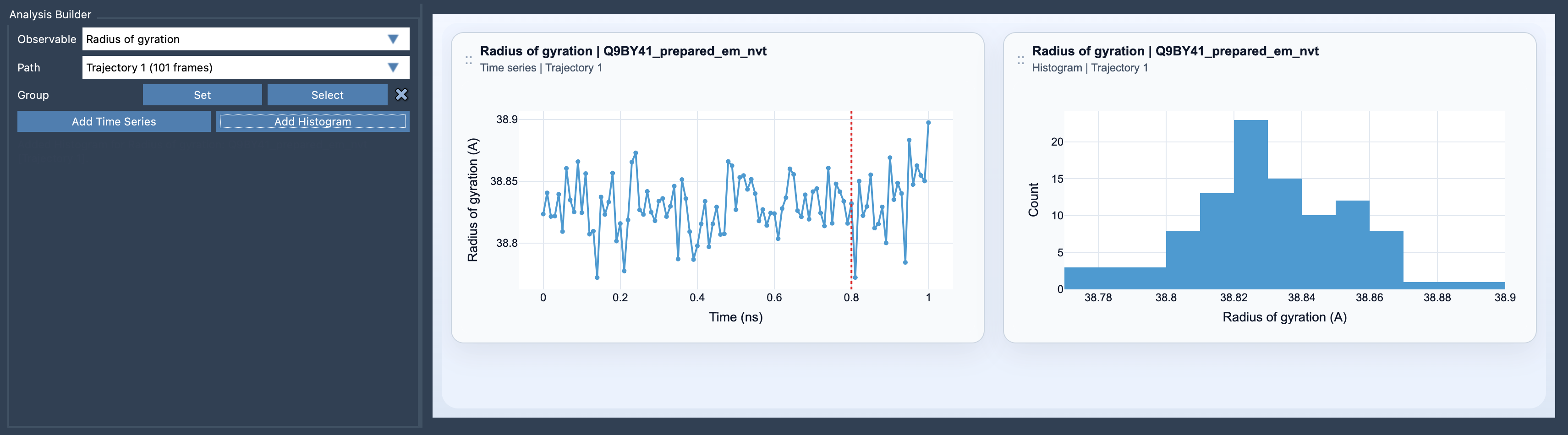
- Choose Add Time Series or Add Histogram.
The result is reported in A (ångströms). A time series is useful when you want to see where along the path compactness changes. A histogram offers a complementary view: it helps you inspect the range of compactness values represented in the path. The two views answer different questions, so use the one that matches the comparison you have in mind.
Read the trend carefully
A rising radius of gyration indicates that the selected group is becoming more spread out overall; a falling value indicates that it is becoming more compact. A relatively steady trace suggests that its overall compactness is not changing much, even if other aspects of the structure may be moving. Look for sustained trends as well as short-lived deviations, and relate them to the part of the path you are studying.
One important caution: compactness is not the same as shape. Two structures can have similar radius-of-gyration values while differing in how their atoms are arranged. Likewise, a change in this measure alone does not establish why the structure changed or whether a particular molecular event occurred. Treat it as a first diagnostic, then use other evidence to interpret the result.
When one number is not enough
If you also need to understand how the shape changes, pair radius of gyration with Asphericity or Shape parameter. Together, these observables can give a more informative picture than compactness alone: one tracks overall size, while the others help characterize aspects of shape.
For a quick check of expansion, collapse, or swelling, radius of gyration offers a clear starting point—as long as you keep the selected group and the limits of the measurement in mind. Learn more in the Radius of Gyration documentation.
Note: SAMSON and all SAMSON Extensions are free for non-commercial use. Get SAMSON.