



A candidate molecular pathway can be useful for seeing how a ligand might move, yet still contain awkward intermediate structures. If you already have a sequence of conformations or a path, the Parallel Nudged Elastic Band (P-NEB) app in SAMSON can refine that starting point. The key distinction is important: P-NEB improves a pathway you provide; it is not the step that invents the initial route.
This makes path refinement a practical next step after generating a candidate with a path-finding method or interpolation. Instead of treating every intermediate as a finished answer, you can optimize the sequence while accounting for the molecular forces and the spacing between neighboring states.
What P-NEB changes
The Nudged Elastic Band method optimizes the intermediate images along a path. Spring forces help keep neighboring states distributed along the pathway, while the interaction model supplies energies and forces. The P-NEB app also implements the climbing-image strategy, which can be enabled to help locate a saddle point. In the workflow below, leave that option off for the first run; you can try a separate run with it enabled.
Think of the result as a refined sequence of structures, not as a molecular dynamics movie with experimentally meaningful timing. The method is for optimizing a transition path between states, not for determining how quickly a transition occurs.
Start with a candidate route
Before opening the app, load a sample path or a set of conformations. For example, the SAMSON tutorial provides a smaller Zinc ligand unbinding example and a protein–ligand system involving lactose permease (1PV7) and thiodigalactoside (TDG), with paths generated using Ligand Path Finder.
If you have two relaxed endpoint structures but no intermediates, generate a sequence between them first. Linear interpolation or a path-generation extension such as Ligand Path Finder can provide a starting route. P-NEB is most useful once that initial candidate exists.
A practical first run
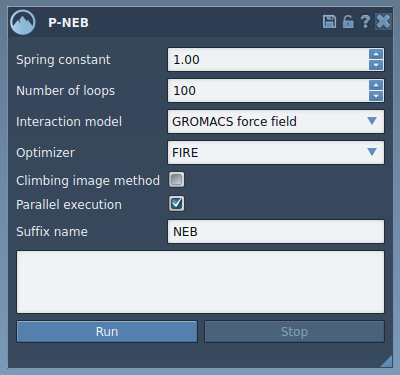
- Install the P-NEB extension and the FIRE state updater.
- Open P-NEB from Home > Apps > All, or find it with the Find everything… search box.
- Set the spring constant to
1.00and the number of loops to100. - Choose Universal Force Field as the interaction model and FIRE as the optimizer.
- For the initial run, leave Climbing image method unchecked. Enable Parallel execution, and enter
NEBas the suffix name. - Select the path in the Document view and click Run.
When the Universal Force Field setup asks whether to use existing bonds, choose to use them and confirm. Initialization and computation then begin; progress is shown in the status bar. After the run, look for the new path in the Document view and review the computation summary in the P-NEB interface.

Prefer paths when you can
P-NEB can also take a selected set of conformations as input. However, for the same system and number of steps, the tutorial notes that this takes longer than applying P-NEB directly to a path. If your conformations form a sequence, select them and use Conformation > Create path from conformations in the context menu, then run P-NEB on the resulting path.
Once optimization is complete, inspect the output rather than relying only on the fact that a new path was created. Select it and use the Inspector to examine it, or double-click the path to start and stop its animation. You can also access path options by right-clicking and choosing Path > …. This review helps you assess whether the refined route is useful for your next modeling step.

For the full walkthrough and related tutorials on creating initial paths, see the P-NEB documentation.
Note: SAMSON and all SAMSON Extensions are free for non-commercial use. Get SAMSON.