



Two protein structures can show different conformations of the same molecule, but comparing only the endpoints leaves a practical question unanswered: what might a continuous structural transition between them look like? Moving every atom independently can produce unhelpful intermediate shapes. A useful first step is to generate a connected series of conformations that respects the structure’s geometry.
SAMSON’s ARAP Interpolator creates such a path between two protein conformations using As-Rigid-As-Possible (ARAP) interpolation. The resulting intermediates can be inspected and exported, and the path can provide a geometric starting point for workflows such as transition-path refinement or umbrella-sampling setup. It is important to treat an interpolated path as a model to analyze—not, by itself, proof of the protein’s actual kinetic route or a free-energy profile.
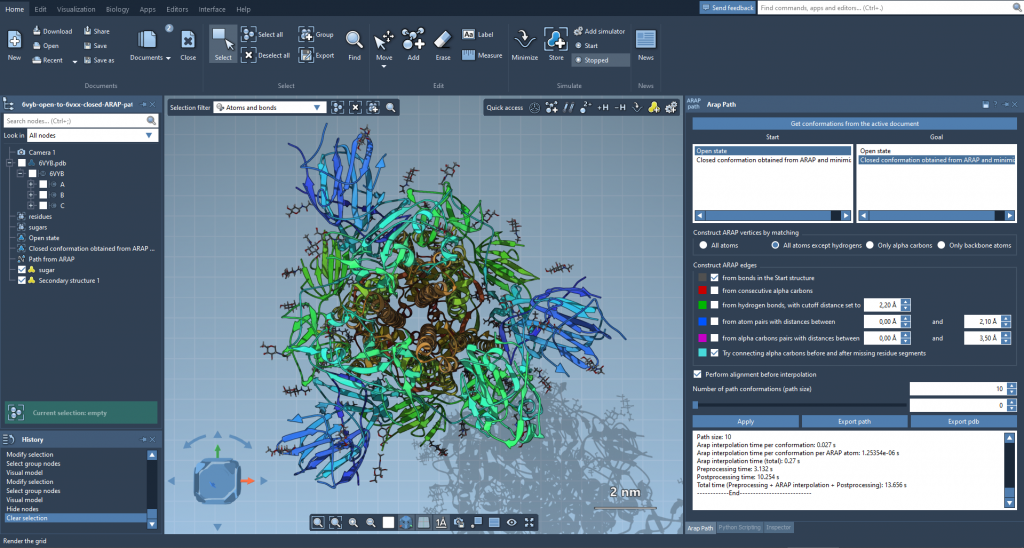
Prepare comparable endpoints first
The example uses two conformations of diphtheria toxin from PDB entries 1DDT and 1MDT. In SAMSON, fetch both structures using Home > Fetch, entering 1DDT 1MDT. The example focuses on chain A. In the Document view, remove chain B from 1MDT, then run Home > Prepare on both structures to remove alternate locations, water, ligands, and ions.
This cleanup is more than housekeeping: the structures need corresponding atoms and a connected structure for the interpolation setup. If the app reports that the structure does not make one connected component, check for leftover water, ions, ligands, or other disconnected pieces and prepare the structures again.
Next, create a conformation for each cleaned structure. Select a structure in the Document view and choose Edit > Conformation; name the examples 1DDT A and 1MDT A. These saved conformations will be the start and goal of the path.
Choose what the interpolation should connect
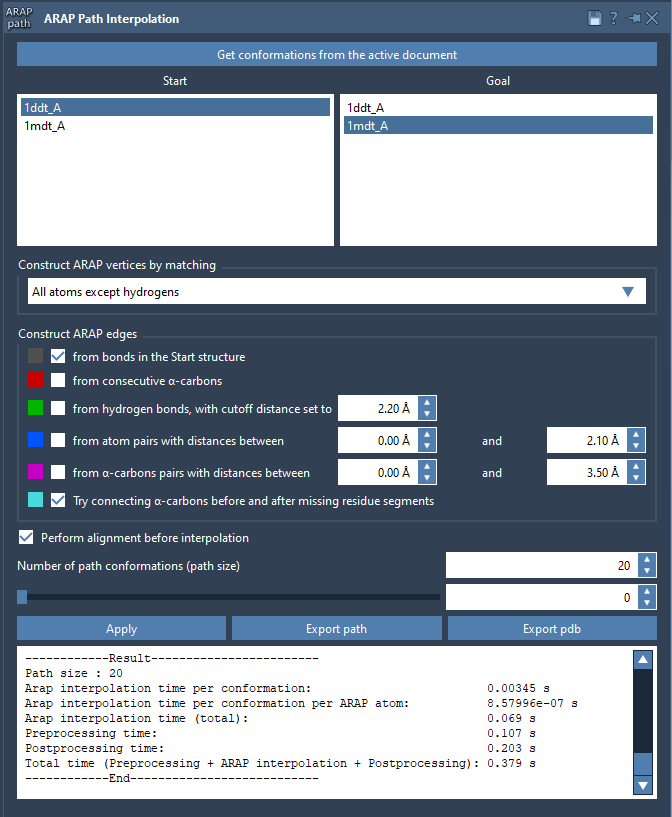
Open Home > Apps > Biology > ARAP Path Interpolation, get conformations from the active document, and select 1DDT A as Start and 1MDT A as Goal.
For matching, the tutorial uses All except hydrogens. This matches non-hydrogen atoms between the endpoint conformations and uses the matched atoms in the start conformation as ARAP vertices. Other choices include all atoms, alpha-carbons only, or backbone atoms. The right choice depends on what you want to represent: a broad atom-level correspondence or a simpler representation focused on the protein backbone.
For edges, select from bonds in the Start structure and Try connecting alpha-carbons before and after missing residue segments. The first builds edges from bonds in the start structure; the second adds connections across missing-residue segments. These settings define the connectivity used to construct the interpolation, so inspect the input structures and choose options appropriate to their completeness.
Align, sample, and inspect
Enable Perform alignment before interpolation so the start conformation is aligned with the goal before interpolation. Set Number of path conformations to 20; this count includes both the start and goal. Then click Run.
When the calculation finishes, use the app’s slider to move through the conformations and look for changes that warrant closer inspection. The app also creates a visual model of the ARAP edges. Toggle it in the Document view to see the connectivity used to build the path. The information box at the bottom of the app summarizes computation details.
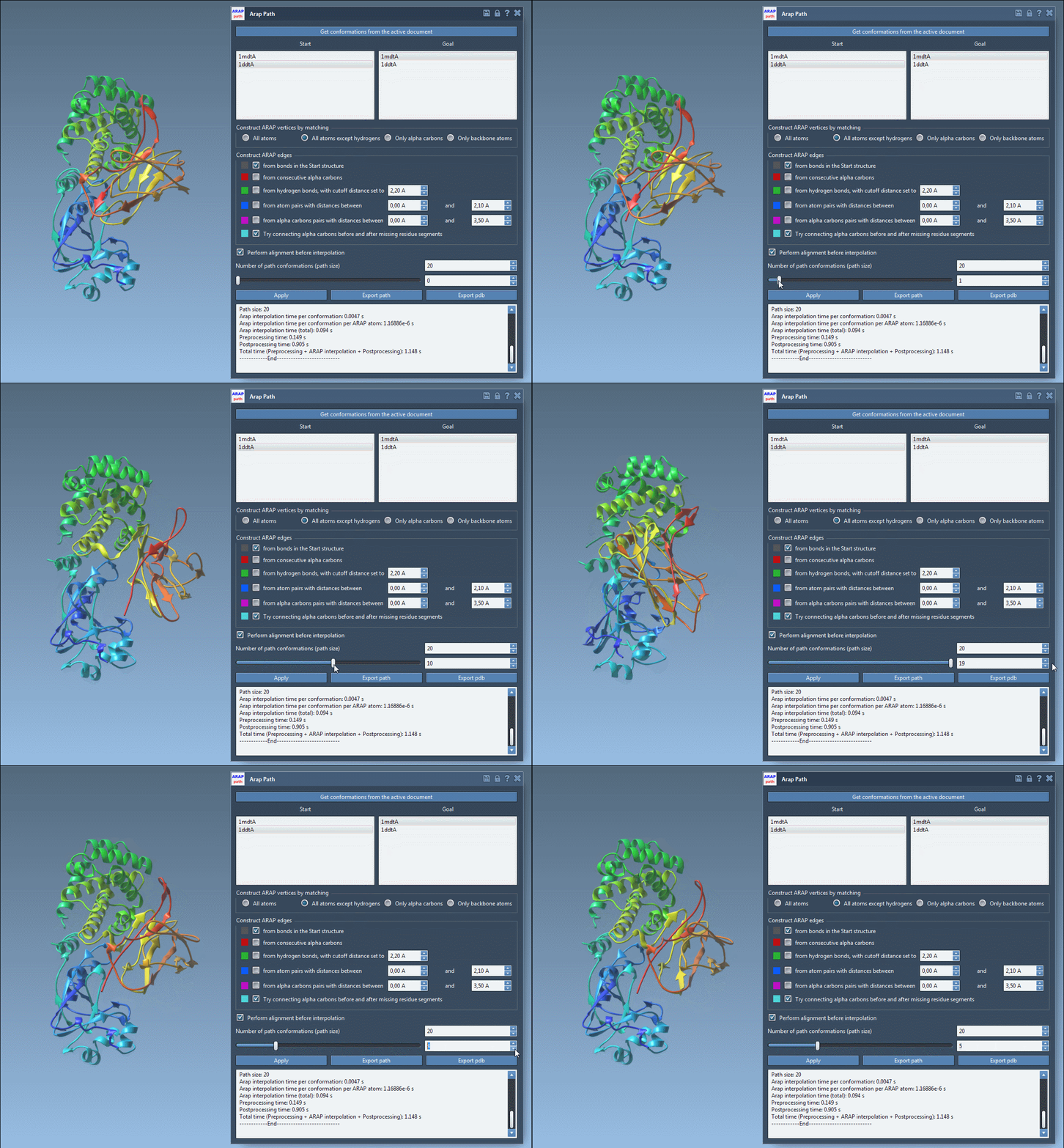
You can export the path as a trajectory object in the current SAMSON document, or export the whole path and its individual conformations as sequential PDB files. For downstream simulation, use the exported path as an input to an appropriate workflow and validate or refine it for that purpose. The documentation describes using it with GROMACS Wizard for umbrella sampling, or with steered molecular dynamics or P-NEB refinement.
For the complete walkthrough and additional details, see the ARAP protein interpolation tutorial.
Note: SAMSON and all SAMSON Extensions are free for non-commercial use. Get SAMSON.