



Designing polymers with specific repeating units—especially when bond types matter—is a common challenge for molecular modelers working on materials science, drug delivery, or bioengineering applications. While small molecules can be drawn fairly quickly, building realistic polymer sequences with chemically accurate connections is a different story.
If you’ve ever tried to manually assemble a copolymer with alternating or custom sequences, you’ve likely encountered labor-intensive steps, repeated work, or the fear of introducing atom clashes and invalid bonds. That’s where the Polymer Builder in SAMSON offers a practical solution.
Register and Reuse Monomer Sequences
Rather than building a polymer chain monomer by monomer, SAMSON’s Polymer Builder lets you store and reuse library-like monomer sequences. Here’s how this helps:
- No need to redraw common coils or custom repeat units.
- Monomer groups can be mapped and reused across multiple designs.
- Bond types between units (single, double, triple) are explicitly controlled.
To register a sequence, follow these steps:
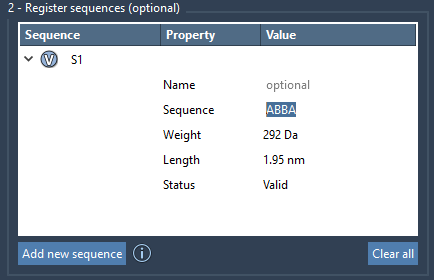
- Click Add new sequence.
- Type your sequence using registered monomer IDs (e.g.,
ABBA). - Specify bond types if needed:
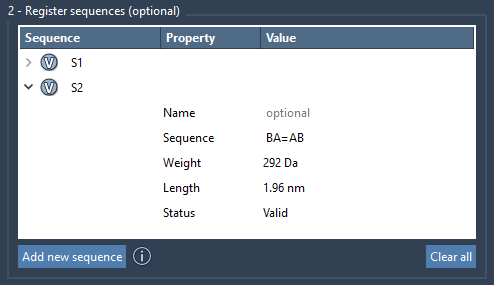
=for double,#for triple bonds (e.g.,A=BorA#B).
You’ll be shown validation feedback instantly. An incorrect sequence will trigger an error in the Status column—and if it’s valid, you’re ready to use it in your polymer design. Each sequence is also automatically labeled (S1, S2, etc.), and approximate mass and length are listed.
Visual Feedback and Editing
Want to confirm what monomers are included in a sequence? Click the V button for a structural highlight. You can also name the sequence for better project organization—helpful if you work with structural groups in longer chains. Right-click and use Delete sequence when it’s time to clean up.
Combine Sequences to Build Full Chains
Once sequences are registered, they can be used like building blocks in a final expression. You can mix sequences, monomers, repeat counts, and bond types as needed. Example:
|
1 |
2*S1 + AB=BA + C#D |
This flexibility allows for rapid iterations and exploration of new chain designs without starting from scratch.
For modelers working on block copolymers, this approach is particularly useful. The Polymer Builder even supports converting a generated polymer into a new monomer—which opens the door to hierarchical polymer construction.
To learn more about SAMSON’s Polymer Builder and how to use sequence registration effectively, check out the full documentation here: Polymer Builder Documentation.
SAMSON and all SAMSON Extensions are free for non-commercial use. You can get SAMSON at https://www.samson-connect.net.