



In the world of materials modeling, the beauty is often in the imperfections. Understanding how defects affect crystal structures is essential for researchers modeling semiconductors, catalysts, and other advanced materials. One recurring challenge is visualizing and testing these defects without writing custom code from scratch. This is where the Crystal Creator Extension in SAMSON offers a helpful solution — especially when working with diamond-like materials.
This post focuses on how to model atomic site defects in a diamond crystal using SAMSON. If you’ve ever wanted a quick way to experiment with partial occupancies or defects in your simulations without diving into syntax-heavy scripts, read on.
Step 1: Load the Diamond Crystal
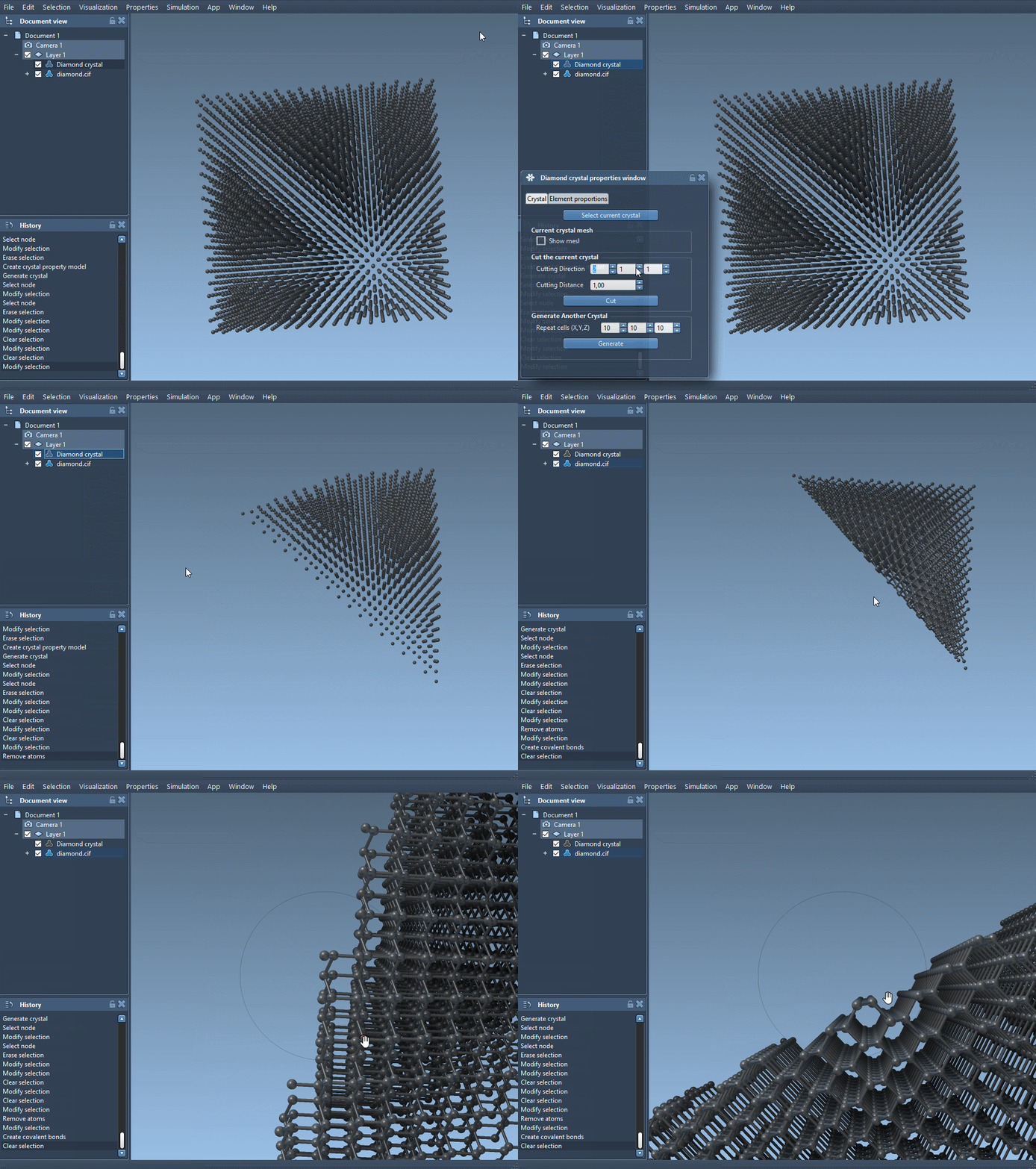
Start by importing a diamond crystal structure from a CIF file into SAMSON using the Crystal Creator App. If you need a CIF file, databases like the American Mineralogist Crystal Structure Database and RRUFF are great sources.
Once imported, choose your crystal unit cells in the opening dialog, and verify the structure using the app’s mesh and bond visualization tools.
Step 2: Add Defects
To introduce defects into the structure, you’ll need to manually edit the CIF file. Make a duplicate of your original file and open it in a text editor.
Find the section that begins with the loop of atomic positions, which looks like this:
|
1 2 3 4 5 6 |
loop_ _atom_site_label _atom_site_fract_x _atom_site_fract_y _atom_site_fract_z C 0.00000 0.00000 0.00000 |
Add the following line below it to introduce an occupancy factor:
|
1 2 3 4 5 6 7 |
loop_ _atom_site_label _atom_site_fract_x _atom_site_fract_y _atom_site_fract_z _atom_site_occupancy C 0.00000 0.00000 0.00000 0.95 |
This tells SAMSON to simulate a 95% probability of the carbon atom occupying that site — a simple way to simulate vacancies or disorder in the structure.
Step 3: Load and Analyze
Load the modified CIF file back into SAMSON. Use the Crystal Creator App to generate bonds as before. You can toggle between the original and edited structures to visualize how the atomic network changes due to defects.
For deeper insights, use SAMSON’s energy minimization tools — like the Brenner interaction model — to see how the structure relaxes around these imperfections.
Why This Matters
Introducing defects allows molecular modelers to simulate real-world phenomena like non-ideal crystal growth, dopant behavior, or mechanical weaknesses. It’s a useful strategy for designing materials with tailored properties.
This approach provides a low-barrier way to experiment with crystal imperfections visually and structurally. And the best part? No specialized scripts or external file converters required.
To take the next step, try introducing different levels of occupancy or simulating substitutions. Then analyze the resulting structures using SAMSON’s mechanical or electronic modeling tools.
To learn more, check the full SAMSON Crystal Creator documentation here: https://documentation.samson-connect.net/tutorials/crystal-creator/generating-crystal-models/
SAMSON and all SAMSON Extensions are free for non-commercial use. You can download SAMSON at https://www.samson-connect.net.