



When exploring the fascinating world of materials modeling, understanding how defects in a crystal impact its properties is a crucial step. Defects can significantly alter a material’s electrical, optical, or mechanical behavior, and modeling them accurately is central to many research and engineering applications—from semiconductors to catalysts.
But what if you’re using a Crystallographic Information File (.cif) and want to introduce defects without manually editing the entire structure in a graphical interface?
If you are working with SAMSON and its Crystal Creator Extension, there’s a simple way to do this directly through editing your .cif file. This is especially useful when evaluating the effect of atomic vacancies or fractional occupancies on the overall structure.
Background: The CIF Format and Atomic Occupancy
CIF files contain precise crystallographic data, including atom positions, labels, and occasionally a field called _atom_site_occupancy. This field allows for fractional occupancy, indicating the probability of an atom being present at a specific site—which is a simple yet effective way to introduce defects.
Quick Walkthrough: Introducing Defects
Let’s say you have imported a diamond crystal CIF file into SAMSON, and you want to explore what happens when one of the carbon atoms is not always present—that is, it has a 95% chance of being present in the structure.
To do so, follow these steps:
- Download a standard diamond CIF file and open it in a text editor.
- Scroll to the area where atomic positions are defined. You might see something like this:
|
1 2 3 4 5 6 |
loop_ _atom_site_label _atom_site_fract_x _atom_site_fract_y _atom_site_fract_z C 0.00000 0.00000 0.00000 |
- To specify the occupancy, modify this block by adding the
_atom_site_occupancyfield and the value:
|
1 2 3 4 5 6 7 |
loop_ _atom_site_label _atom_site_fract_x _atom_site_fract_y _atom_site_fract_z _atom_site_occupancy C 0.00000 0.00000 0.00000 0.95 |
This small change indicates that the carbon atom has a 95% probability of being present at this site.
Save the modified file and reload it into SAMSON. Use the Crystal Creator App to visualize the crystal and generate bonds. If you compare it with the original defect-free version, you’ll immediately notice structural variations. To go further, minimize both structures (with or without defects) with the Brenner interaction model and observe how the structure adapts.
Why It Matters
This simple edit gives you direct control over simulated imperfections without needing to reconstruct the model manually. It also makes your crystal structures more realistic—real-world materials often contain non-idealities that affect behavior. Whether you’re studying conductivity, strength, or optical properties, small inaccuracies in structure modeling can drastically modify your simulation outcomes.
More importantly, understanding how to model such defects using standard crystallographic techniques helps in producing publications, reproducible simulations, and accurate materials predictions.
Visual Example
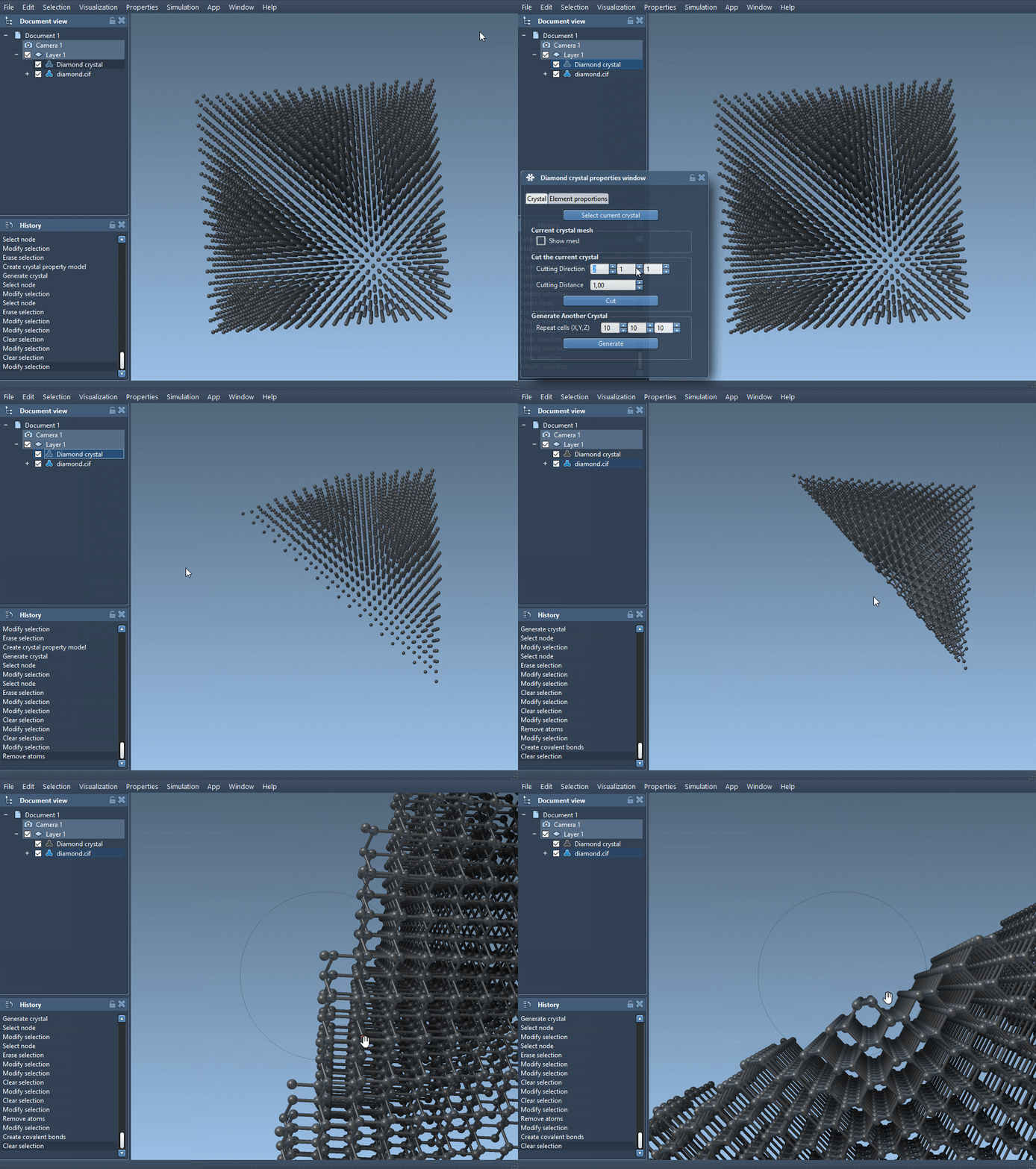
This animation shows the effect of cutting a diamond crystal—try visualizing the same structure before and after adding occupancy-based defects and cutting along different directions. It reveals how lattice imperfections interact with macro-level structural modifications.
To dive deeper into this and other crystal modeling techniques, visit the full tutorial here.
SAMSON and all SAMSON Extensions are free for non-commercial use. You can download SAMSON at https://www.samson-connect.net.