



Real-world crystals are rarely perfect. Defects and substitutions play a fundamental role in determining the physical properties of materials, whether it’s the hardness of a gemstone or the conductivity of a semiconductor. But for molecular modelers, simulating these imperfections accurately can be tricky. If you’re working with molecular crystals like diamond and want to model structural defects efficiently, here’s a simple and practical approach using the Crystal Creator extension in SAMSON.
This tutorial walks you through introducing vacancy defects into a diamond crystal by modifying its CIF file. This can be especially useful for those studying material behavior under real-world conditions, where vacancies, spins, and substitutions are commonplace.
Start with a Clean Diamond Model
First, open your diamond crystal in SAMSON by loading its CIF file using the Crystal Creator App. Once loaded, generate the bonds to visualize the structure. It should look neat and symmetric — the perfect starting point before the introduction of defects.
Minimize the Structure
Before making changes, run a quick structure minimization using the Brenner interaction model. This gives you a relaxed version of the ideal lattice structure.
Editing the CIF File
Now that you’ve minimized the structure, make a copy of this CIF file and open it in any text editor. You’ll be adding occupancy data to simulate atomic vacancies.
Locate a block in the CIF that defines atom sites, such as:
|
1 2 3 4 5 6 |
loop_ _atom_site_label _atom_site_fract_x _atom_site_fract_y _atom_site_fract_z C 0.00000 0.00000 0.00000 |
Replace it with the modified block that includes the _atom_site_occupancy field:
|
1 2 3 4 5 6 7 |
loop_ _atom_site_label _atom_site_fract_x _atom_site_fract_y _atom_site_fract_z _atom_site_occupancy C 0.00000 0.00000 0.00000 0.95 |
This tells the model that this carbon atom has a 95% chance of being present at this site — in other words, there’s a 5% probability it’s missing.
Load the Defective Crystal
Save your changes and open the modified CIF file in SAMSON. Again, generate the bonds once the structure is loaded. You’ll immediately notice differences in the bonding network, especially around the site where the atom has a reduced occupancy.
This is a quick but effective way to model vacancy-type defects using experimentally supported CIF formatting and integrates directly with SAMSON’s visual and computational capabilities.
Compare & Analyze
To observe the effects of defects, view side-by-side comparisons of the perfect and defective structures. Observe potential distortions or relaxation around the defective sites. This is useful for studies in mechanical strength, electron mobility, and more.
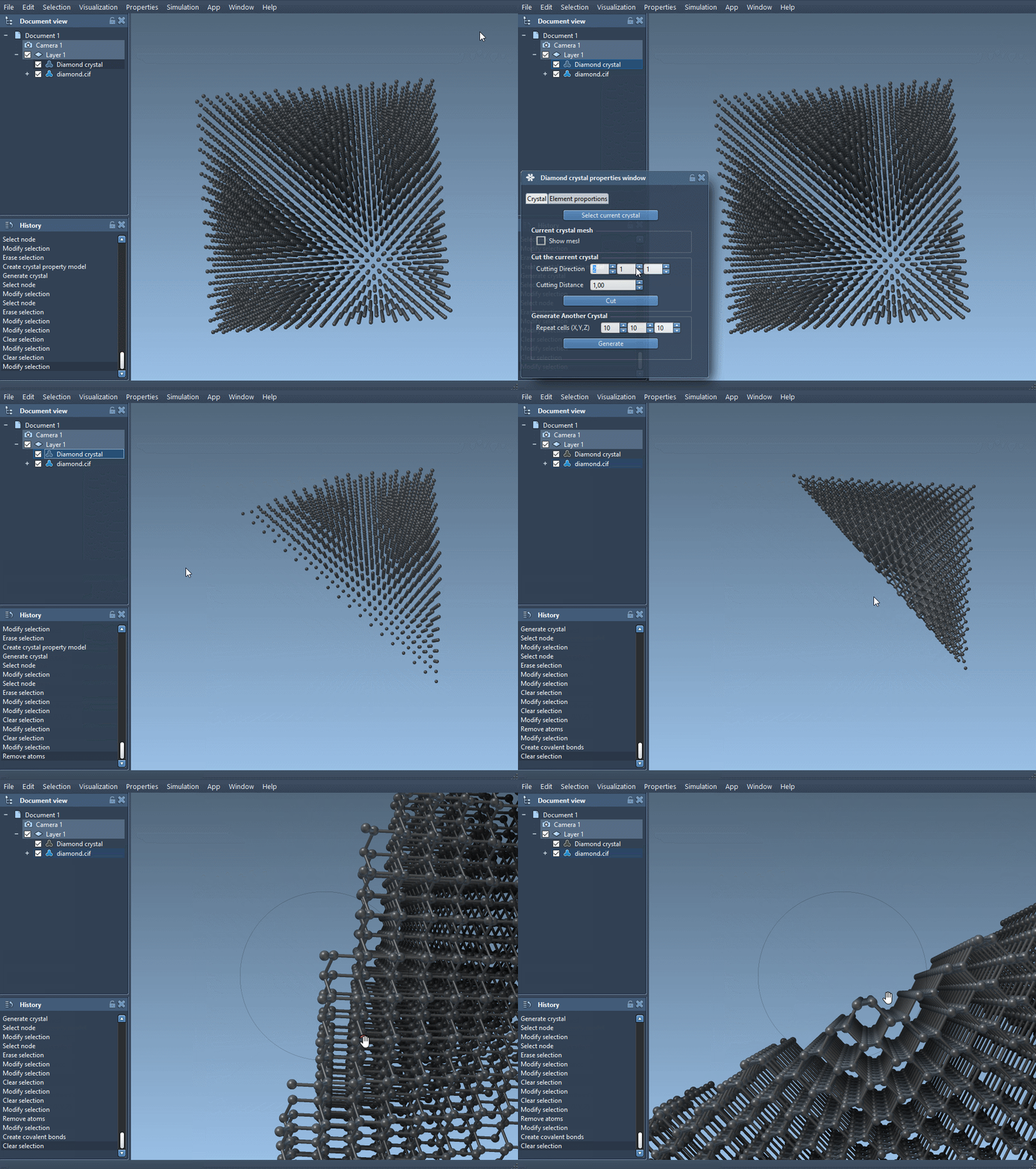
Structural imperfections like these are often the key to tailoring properties in materials science, and simulating them visually can make all the difference in understanding their impact.
To explore more about generating and customizing crystal models, see the full tutorial at SAMSON Documentation – Crystal Creator.
SAMSON and all SAMSON Extensions are free for non-commercial use. To get started, download SAMSON from SAMSON Connect.