



When you’re modeling molecular systems—whether it’s a new nanomaterial or an intricate 3D arrangement of biological molecules—atom selection is fundamental. But what if you’re working with thousands of atoms and need to select a subset based on a specific spatial or chemical criterion? Doing it manually can be time-consuming and error-prone.
That’s where the Atoms Selector Extension in SAMSON comes in. It’s a scripting tool that lets you select atoms in your active document based on mathematical expressions. If you find yourself frequently needing precise control over atom-level selections, this feature could dramatically speed up your workflow.
When Simple Clicks Aren’t Enough
Imagine you’re studying a defect in a silicon crystal and you want to isolate only the atoms within a spherical region. Or perhaps you’re designing a nanotube-based material and need to manipulate atoms within a specific cylindrical volume. Traditional selection tools might fall short—or become tedious—when criteria become complex.
With the Atoms Selector Extension, you write a single expression. Here’s a quick example that selects all atoms within a cylinder (radius 10 Å) centered at a given point (x=15, y=15):
|
1 |
((a.x - 15)^2 + (a.y - 15)^2) < 100 |
This selects atoms where the projection of their position onto the XY-plane lies within a circle of radius 10. It’s compact, reproducible, and easy to adapt to new geometries.
How It Works
The syntax is quite straightforward, especially if you’ve worked with scripting or mathematical logic before. Variables such as a.x, a.y, a.z refer to the atom’s coordinates, and other attributes like a.element or a.symbol let you target atoms of specific types. For example:
|
1 |
a.element == 'Carbon' |
Selects all carbon atoms.
The Atoms Selector Extension supports a wide range of operators and functions, from basic arithmetic to trigonometric and logical expressions:
+, -, *, /, ^and, or, not, >, <, ==- Standard math functions like
abs, sqrt, sin, clamp, etc.
You can also combine conditions. Here’s an example of selecting atoms that are carbon and are located in the positive quadrant of the XY-plane:
|
1 |
(a.element == 'Carbon') and (a.x > 0) and (a.y > 0) |
This approach becomes especially powerful when you’re automating workflows or building nanostructures programmatically. You can easily reuse and adapt your expressions without repeatedly selecting areas manually.
Visual Example: Cutting a Cylinder
Here’s a visual of this concept applied to quartz crystal atoms, selecting those within a cylindrical region:
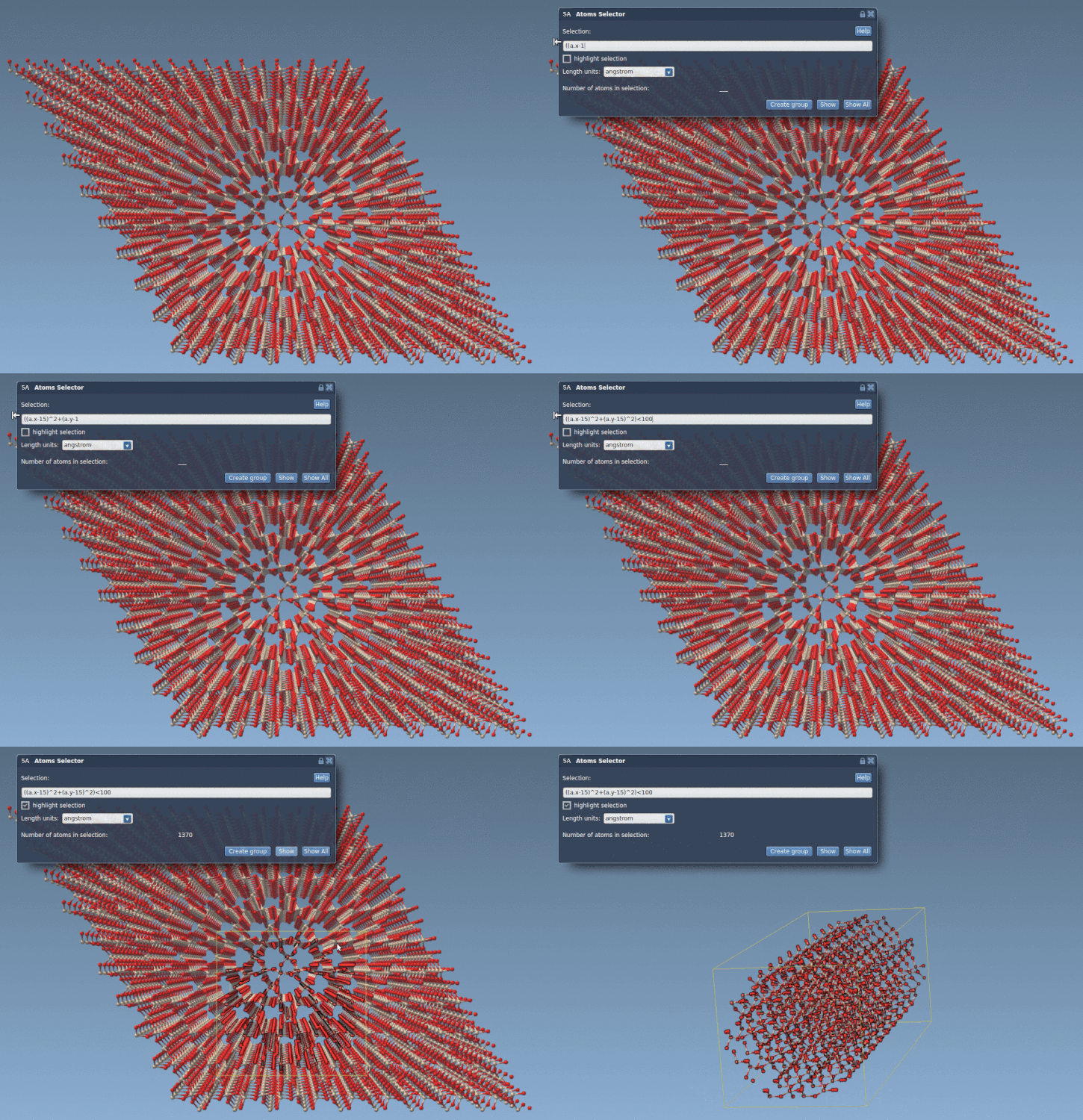
We use a radius-squared condition to define the circular cross-section, and the extension handles the rest. This makes the tool useful for custom geometrical selections in experimental setups, nano-device prototyping, or structural biology.
Why It Matters
Selection is often the first step toward modification, visualization, measurement, or export. The more precisely you can define selections, the better you can control your analysis and design. By integrating mathematical expressions into selection criteria, you shift from manual to programmatic workflows—saving time, improving reproducibility, and allowing more complex operations.
If you’re already using the Simple Script Extension for atomic modifications, you’ll find the Atoms Selector familiar and complementary. In fact, they use the same syntax and variable system, so switching between selecting and scripting becomes seamless.
To learn more, visit the full documentation page here.
SAMSON and all SAMSON Extensions are free for non-commercial use. You can download SAMSON here.