



Editing molecular structures can sometimes feel frustrating. You move an atom slightly, and suddenly your bond network collapses. Or maybe you’re trying to form a new bond manually but are blocked by invisible forces. These disruptions are often caused by force fields not being designed to support real-time editing and topology changes.
This is where the Interactive Modeling Universal Force Field (IM-UFF) can help. IM-UFF extends the traditional Universal Force Field (UFF) to enable seamless, real-time manipulation of atoms — including bond breaking and formation — making molecule editing not only easier but much more intuitive.
Smoother Topology Transitions
The key feature of IM-UFF is its ability to smoothly handle changes in molecular topology. When using traditional force fields, changes like bond breaking or forming must be handled explicitly. With IM-UFF, if you pull an atom far from its neighbors, bonds will automatically break. Conversely, bring atoms close enough and new bonds may form — no extra clicking required.
This opens up new possibilities for creativity and speed in molecular design. Whether you’re building new structures, testing conformational changes, or teaching others about molecular mechanics, IM-UFF helps you concentrate on ideas rather than interface constraints.
Flexible Van der Waals Interactions During Edits
Another small, but powerful setting is the “Keep vdW for manipulated” option. When off, the atoms you’re moving are not included in the calculation of vdW forces. Why does this matter? Because vdW repulsion could otherwise prevent atoms from getting close enough to form new bonds. With this disabled, it becomes easier to bring atoms together and let the topology adapt accordingly.
How to Try It
- Install the IM-UFF Extension via SAMSON Connect.
- Open a molecular document you want to modify.
- Add a simulator: Edit > Simulate > Add simulator.
- Select Interactive Modeling Universal Force Field.
- Start the simulation: Edit > Simulate > Start.
- Ensure both Static topology and Keep vdW for manipulated are unchecked for full flexibility.
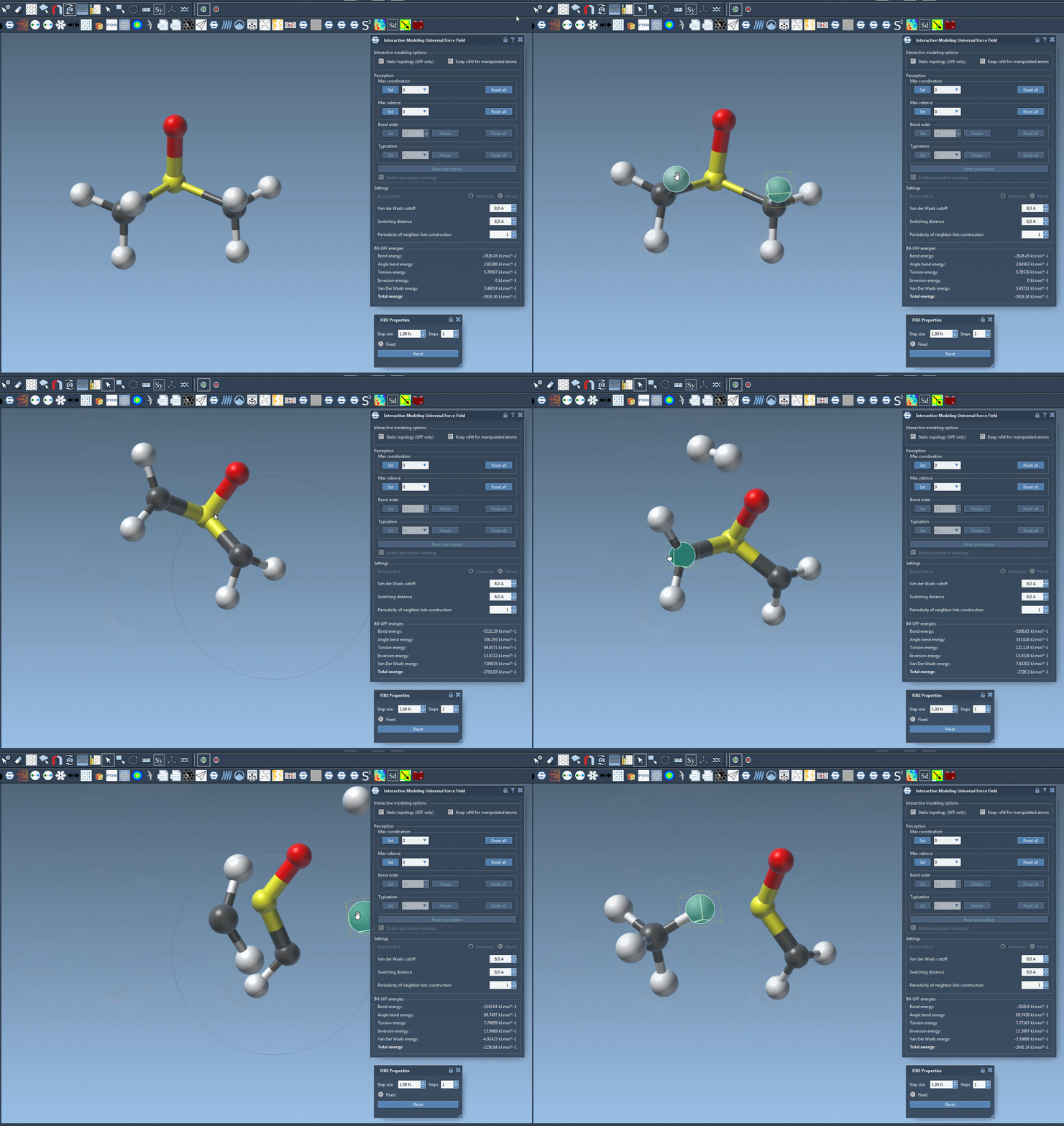
Now try moving atoms around. Displace one atom gently and notice that the bond stretches but stays intact. Move it farther and observe automatic bond breaking. Bring atoms together and see new structures form in real time. You’ll notice that the simulation doesn’t halt or complain — it adapts. You can focus on modeling, not manual updates or bond recalculations.
When Should You Use IM-UFF?
IM-UFF is especially useful when:
- You are iteratively building or modifying molecular systems.
- You need to demonstrate molecular interactions in a teaching or collaborative setting.
- You want to explore how topologies shift as atoms move, without constantly switching tools.
It’s a great middle ground between structure editors and full-blown simulations.
To learn more, visit the full tutorial: Interactive Modeling Universal Force Field documentation.
Note: SAMSON and all SAMSON Extensions are free for non-commercial use. You can get SAMSON at https://www.samson-connect.net.