



Crystals may seem perfect at first glance, but most real-world materials contain defects—small irregularities that can strongly influence a material’s behavior. If you’re involved in molecular modeling of materials and want to explore how imperfections affect crystal structures, SAMSON’s Crystal Creator Extension offers an accessible way to take that deep dive 🌐💎.
In this post, we’ll walk through how to introduce defects into a diamond crystal using the Crystal Creator App in SAMSON and observe how these changes influence the model.
Why Defects Matter
Crystalline defects such as vacancies, interstitial atoms, or substitutions can significantly change a material’s stability, conductivity, reactivity, and optical properties. For material scientists and molecular modelers, being able to simulate and analyze such behavior is essential—especially when designing new materials or investigating performance under varying conditions.
Simulating Defects in SAMSON
Let’s start by loading a clean diamond crystal from a CIF (Crystallographic Information File) using the Crystal Creator. This can be done by downloading a diamond file from databases such as:
Once loaded in SAMSON, generate the bonds in the structure and minimize it using the Brenner interaction model. This gives you a baseline to later compare against the defective version.
Adding Defects to Diamond
You’ll now create a slightly altered version of the lattice with a lower occupancy at one of the carbon sites. To do this:
- Copy the diamond CIF file and open the duplicate in a text editor.
- Find the section starting with:
- Replace it with:
|
1 2 3 4 5 6 |
loop_ _atom_site_label _atom_site_fract_x _atom_site_fract_y _atom_site_fract_z C 0.00000 0.00000 0.00000 |
|
1 2 3 4 5 6 7 |
loop_ _atom_site_label _atom_site_fract_x _atom_site_fract_y _atom_site_fract_z _atom_site_occupancy C 0.00000 0.00000 0.00000 0.95 |
This update tells SAMSON there’s only a 95% chance that the carbon atom is present at this position, mimicking a vacancy-type defect.
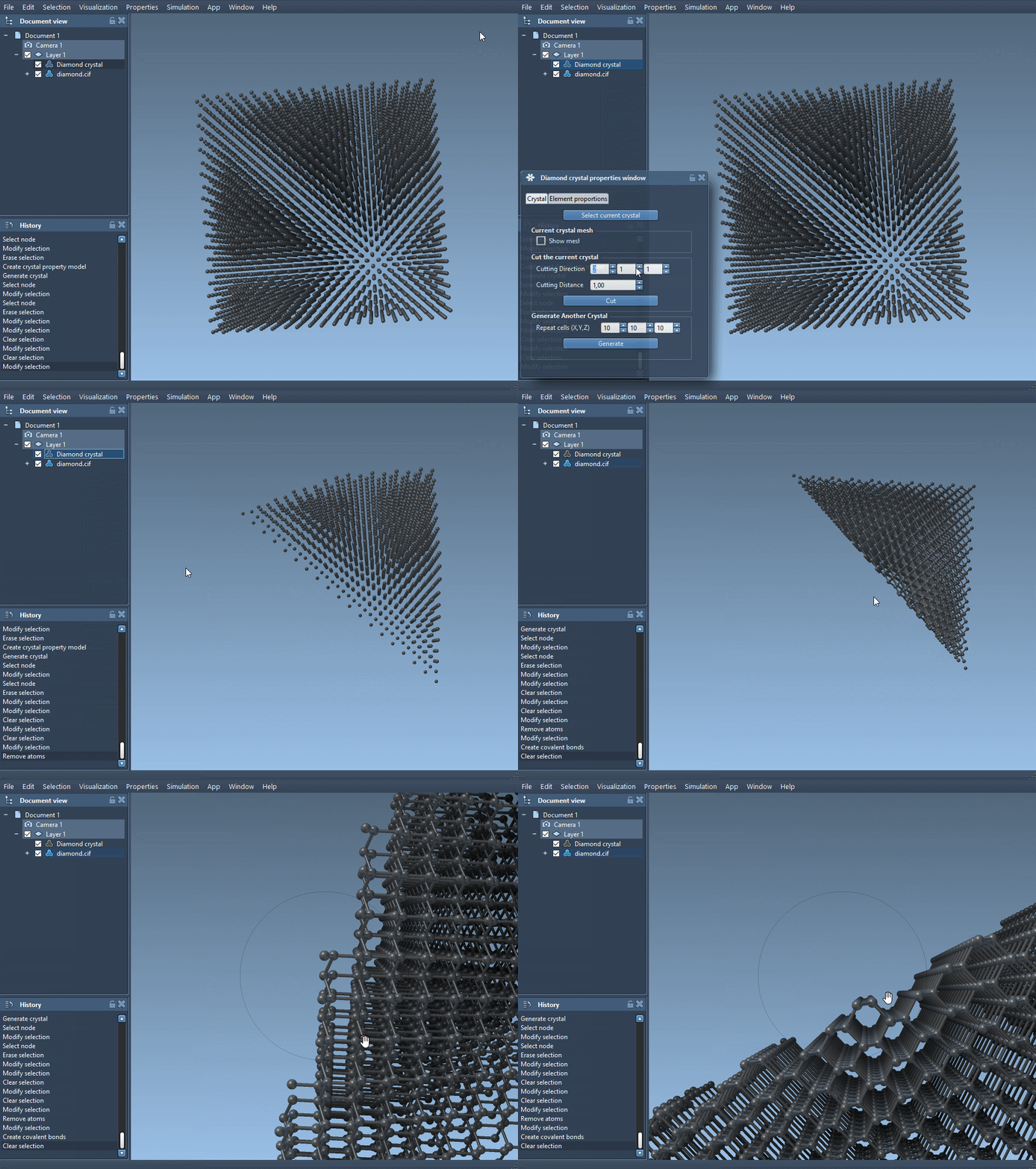
Load this modified file back into SAMSON, regenerate the bonds, and observe how the introduction of even a small defect begins to alter the overall crystal structure. You may notice different local geometries or atomic arrangements emerging that were not previously visible.
Analyzing What Changed
Once loaded, SAMSON allows for additional analysis. Right-click on the property model and select Properties. In the second tab, click Check Atoms Ratio to verify that your atomic occupancy values are being respected. This way, you confirm whether your defective crystal accurately represents your input.
Introducing these types of precise changes isn’t just for interest—it prepares your model for more advanced simulations such as energy minimizations, electronic structure calculations, or defect migration studies.
Explore the behavior of imperfections and how they shape the worlds of materials science and solid-state physics. Whether you’re researching new semiconductors or exploring nanostructures, building intuition for defects is key.
To learn more about working with crystals in SAMSON, including generating custom crystal structures and cutting them along specific planes, visit the full documentation page: SAMSON Documentation: Generate Crystal Models.
SAMSON and all SAMSON Extensions are free for non-commercial use. You can download SAMSON at https://www.samson-connect.net.