



One common challenge for molecular modelers is editing molecular structures while maintaining physical realism. Whether you’re designing molecules, studying reaction pathways, or exploring hypothetical structures, you often need to dynamically add or break bonds. Doing this manually can be time-consuming and error-prone if the system’s energy is not automatically adjusted to reflect new atomic arrangements.
The Interactive Modeling Universal Force Field (IM-UFF) in SAMSON offers a practical solution to this problem. This enhanced interaction model makes it possible to modify molecular topologies directly during simulation — bonds form and break based on the spatial arrangement of atoms, guided by a physical energy model.
What makes IM-UFF different?
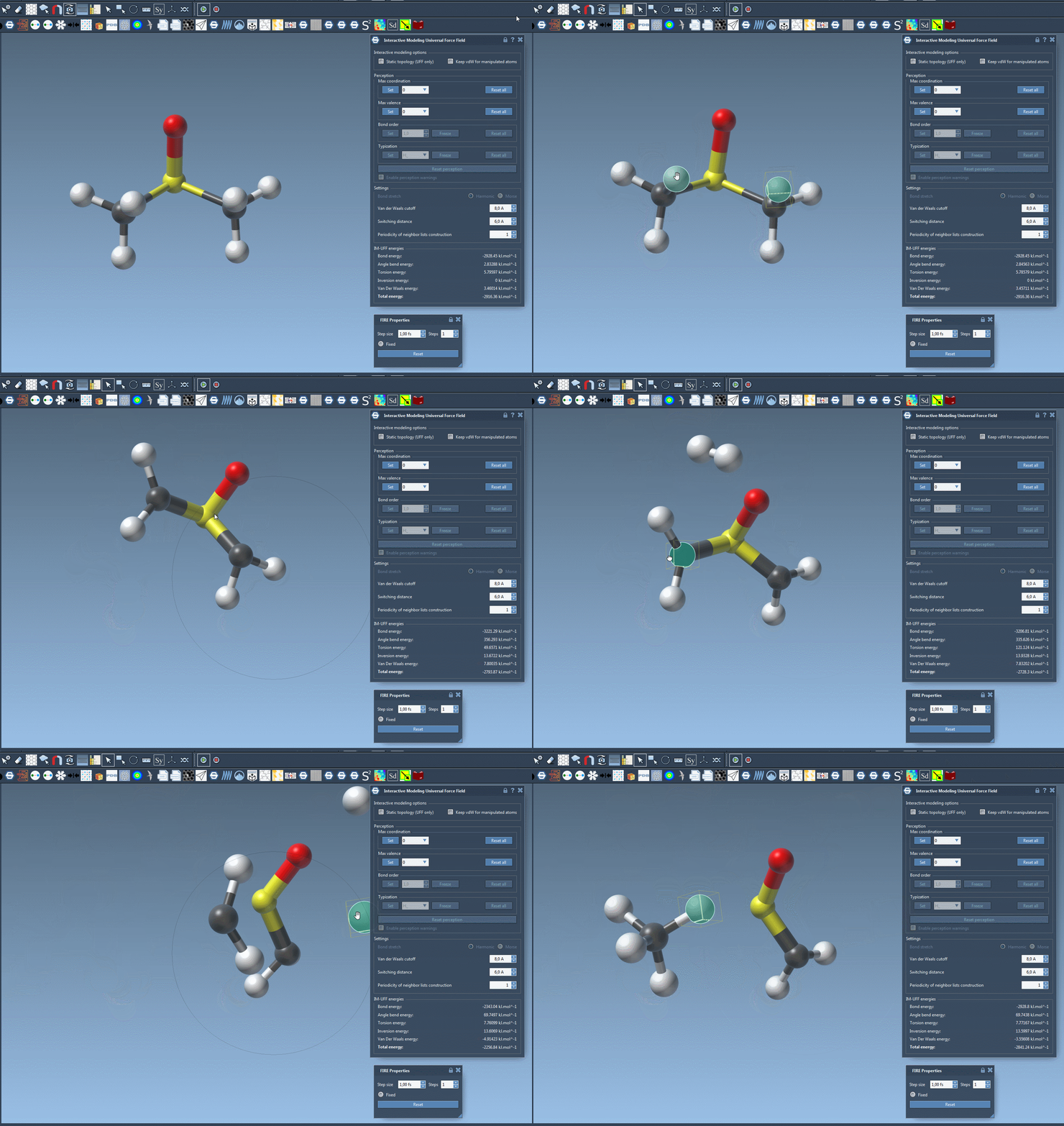
Unlike the standard UFF model, which assumes a static bond topology, IM-UFF allows for topological changes in real time. As you move atoms with your mouse, bonds dynamically adjust:
- Move atoms slightly, and the system relaxes thanks to interactive forces without breaking bonds.
- Move atoms beyond certain thresholds, and bonds to neighboring atoms break.
- Bring atoms close together, and new chemical bonds may form.
This interactive behavior is particularly useful when modeling chemical reactions or assembling structures, as it allows you to intuitively explore molecular transformations.
How to use IM-UFF for bond editing
To get started with IM-UFF bond manipulation:
- Install the IM-UFF extension.
- Open or create a molecular system in SAMSON.
- Go to Edit > Simulate > Add Simulator, or use
Ctrl+Shift+M(Cmd+Shift+Mon macOS). - Select Interactive Modeling Universal Force Field as the interaction model.
- Choose an appropriate state updater (we recommend FIRE for most cases).
- Ensure the options Static topology (UFF only) and Keep vdW for manipulated are unchecked to enable dynamic bonding.
- Start the simulation by selecting Edit > Simulate > Start.
Now try moving atoms. You’ll see bonds forming or breaking depending on proximity — no need to manually edit bond types or energies. The total and individual energy terms are displayed in the parameter window, providing continuous feedback.
Why care about bond dynamics?
Interactive bond editing opens new possibilities:
- Real-time feedback: Immediate visual and physical feedback helps identify chemically plausible changes.
- Improved productivity: Rapid prototyping of molecular structures without navigating through menus to alter bonding.
- Better understanding: Learning how molecular geometry and bonding change in response to external manipulation provides intuition, especially for students and early learners.
Some considerations
When using IM-UFF, the reference energy is adjusted so that it equals zero when atoms are at infinite distance — this matches the default energetics of interactive modeling rather than traditional force field conventions. Also, bond orders and atom typizations are computed dynamically, meaning you cannot manually assign them while IM-UFF is active.
For most users, however, this flexibility will be a feature rather than a constraint — making molecular editing far smoother and more intuitive than with static topology models.
To learn more about IM-UFF, including customizing parameters and advanced settings, refer to the full documentation at https://documentation.samson-connect.net/tutorials/uff/im-uff/.
Note: SAMSON and all SAMSON Extensions are free for non-commercial use. You can download SAMSON at https://www.samson-connect.net.