



Designing polymers with custom sequences can be repetitive and tedious, especially when you’re experimenting with variations of monomer units. If you’ve ever found yourself manually repeating patterns or trying to track down bond types between units, there’s a more efficient way inside SAMSON.
The Polymer Builder extension allows you to register not just monomers, but also sequences of those monomers—helping you work at a higher abstraction level. This blog post will walk you through why and how to design reusable polymer sequences with SAMSON, so you can speed up your workflow and reduce errors.
What are monomer sequences?
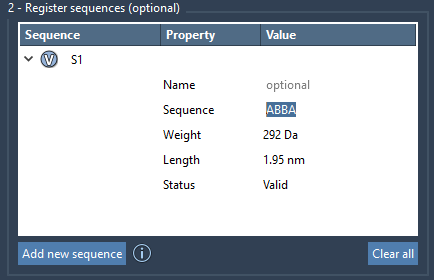
Once you’ve registered your monomers in the Polymer Builder, you can use them to create sequences by assigning a combination of monomer identifiers. For example, if you’ve registered monomers A and B, a sequence like ABBA can be saved and reused later.
To register a new sequence in Polymer Builder:
- Click Add new sequence.
- Enter your sequence using registered monomer IDs, like
ABBA. - Click the V button to visualize the monomers used in the sequence.
Sequences are automatically given labels like S1, S2, and so on.
Adding bond types
You can also specify different bond types between monomers directly in the sequence. This is especially helpful when modeling conjugated systems or more complex polymer topologies.
Use:
=for a double bond:A=B#for a triple bond:A#B
Examples:
A=B=Cspecifies double bonds between all three monomers.AB#BAcombines units with a triple bond to explore stiffness or charge transport properties.
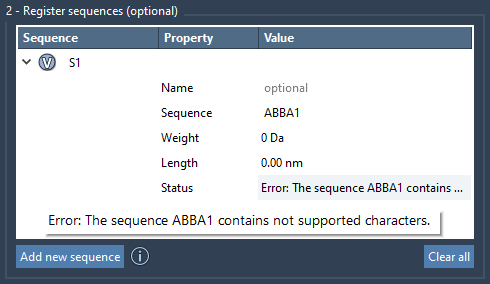
Invalid sequences will trigger an error message in the Status column, guiding you to correct mistakes before generating polymers.
Why sequences help
Once sequences are registered, you can use them in larger expressions when generating a complete polymer. For instance:
|
1 |
2*S1 + AB=BA + S2 |
This means: two repeats of sequence S1, followed by a custom AB-BA double-bonded combination, and then one repeat of sequence S2.
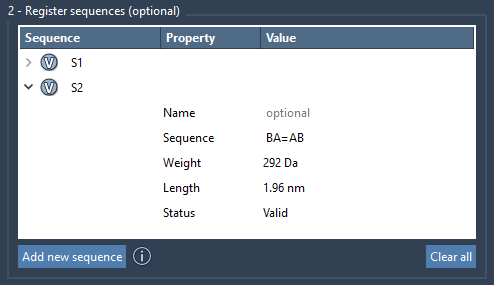
Even better, you can assign a name to a sequence to group its monomers in a common structural group for easier analysis and manipulation.
Working with defined sequences allows for repeatable, documented design steps—especially useful for automatic workflows, simulations, and collaboration.
Learn more in the Polymer Builder documentation.
SAMSON and all SAMSON Extensions are free for non-commercial use. You can download SAMSON at https://www.samson-connect.net.