Skip to content
YouTube Twitter RSS AboutMe Mail
SAMSON Blog
Skip to content
  • Latest posts
  • Get SAMSON

Author: OneAngstrom

A Clean Cut: Using the Hide Animation to Focus Your Molecular Story

OneAngstrom

If you’re a molecular modeler creating animations of complex molecular systems, you’ve likely run into this challenge: too many elements vying for attention in your scenes. Whether you’re showing conformational changes, reaction mechanisms, or protein-ligand interactions, excess visual clutter can…

How to Choose the Best Symmetry Group in Complex Biological Assemblies

OneAngstrom

When working with large protein complexes or viral capsids, understanding and leveraging their symmetry can significantly simplify your structural analysis and simulations. The Symmetry Detection extension in SAMSON automatically identifies possible symmetry groups in biological assemblies — but what happens…

Avoid Topology Errors in MARTINI by Renumbering Chains and Residues

OneAngstrom

If you’ve ever built coarse-grained (CG) models using the MARTINI force field and hit a frustrating error during topology generation, you’re not alone. One common cause? Non-unique residue and chain identifiers in systems that include multiple replicas. Fortunately, SAMSON makes…

Dragging Atoms, Watching Molecules React: A Closer Look at Interactive Simulation in SAMSON

OneAngstrom

Interactive simulation can be a game-changer when modeling molecules. Instead of building a molecular structure, launching a long simulation, and then checking the result, what if you could poke, prod, and drag atoms—and see in real time how the molecule…

One-Click Protein Preparation in SAMSON: Save Time Before Docking

OneAngstrom

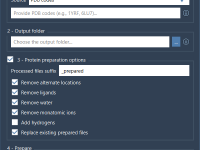
Getting a protein ready for docking is often more time-consuming than the docking itself. Whether you’re preparing for virtual screening or structural analysis of complexes, the cleanup step is crucial. Missing hydrogens, alternate atom positions, leftover water molecules—these details can…

Faster Nanotube Building with Pattern Editors: A Step-by-Step Guide

OneAngstrom

Designing carbon nanotubes manually in molecular modeling platforms can be a slow and repetitive process. If you’ve ever painstakingly duplicated and aligned atomic rings to form tubes, you know how tedious it can get—especially when you’re aiming for atomic precision…

Controlling Molecular Visibility in Time with the Hidden Animation

OneAngstrom

In molecular modeling and dynamics, visual clarity is essential. Whether you are preparing a scientific presentation, illustrating a complex conformational change in a biomolecule, or creating an educational video, the ability to orchestrate what appears—and when—can mean the difference between…

Cleaning Up Protein Structures for Reliable Conformational Interpolation

OneAngstrom

When modeling conformational transitions between protein states, one of the most overlooked yet crucial steps is structure preparation. Whether you’re setting up umbrella sampling, visualizing intermediate states, or refining with steered molecular dynamics, how you prepare your structures can determine…

Making Room for Clarity: Visual Disassembly of Molecular Structures in SAMSON

OneAngstrom

When presenting or analyzing complex molecular systems, one common challenge is visual clutter. Protein assemblies and large biomolecular structures often appear as dense blocks where important elements can be hidden or hard to distinguish. If you’ve ever struggled to present…

Exporting Ligand Trajectories in PDB Format Without the Extra Work

OneAngstrom

When setting up calculations for reaction coordinates or preparing data for free energy profiling, researchers often find themselves in need of atomic coordinate files at multiple points along a ligand’s movement path — usually in PDB format. Doing this manually…

«‹561562563564565›»
  • Subscribe for tips and news

    Check your inbox or spam folder to confirm your subscription.

  • About
  • Privacy Policy
  • Terms of use
  • Contact us
  • Twitter
  • Facebook
  • Back to Top
Powered by Nirvana & WordPress.