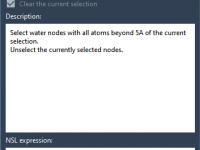
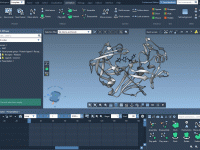
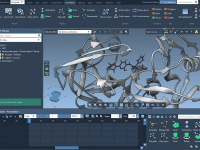
One of the subtle yet recurring challenges in preparing biomolecular systems for simulations is the question of what to do with crystal waters. These water molecules, often captured in PDB structures, can be either essential to the biological function or…
Preparing molecular animations for presentations often raises the question: how can I make certain components of a model appear and then vanish in sync with narration or key visual moments? Whether you’re explaining reactive sites in a protein or walking…
One of the key challenges in molecular modeling is communicating complex molecular motions clearly. Whether you’re modeling ligand binding, protein folding, or molecular assembly, it’s often difficult to visualize trajectories in a way that’s intuitive to others — or even…
For many researchers and developers working in molecular modeling, one of the main challenges is integrating custom algorithms or tools with existing visualization and simulation environments. Often, researchers have developed their own code (for structure analysis, energy calculations, or custom…
When preparing molecular animations or presentations, it’s often important to convey structural dynamics in a clear and intuitive way. A common need is to rotate a specific part of a molecule—like a ligand, domain, or fragment—around its own center, rather…
If you spend a lot of time building, analyzing, or sharing molecular models in SAMSON, you’re probably used to toggling visual representations multiple times during a session. Whether you’re switching from a surface to a ribbon view, hiding a representation…
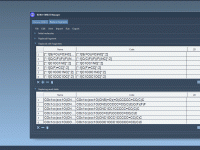
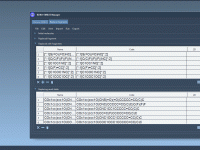
Designing a focused library of compounds is a central part of molecular modeling, whether for virtual screening, SAR studies, or lead optimization. However, creating diverse analogues by hand can become tedious, especially when you’re tweaking only specific fragments. The SMILES…
For molecular modelers working on drug discovery or molecule optimization, building a focused library of analogues is a routine—but often tedious—task. Whether you’re performing lead optimization or investigating SAR, repeatedly modifying specific functional groups in a base structure can be…
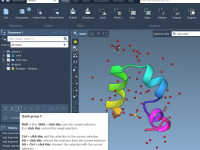
When working on complex molecular systems, constantly switching between different parts of your model can slow you down. Molecular modelers often find themselves selecting the same residues, chains, or ligands over and over — whether for visualization, simulation, or structural…
When presenting molecular models, clarity and elegance go hand in hand. But if you’ve ever tried to represent dynamic states—highlighting or fading specific parts of a complex structure over time—you’ve likely wondered how to do this smoothly and repeatedly without…