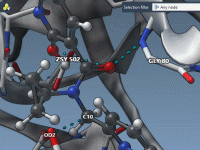
When working with large molecular systems, searching for specific atom types—aromatic carbons, water oxygens, charged residues—can feel like finding a needle in a haystack. Whether you’re setting up a simulation, preparing a molecular surface analysis, or generating properties to color…
For many molecular modelers, switching between development environments, simulation tools, and analysis platforms is a regular part of the workflow. This fragmentation can be time-consuming and error-prone, especially when adapting or reusing previously developed code. But what if your trusted…
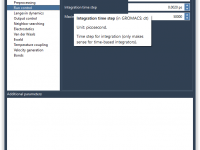
If you’re a molecular modeler using GROMACS through the SAMSON platform, you may have tried to customize molecular dynamics parameters for different simulation steps—only to discover later that some of your settings were not applied during the run. This can…
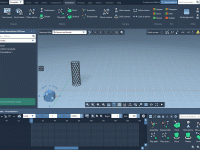
When preparing molecular animations, researchers often face a common challenge: how to focus attention on meaningful movement without unnecessary distractions. If everything in the scene moves, it can become harder to understand what matters. Sometimes, it’s crucial to anchor part…
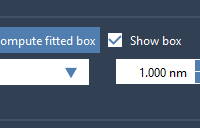
When preparing molecular simulations with periodic boundary conditions, one common challenge is selecting the most appropriate unit cell shape. This choice can impact your simulation’s efficiency and accuracy, especially when dealing with spherical or flexible biomolecules in solution. If you’ve…
When you’re working on complex molecular systems, clarity matters. Labels help provide context, highlight key elements, or annotate crucial measurements. But when too many labels crowd the Viewport or overlap with atoms and bonds, they can obscure what you’re trying…
When working with complex molecular systems, modelers often face a common challenge: how to efficiently pick and analyze only the molecules that meet specific structural criteria. Whether you’re trying to extract smaller fragments from massive biomolecules or isolate candidates for…
One of the subtle pain points in molecular modeling is choosing effective colors that communicate your data clearly. Whether you’re differentiating chains in a protein, visualizing atom types, or building figures for publications, poor color choices can easily confuse viewers…
When working on complex molecular systems, visual clarity is key. Whether you are preparing figures for publication, designing custom visualizations for a client, or simply trying to study part of a simulation in better detail, controlling what is visible—and what…
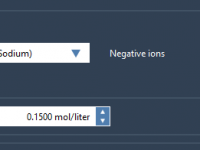
When running molecular dynamics simulations—especially in a coarse-grained (CG) setup using the MARTINI force field—preparation is key. One often overlooked but crucial step is ensuring your system is properly neutralized and has the right salt concentration. This blog post walks…