



Most molecular modeling begins with the ideal. Perfect lattices, flawless symmetry, and pristine atomic arrangements. But real-world materials are rarely so tidy. Defects — like vacancies, substitutions, and distortions — play a crucial role in defining the physical and chemical properties of crystals, from electronic behavior to mechanical strength.
Fortunately, SAMSON’s Crystal Creator Extension allows you to move beyond perfection and dig into the subtle, yet essential world of defective crystals. Here’s how to bring realism into your materials modeling by importing and manipulating crystal structures with specific defect patterns, all within SAMSON.
Why model defects?
Crystal defects are not annoyances — they are often the key to interesting behavior. For example:
- They influence conductivity in semiconductors.
- They can control strength and brittleness in alloys.
- They affect optical properties in gemstones and LEDs.
Modeling crystals without defects might be fine for basic studies—but if you’re working with materials design, it’s often necessary to embrace the imperfect.
Step-by-step: Adding defects to a diamond crystal
Let’s go through a concrete example: introducing vacancy defects in a diamond crystal using a CIF file.
- First, load a .cif file of a diamond crystal into SAMSON using the Crystal Creator Extension.
- Create its bonds, if needed, so you can better see the structure.
- To model defects, make a copy of the .cif file and open it in a text editor.
Near the end of the file, you’ll find a section that looks like:
|
1 2 3 4 5 6 |
loop_ _atom_site_label _atom_site_fract_x _atom_site_fract_y _atom_site_fract_z C 0.00000 0.00000 0.00000 |
To introduce a vacancy defect — where a carbon atom has only a 95% chance of existing at its site — modify it to add an occupancy field like this:
|
1 2 3 4 5 6 7 |
loop_ _atom_site_label _atom_site_fract_x _atom_site_fract_y _atom_site_fract_z _atom_site_occupancy C 0.00000 0.00000 0.00000 0.95 |
This gives the atom a 95% presence probability. When imported into SAMSON, the Crystal Creator interprets this to randomly include or exclude that atom according to the given probability.
After loading the modified CIF file, create the bonds again and observe how the lattice has changed. You can use the tool in the Extension to check atom ratios and verify defect distributions. SAMSON helps ensure that substitutions and vacancies are properly enforced based on the occupancy values found in the CIF file.
Now you’re simulating a more realistic diamond, which can help if you’re exploring mechanical deformation, thermal behavior, or electronic properties under real-world conditions.
Go further
Start experimenting with more complex cases: add different occupancy values for multiple atoms, model substitutional atoms, or create crystals from scratch and fine-tune them using the Crystal Creator toolbox.
The more you understand the imperfections, the more accurately you can model reality.
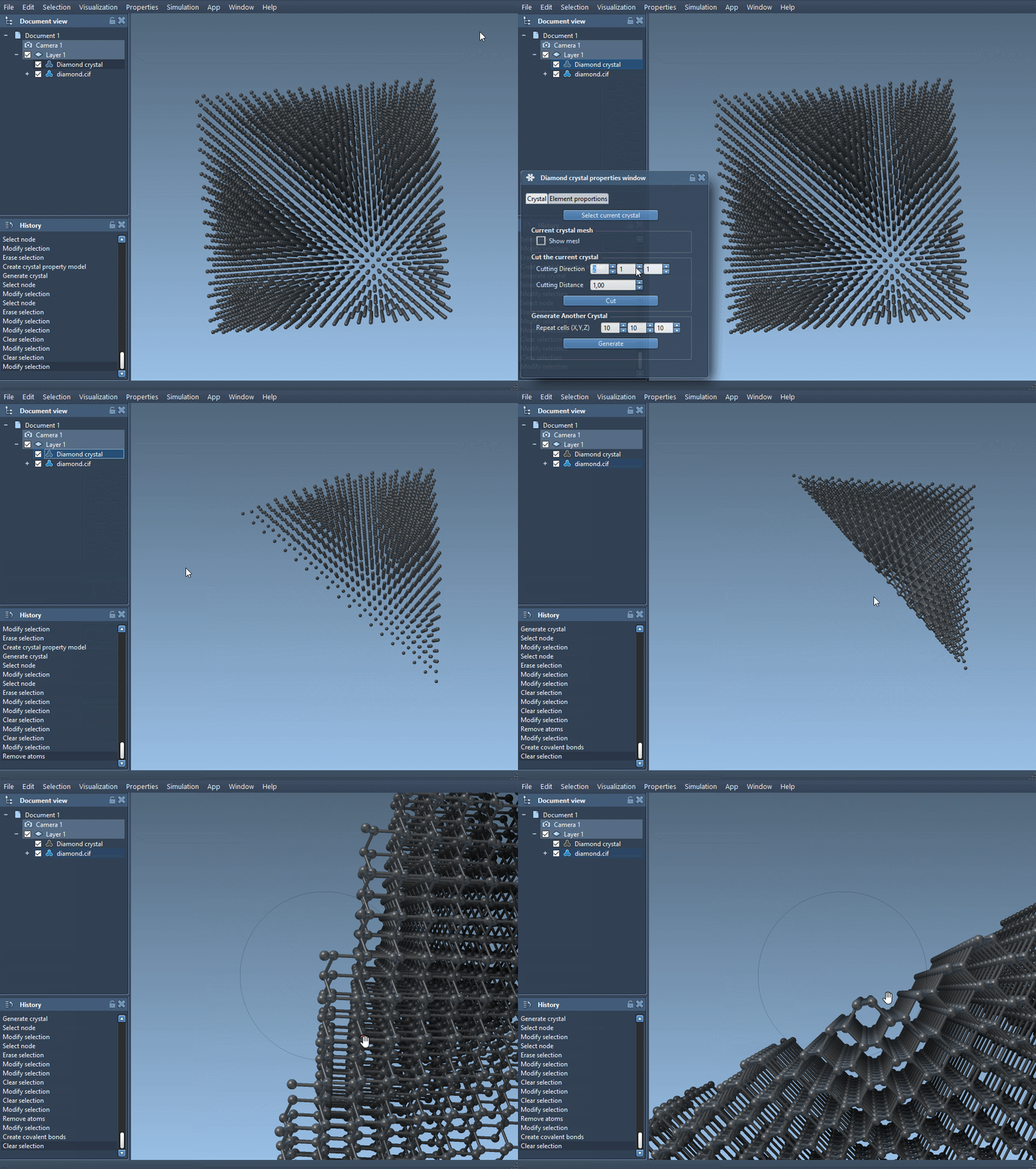
To learn more about using the Crystal Creator to model realistic crystals, including how to cut crystals, check bond ratios, and build structures from scratch, visit the full tutorial here:
https://documentation.samson-connect.net/tutorials/crystal-creator/generating-crystal-models/
SAMSON and all SAMSON Extensions are free for non-commercial use. You can get SAMSON at https://www.samson-connect.net.