



Molecular design often involves the intricate process of editing molecular systems. Whether adding new bonds, breaking existing ones, or reshaping molecular topologies, these tasks can be complex and time-consuming without the right tools. For molecular modelers who face these challenges, the Interactive Modeling Universal Force Field (IM-UFF) offers an innovative and user-friendly solution for dynamic molecular editing within SAMSON. Let’s dive into why this extension might change the way you model molecular systems.
The Challenge of Editing Molecular Structures
Traditional molecular modeling workflows often assume fixed topologies, meaning that users are restricted when trying to simulate large structural modifications, such as bond formation or breaking. For dynamic design processes, this lack of flexibility can be a major bottleneck, particularly when exploring new chemical reactions or designing novel compounds in silico. IM-UFF overcomes these challenges by enabling topological transformations directly during simulations, making the process far more interactive and intuitive.
What Makes IM-UFF Special?
IM-UFF extends the Universal Force Field (UFF), widely recognized for its applicability across the periodic table, into the realm of interactive modeling. With IM-UFF, covalent bonds can form or break in response to atomic movements during a simulation. This makes it possible to, for example, bring new atoms into proximity with a molecule and observe how bonds adapt or disappear, driven by physically-based interatomic forces. The extension retains the precision of UFF but allows real-time topology adjustments as you manipulate systems.
Getting Started with IM-UFF
To explore IM-UFF in SAMSON:
- Add the IM-UFF extension.
- Open a molecular system file in SAMSON that you’d like to edit.
- Add a simulator by navigating to Edit > Simulate > Add simulator. Alternatively, use the shortcut
Ctrl+Shift+M(orCmd+Shift+Mon Mac). - Select Interactive Modeling Universal Force Field from the list of interaction models.
- Choose a state updater for simulation, such as the Fast Inertial Relaxation Engine (FIRE).
- Click OK, and you’re ready to begin editing.
Unlike standard UFF setups, IM-UFF doesn’t use a separate setup window. Its parameter window includes an additional group called Interactive modeling options that simplifies the process. For example:
- The Static topology (UFF only) option lets you toggle between static UFF behavior and IM-UFF’s dynamic topology capabilities.
- The Keep vdW for manipulated option ensures van der Waals forces are only applied as needed during manipulations, making it easier to create or break bonds manually.
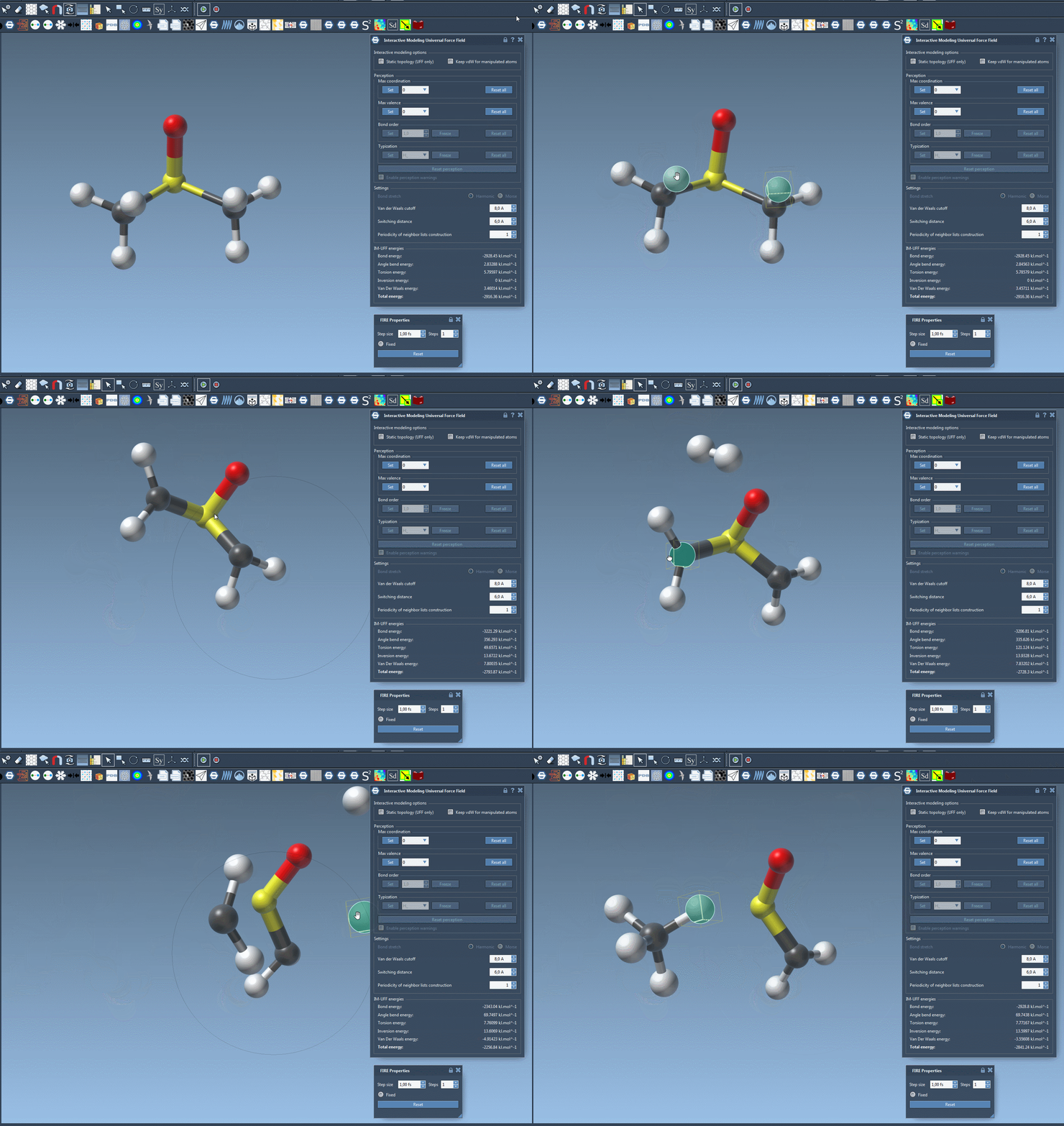
Real-Time Visualization of Topology Changes
Imagine dragging an atom closer to another part of your model and seeing a covalent bond naturally form. Or, moving an atom far enough to break its existing bonds. With IM-UFF, these topology changes occur smoothly and dynamically during the simulation. This feature enables you to iteratively refine molecular systems in ways that would be cumbersome with fixed-topology models.
For example, while editing a molecular structure:
- Small atomic movements maintain the local topology of the system.
- Larger displacements of atoms result in bond breaking, allowing you to intuitively reorganize molecular structures.
- The formation of new bonds occurs naturally as atoms approach suitable bonding distances based on UFF’s physical principles.
Why Use Interactive Modeling?
The ability to switch between static and dynamic topology settings makes IM-UFF versatile for different modeling tasks. For manual exploration of chemical pathways or structural hypotheses, dynamic topology provides unmatched flexibility. However, you can also revert back to static topology (UFF-only mode) for conventional workflows where fixed bond definitions are necessary.
Customization options, including van der Waals cutoff and switching distances, add further control over the behavior of your system. These refinements make IM-UFF a comprehensive tool for researchers and modelers seeking novel designs or insights into molecular systems.
Start Exploring IM-UFF Today
If you’re interested in interactive molecular modeling, IM-UFF provides a straightforward and effective way to enhance your workflow. Whether you’re prototyping new compounds, exploring chemical reactivity, or refining molecular designs, IM-UFF empowers you to make rapid, informed adjustments in real-time.
Learn more about IM-UFF and dive into the documentation here: Interactive Modeling Universal Force Field.
Note: SAMSON and all SAMSON Extensions are free for non-commercial use. Get SAMSON at https://www.samson-connect.net.