



When working on molecular modeling, understanding the nature of bonds within your system is essential for a wide array of tasks—from structure refinement to qualitative property analysis. But accurately visualizing bond orders can often be challenging, especially when moving between relaxed geometries or during interactive simulations. That's where the UMA Force Field in SAMSON and its dynamic Bond Update modes come in handy.
The UMA Force Field offers several options to manage the bond graph as part of its properties window. These settings are particularly useful during interactive exploration, as they allow you to toggle between different approaches for updating bonds based on your system's structure. Here's an overview of the available modes and when to use them:
Bond Update Modes in UMA
Located within the UMA Properties window, the Bond Update list provides four key modes:
- Covalent: This mode recalculates covalent bonds directly from the current structure. Use it when changes to your molecular system require rebuilding an accurate covalent bond network.
- Wiberg Bond Order (estimated): In this mode, a deep-learning model provides an estimate of Wiberg bond orders. It's an excellent choice for quick and insightful visualization of bond characteristics during structure manipulations.
- Mayer Bond Order (estimated): Similar to the Wiberg method, this mode employs a deep-learning model to estimate Mayer bond orders. Both methods work well for qualitative exploration but require validation through rigorous calculations for critical conclusions.
- Off: Select this option to keep the current bond graph unchanged. Use this when you prefer not to recompute bonds, ensuring consistency in the bond representation you've previously established.
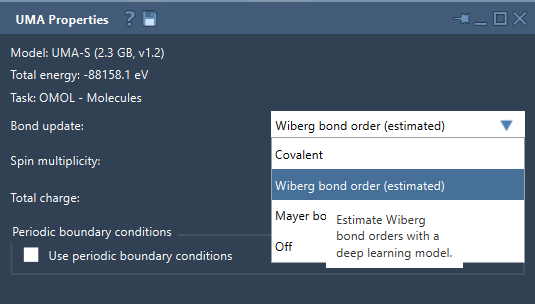
Important Note: The Wiberg and Mayer bond orders are estimated visualizations. While they offer valuable insights for interactive workflows, it's crucial to verify critical discoveries with your preferred reference computational method.
When to Update Bonds
The ability to update bonds in real-time proves especially useful under specific circumstances:
- During Structure Refinement: If your molecular structure undergoes significant geometry alterations, the bond network may shift dynamically. The Covalent mode ensures accurate recalculations to reflect structural changes.
- In Exploratory Modeling: The estimated Wiberg or Mayer bond order modes let you rapidly understand bonding trends, helping you decide on further refinements.
- Consistency Maintenance: When you simply want to freeze the bond graph for uniformity during a visualization phase, the Off mode streamlines this process.
Quick Recommendation
If you're new to UMA or unsure where to begin, start by experimenting with the estimated Wiberg Bond Order mode. This mode combines interactive flexibility with meaningful bond order visualization, enabling quick feedback during molecular modeling tasks.
You can learn more about the UMA Force Field and how bond update modes integrate into broader workflows by visiting the full documentation page here.
Note: SAMSON and all SAMSON Extensions are free for non-commercial use. You can download SAMSON at https://www.samson-connect.net.