



Defects in crystals are a fascinating aspect of materials science. They not only influence the properties of materials but also play a crucial role in applications ranging from semiconductors to mechanical systems. For molecular modelers, understanding and visualizing these imperfections can often be a challenge. In this post, we’ll explore how the SAMSON Crystal Creator makes it easy to introduce and visualize defects, specifically focusing on diamond crystals.
Why Study Defects?
Defects such as vacancies or substitutions in a crystal lattice can significantly alter the material’s properties. For instance, the presence of defects in diamond affects characteristics like hardness, conductivity, and optical properties, making it a critical study area for both academic research and industrial applications.
Adding Defects to Diamond Crystals
SAMSON Crystal Creator provides a simple yet powerful way to introduce defects into your crystal models and observe their effects. Here’s how you can experiment with defects in a diamond crystal:
- Load a diamond crystal: First, obtain a CIF (Crystallographic Information File) for diamond and load it into SAMSON’s Crystal Creator App. If you don’t have one, you can find CIF files on trusted databases such as the American Mineralogist Crystal Structure Database.
- Minimize the structure: Use the Brenner interaction model in SAMSON to minimize the loaded diamond’s structure, ensuring a stable geometry.
- Edit the CIF file: Make a copy of your CIF file and open it in a text editor. Locate the section containing atom site information. For example, you might see something like this:
1234567loop__atom_site_label_atom_site_fract_x_atom_site_fract_y_atom_site_fract_zC 0.00000 0.00000 0.00000
To introduce defects, paste the following instead:
12345678loop__atom_site_label_atom_site_fract_x_atom_site_fract_y_atom_site_fract_z_atom_site_occupancyC 0.00000 0.00000 0.00000 0.95The added _atom_site_occupancy value specifies a 95% probability of the carbon atom being present, effectively modeling a vacancy.
- Load the new crystal: After saving your edited CIF file, load it back into SAMSON using the Crystal Creator App. Visualize the structural changes caused by the introduction of vacancies or substitutions.
Visualizing the Impact
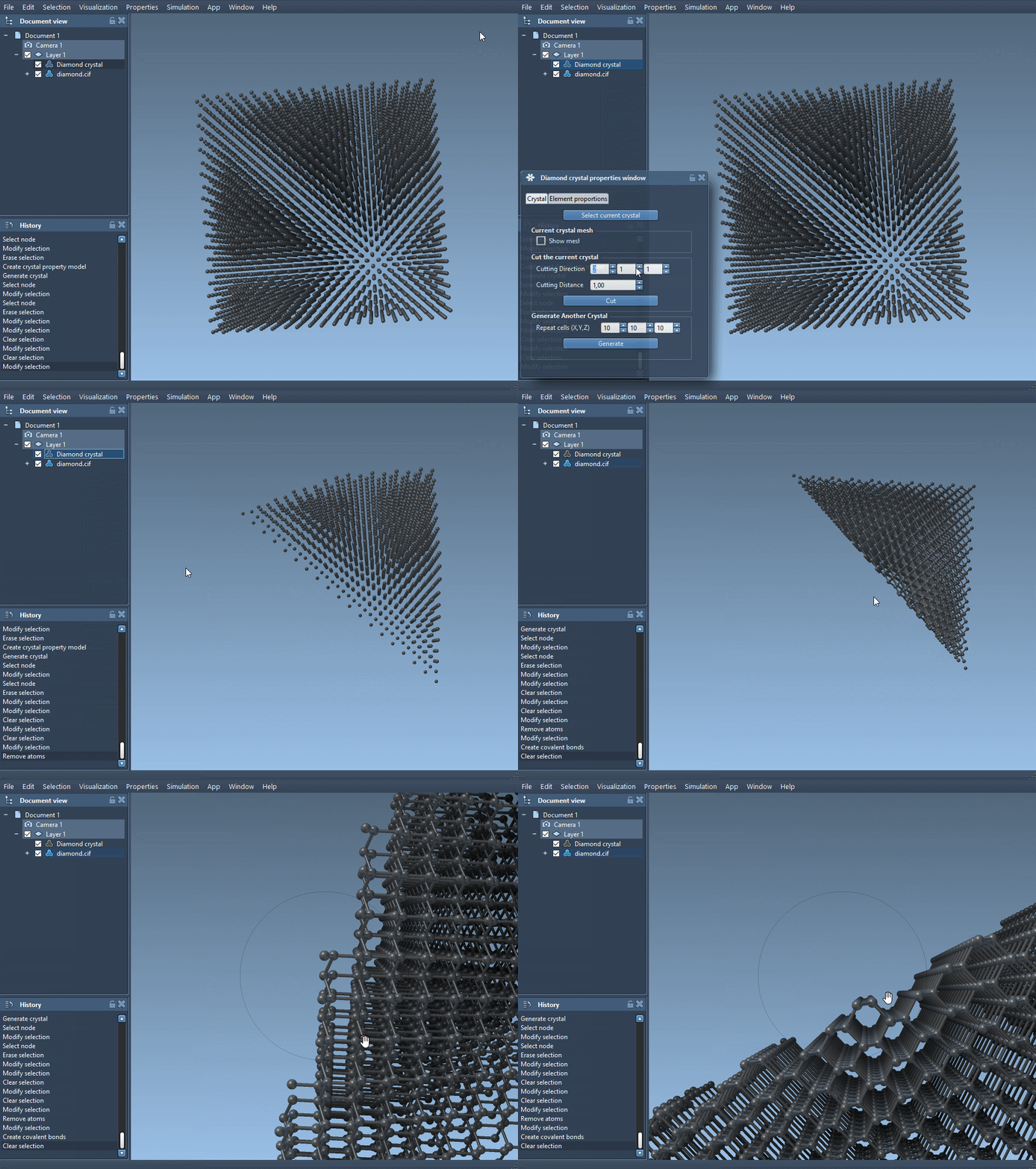
SAMSON makes it easy to observe how these changes influence the geometry and properties of the diamond crystal. Whether you’re analyzing the effects of vacancies on atomic bonding or studying substitution ratios, the platform provides interactive tools to refine and inspect your model.
For instance, you can generate all the bonds in your crystal with SAMSON tools and evaluate how the overall structure adapts to imperfections. Additionally, SAMSON allows you to check the atom site ratios, ensuring that introduced defects align with your experimental expectations.
Applications of This Workflow
Understanding and controlling defects is critical in numerous research fields. For example, introducing specific impurities into diamonds forms the basis for color tuning in gemstones or quantum sensing applications. Similarly, studying defect ratios helps in designing better semiconducting materials or nanodevices. With SAMSON, these complex processes become intuitive and accessible.
Getting Started
If you’re excited to dive in and explore defects in crystal structures, check out the Crystal Creator App in SAMSON. This tool empowers you to model and manipulate materials with precision, whether you’re studying basic crystal properties or conducting advanced simulations.
For a deeper guide, visit the official documentation page: SAMSON Crystal Creator Documentation.
SAMSON and all SAMSON Extensions are free for non-commercial use. Get SAMSON at https://www.samson-connect.net.