



Defects in crystals are not just imperfections—they are the key to understanding and designing materials with advanced properties. If you’re working with molecular models and wondering how to explore atomic-scale imperfections in diamond—one of the most iconic crystals—this post offers a hands-on guide using the SAMSON Crystal Creator extension.
Defects can significantly alter a material’s optical, electrical, and mechanical properties. In this walkthrough, you will learn how to simulate and visualize the effects of defects in diamond crystal structures, all within a few steps in SAMSON.
Why look at defects?
Even in a perfectly cubic diamond lattice, real-world materials exhibit a variety of defects such as vacancies (missing atoms), substitutions, or distortions due to thermal motion. Understanding these at the atomic level helps molecular modelers identify links between structure and function—particularly in semiconductor applications or quantum material design.
Simulating defects in diamond
To follow along, you will need the Crystal Creator extension in SAMSON. If it's not already installed, you can add it from the SAMSON Marketplace after logging in.
- Load your diamond structure:
First, open a CIF file of diamond in SAMSON using the Crystal Creator App. If you’re looking for a source, try the open-access file repositories such as the American Mineralogist Crystal Structure Database. - Create bonds:
Once loaded, use SAMSON’s built-in tool to create the bonds between atoms. This helps visualize the tetrahedral crystal network characteristic of diamond. - Duplicate and edit the CIF:
Make a copy of the CIF file and open it in a text editor. Locate the section that lists atomic positions, which typically starts like this:
|
1 2 3 4 5 6 7 |
loop_ _atom_site_label _atom_site_fract_x _atom_site_fract_y _atom_site_fract_z C 0.00000 0.00000 0.00000 |
Edit the file to include the occupancy for at least one atom. For example:
|
1 2 3 4 5 6 7 8 |
loop_ _atom_site_label _atom_site_fract_x _atom_site_fract_y _atom_site_fract_z _atom_site_occupancy C 0.00000 0.00000 0.00000 0.95 |
The added _atom_site_occupancy line indicates that the carbon atom has a 95% chance of being present. This introduces a defect into the structure.
- Reload and visualize:
Load the updated CIF file into SAMSON. Create the bonds again to visualize the structure including the implied vacancy. - Observe the structural changes:
The Crystal Creator intelligently interprets the new occupancy information, introducing the corresponding modification in the atomic model. You can also minimize the model using SAMSON's interaction models (e.g. Brenner potential) to see how the system responds to this vacancy.
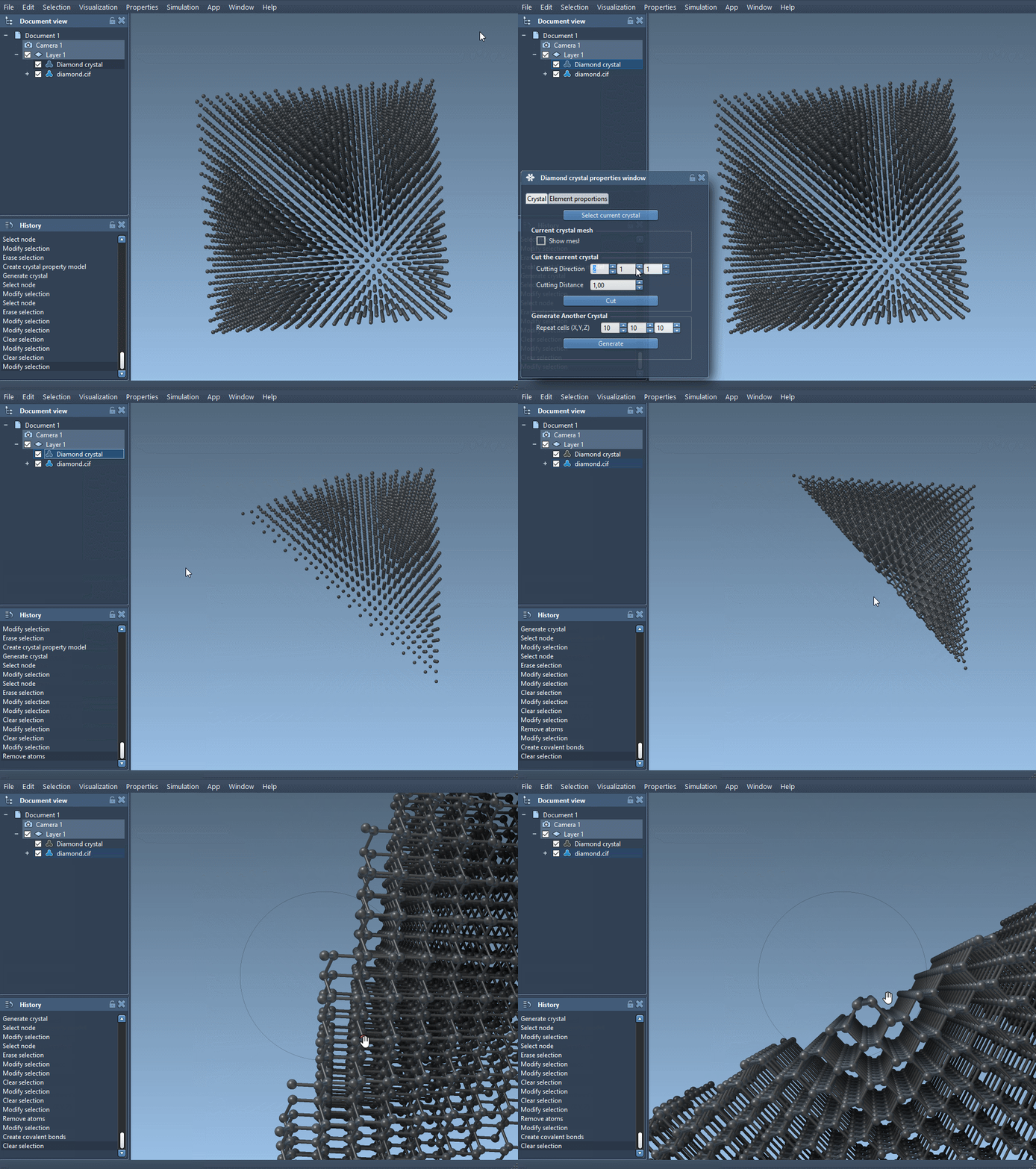
This simple method allows for modeling more realistic materials, especially when comparing perfect lattices versus defective ones. It’s a useful approach in nanoscale materials science, defect engineering, or teaching atomic-level diversity in solids.
To go further, you could experiment with different occupancy probabilities, create substitutional defects by replacing atoms, or combine this with energy minimization tools for dynamic studies.
Want to try this yourself? Explore the full tutorial on generating and manipulating crystals, including how to build your own from scratch, on the official documentation page.
SAMSON and all SAMSON Extensions are free for non-commercial use. You can download SAMSON at samson-connect.net.