



Protein modeling often runs into a simple yet nagging issue: some residues don’t conform to expected backbone geometries. These structural outliers can affect downstream simulations or reduce the quality of homology models—especially when small deviations escape plain sight. Fortunately, there’s an intuitive way to catch and fix these deviations before they become problems: the Interactive Ramachandran Plot in SAMSON.
In this post, we walk through a visual, hands-on approach to identifying and correcting strained or disallowed backbone conformations using phi (φ) and psi (ψ) dihedral angles. You’ll learn how to directly manipulate residues and improve structural quality using just your mouse.
Why You Should Care About Outliers
Whether you’re working on structure refinement, homology modeling, or simulation preparation, strained residues with unusual (φ, ψ) angles can compromise the physical accuracy of your model. Traditional validation tools may flag these, but correcting them without distorting the global fold can be tricky. This is where interactivity becomes valuable.
Using the Interactive Ramachandran Plot
After installing the Interactive Ramachandran Plot Extension and opening your protein in SAMSON, launch the app via Home > Apps > Biology > Ramachandran plot.
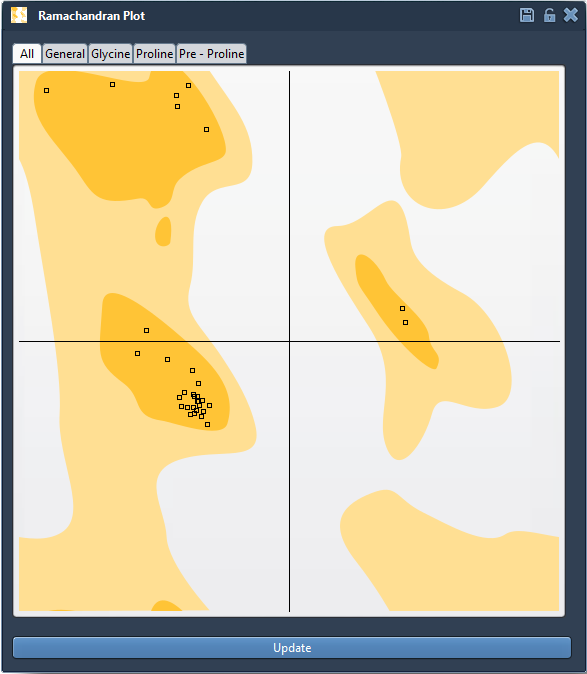
The plot displays each residue as a dot based on its φ and ψ angles. Yellow areas indicate favorable conformations, while white regions highlight geometrically strained or energetically unlikely states. Tabs let you filter by residue types—Glycine, Proline, Pre-proline, etc.—which makes visual analysis easier.
Fixing Outliers: Two Interactive Methods
Method 1: Drag Points in the Plot
- Click a residue in the plot (an outlier dot in a white area).
- Drag the dot to a yellow (allowed) region. The φ and ψ values update in real time.
- Undo any changes with Ctrl / Cmd + Z if needed.
This gives you precise control over the residue backbone without manually entering dihedral values.
Method 2: Use the Twister Editor
For more spatially intuitive control, activate the Twister Editor from the viewport’s left-hand menu:
- Select a residue in 3D.
- Use the Twister tool to rotate around its φ or ψ bond axes.
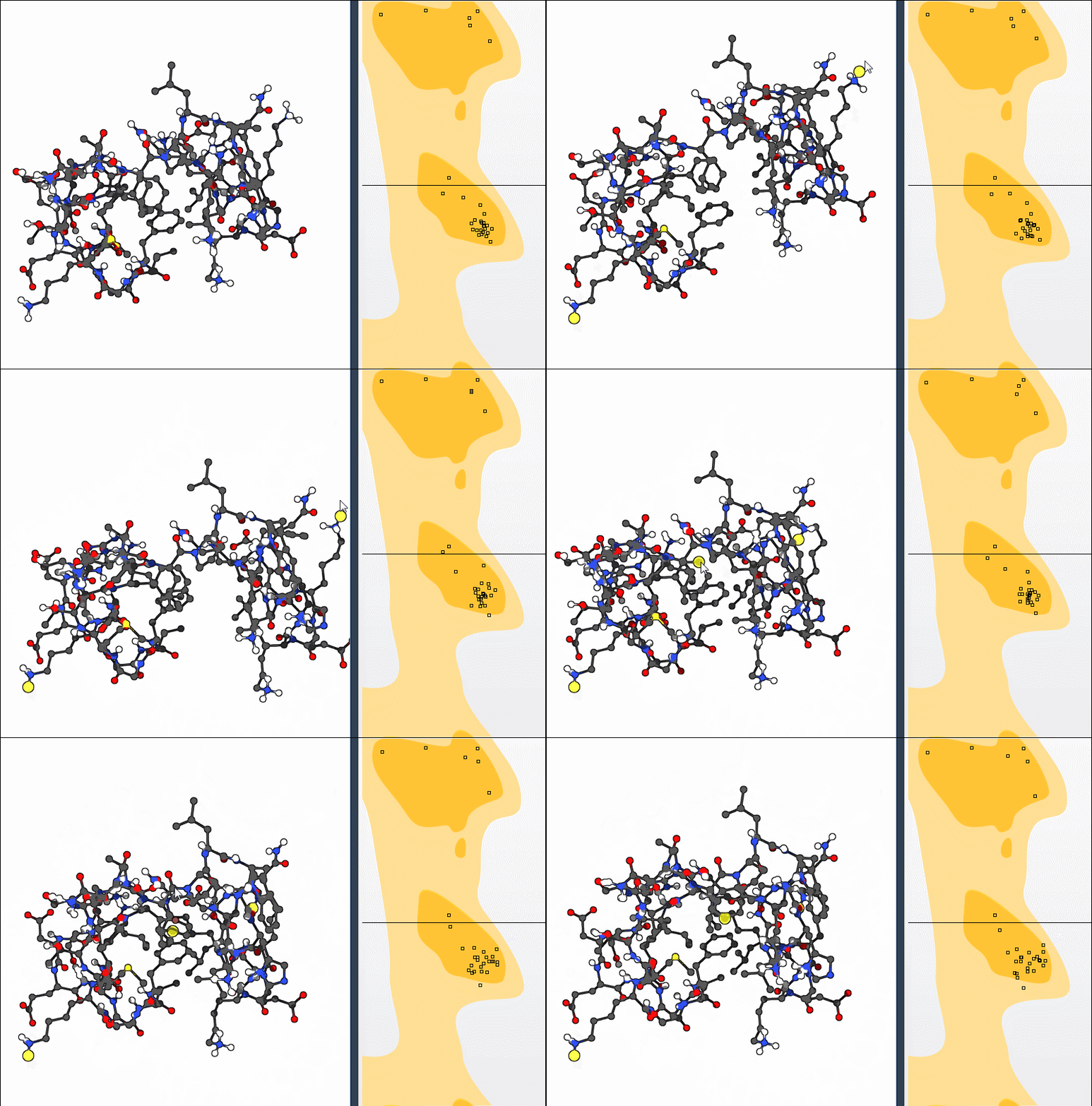
- The Ramachandran plot updates instantly to reflect changes.
Best Practices
- When adjusting residues, make small changes and observe the structure’s overall fold.
- If you’re refining a homology model, focus on outliers flagged during validation.
- Combine this tool with normal mode analysis (NMA) to explore global motion before local tweakings.
Wrap-Up
Not all modeling issues are global. Sometimes, fixing a model means literally dragging one dot into place. With the Interactive Ramachandran Plot, doing so not only becomes feasible—it becomes intuitive.
To learn more, visit the full documentation page.
SAMSON and all SAMSON Extensions are free for non-commercial use. You can get SAMSON at https://www.samson-connect.net.