



A molecular pathway can be easy to inspect and surprisingly hard to use in the next step of a project. You may need coordinates for a free-energy calculation, a record of a ligand’s route out of a binding site, or a set of intermediate structures for visualization. Exporting the entire system when you only need the ligand can make the result harder to work with; exporting only a subset without defining it carefully can leave out atoms you intended to track.
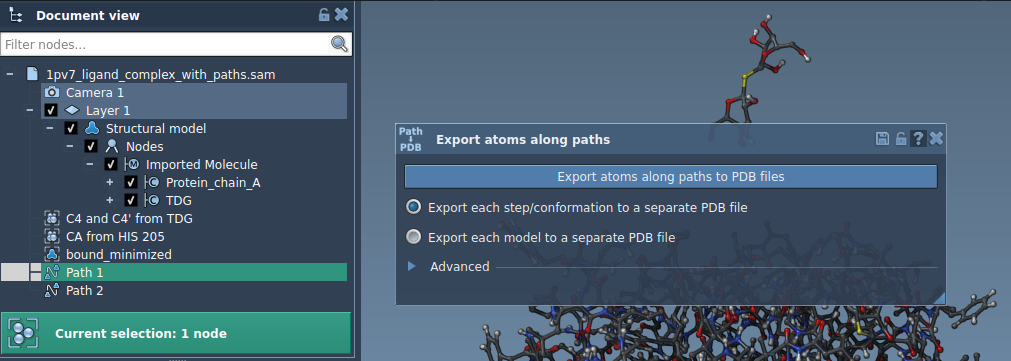
SAMSON’s Export Along Paths extension provides two practical choices: export all atoms associated with a selected path, or define one or more specific atom groups to export. The key is to decide what your downstream workflow needs before creating the files.
Start with a path, not a static structure
In SAMSON, a path is a node that stores atomic trajectories for a group of atoms. Double-clicking a path in the Document view starts or stops the atoms moving along it. Exporting along that path turns those successive positions into PDB output, so you can use the coordinates outside the interactive view.
For a worked example, the documentation’s sample system contains lactose permease (1PV7), the ligand thiodigalactoside (TDG), and two ligand unbinding paths. It is a useful way to see why the choice of atoms matters: a study might need the motion of the ligand, while another workflow may call for all atoms represented along the path.

Choose the output that matches the task
Before exporting, decide how you want the path frames organized:
- All frames in a single PDB file: choose this when you want the frames gathered into one file.
- Each frame as a separate PDB file: choose this when you prefer individual files for the successive structures.
The extension also offers an Advanced setting for changing the frame export interval. Consider this alongside the intended analysis: the interval determines which frames are written, so it is worth checking the setting rather than assuming every export will use the same sampling.
Export only the atoms you need
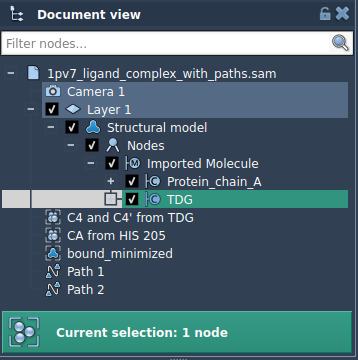
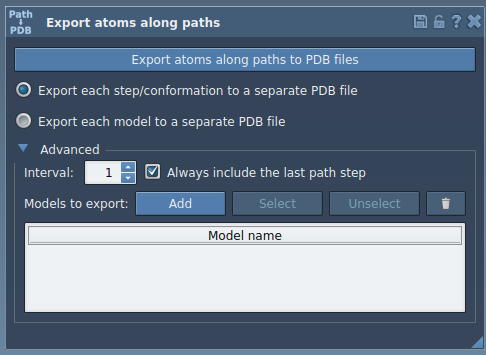
To export a subset, open the Advanced panel and select the desired atoms or molecule in the Document view—for example, TDG. Click Add to define that selection as a model in the export list. This step is useful to keep clear: selecting atoms in the document identifies the group, while adding it makes that group part of the export configuration.
Each model represents a group of atoms. You can give a model a more descriptive name by double-clicking its name, add multiple atom groups, and use Select or Unselect to highlight the atoms included in a model. If you need to redefine one, use Reset or the relevant line’s context menu. Reviewing the listed models before export helps you confirm that the groups you intend to include are actually defined.
A simple pre-export check
- Confirm that the intended path or paths are selected in the Document view.
- Choose whether the frames belong in one PDB file or separate PDB files.
- If exporting a subset, check that each desired group has been added to the model list.
- Review the frame export interval in Advanced settings if you need to change it.
- Click Export atoms along paths to PDB files, then choose a destination folder and file prefix.
This workflow can support tasks such as generating reaction-coordinate inputs, preparing ligand entry or exit trajectories for enhanced-sampling workflows, and saving intermediate states for visualization. It does not replace the analysis or simulation that follows; it gives you a way to carry path coordinates into those next steps.
For the full walkthrough and interface details, see the Export atom trajectories along paths tutorial.
Note: SAMSON and all SAMSON Extensions are free for non-commercial use. Get SAMSON at samson-connect.net.