



Building a polymer model often starts with a collection of fragments and a deceptively difficult question: how do you connect them in the right order without rebuilding the chain one unit at a time? The challenge grows when a design includes repeating blocks, different monomers, or non-single bonds. Polymer Builder in SAMSON addresses this workflow by letting you register chemical fragments, define reusable sequences, and generate a polymer from a compact expression.
The key is to treat polymer construction as three separate tasks: prepare the building blocks, define the pattern, then generate and inspect the result. Keeping those stages distinct makes errors easier to spot and makes a design easier to reuse.
Start with clean, useful monomers
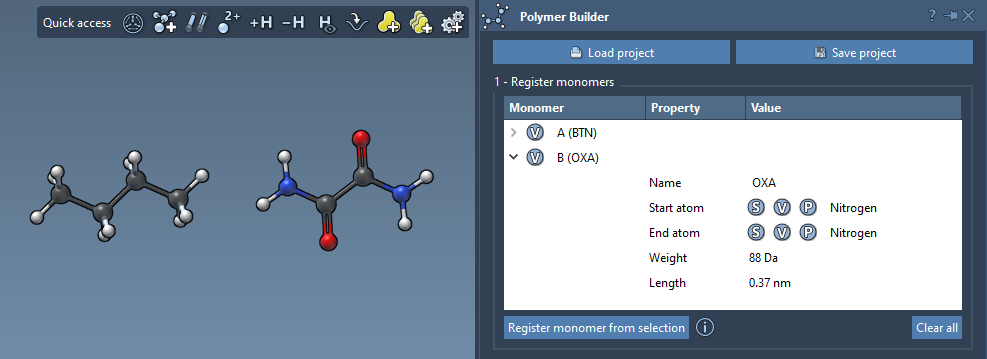
Before registering a monomer, select the intended fragment in the document or viewport. Polymer Builder assigns start and end atoms automatically, choosing atoms at opposite ends of the fragment. Because those atoms determine how the fragment connects into a chain, check them rather than assuming the automatic choice is appropriate. You can set an atom from the current selection with S, or choose one from the structure’s atom list with P. The V control highlights the structure or atoms to help you identify them.
Each registered monomer receives a unique letter, such as A or B. The table also reports molecular weight and the distance between its start and end atoms. These values are useful for a quick sanity check: if a fragment’s connection points or size look unexpected, revisit the selection and registration before building a long chain. You can edit monomers in the table, but a structural change to a registered monomer—for example, adding or removing an atom—causes it to be deregistered.
Turn repeating patterns into reusable sequences
If your design contains a repeated block, register it as a sequence rather than typing the same pattern repeatedly. Add a sequence and enter its monomer IDs, for example ABBA. Sequences receive identifiers such as S1 and S2, which you can use later in the polymer expression. The status field indicates whether a sequence is valid; if it is not, check that the expression uses registered monomer IDs. The sequence’s V button can highlight its monomers, which is helpful when a table contains several similar fragments.
You can also specify the bond between monomers in a sequence. A plain connection is single by default; use = for a double bond and # for a triple bond. For example, A=B describes a double-bond connection between A and B. This notation makes the intended connection explicit in the sequence itself.
Read the build expression before generating
The final expression can combine registered sequences, monomers, and repeated patterns. For example, 2*AB expands to ABAB, while 2*S1 + 2*S2 requests two copies of each registered sequence. A bond marker can also appear between units: AB=BA specifies a double-bond connection between those units, and AB#BA specifies a triple-bond connection.
Before clicking Generate polymer, read the expression as a recipe. Check that each letter or sequence identifier exists, that repeat counts match your intention, and that any special bond marker is in the intended position. Polymer Builder displays predicted molecular weight and length below the expression. Treat these as useful estimates to review before generation, not as a substitute for inspecting the resulting structure.

Generate, inspect, and refine
When you generate the polymer, its shape is based on the directions between the start and end atoms of each monomer, and excess hydrogens at connection sites are removed. The optional Adjust Hydrogens on connection atoms setting adjusts hydrogens according to valence and can also adjust their positions. Adjust for clashes attempts to avoid steric overlaps while connecting monomers; the resulting chain may have slight curvature.
After generation, inspect the connections and overall structure rather than relying only on the expression or predicted values. If needed, SAMSON’s built-in minimizer is available through Edit > Minimize; it uses the Universal Force Field. The generated polymer can also serve as a new monomer, which provides a way to build block copolymers or extend a chain without starting over. Save the selected polymer separately with Home > File > Save selection as…, or save the full project to preserve the monomer and sequence tables for later work.
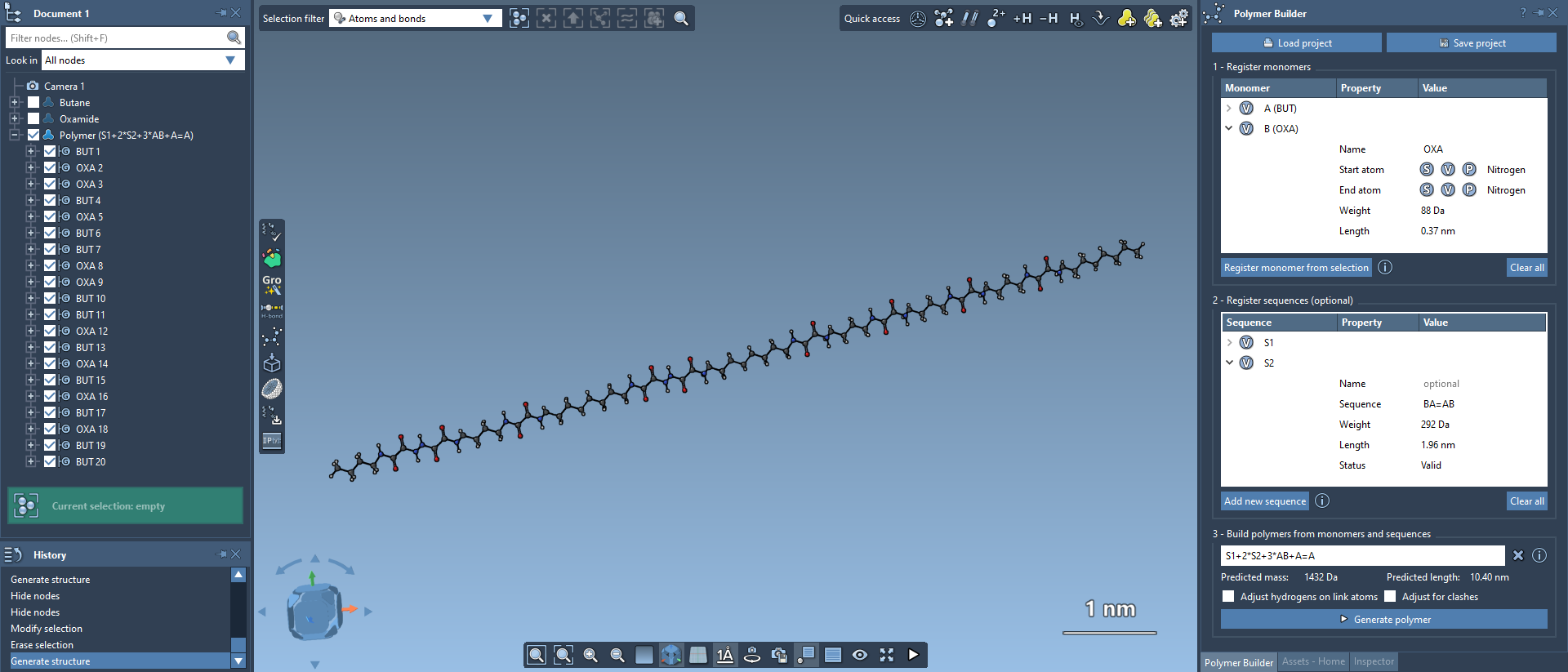
This workflow is especially useful when a polymer is defined by modular fragments and repeated blocks: register connection-ready monomers once, reuse sequence definitions, and keep the final expression readable enough to check. For the complete instructions and interface details, see the Polymer Builder tutorial.
Note: SAMSON and all SAMSON Extensions are free for non-commercial use. Get SAMSON.