



When a promising molecule has several positions that might tolerate a change, exploring them by hand can become repetitive: edit a structure, check that the result is valid, make another edit, and try to keep track of which position changed. Positional analogue scanning offers a more systematic starting point. In SAMSON, the SMILES Manager can search a molecule for a SMARTS pattern and generate analogues by replacing or attaching a group at the matching positions.
The useful idea is to turn a design question into two explicit choices: where should a modification be considered, and what change should be tested? That makes the resulting series easier to review and compare than a collection of unrelated edits.
Start with a molecule you can recognize
Load a starting structure by entering its SMILES, or select a molecule already present in the SAMSON document and use Use selection. The tutorial’s example is a substituted fused-ring compound with a biphenyl group. Starting with a known structure gives you a reference point: as you inspect the generated analogues, you can relate each proposed change back to the original.
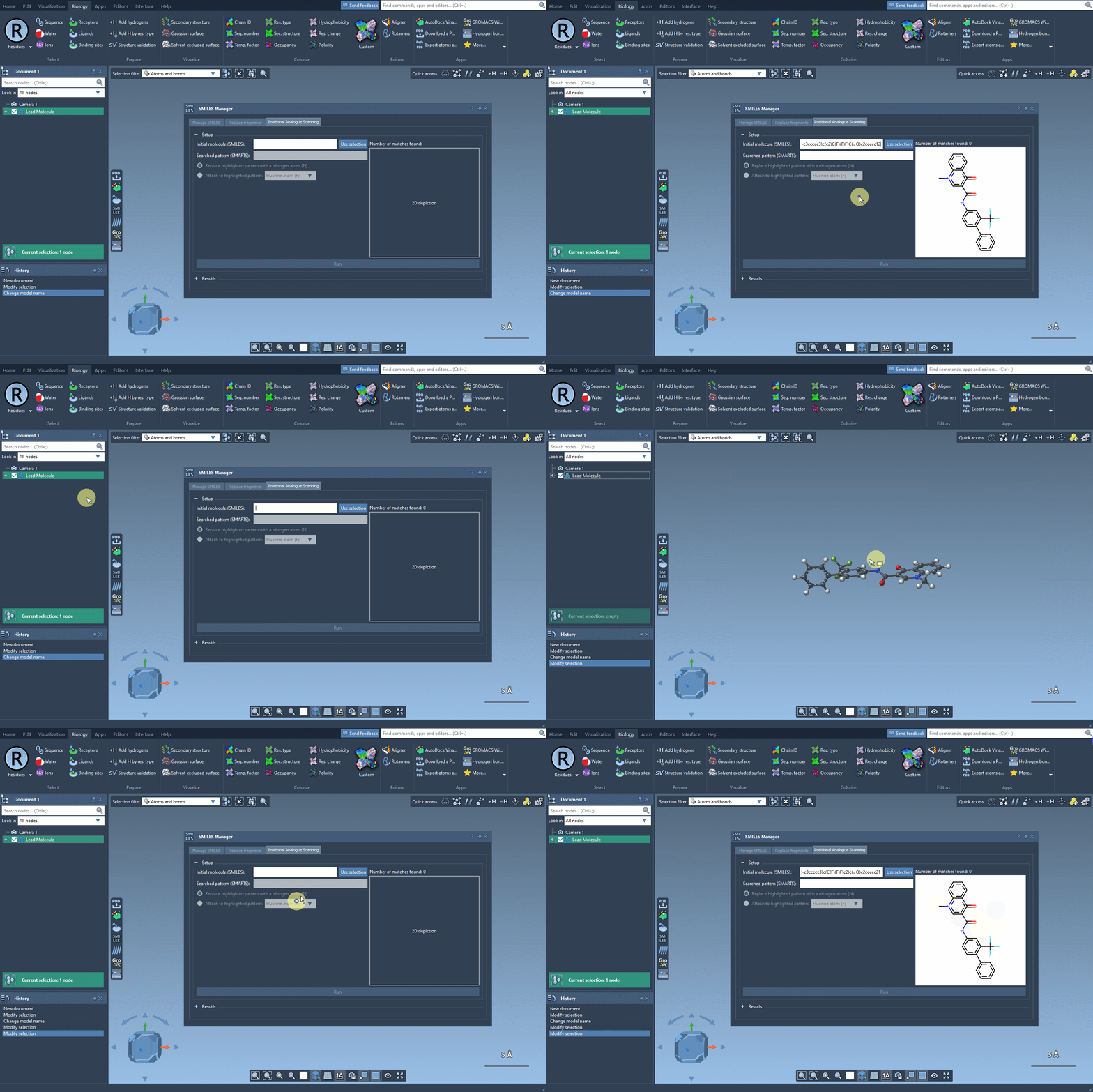
Before scanning, make sure the SMILES Manager extension is installed and that its Positional Analogue Scanning tab is open. If you need help importing or organizing SMILES first, see the SMILES Manager tutorial.
Make the pattern match the question
A SMARTS pattern defines the part of the molecule the scan should find. In the example, [cH] selects aromatic carbon atoms that have a hydrogen. The interface highlights the matches in the starting structure, giving you a chance to check whether the pattern identifies the positions you actually intend to explore.
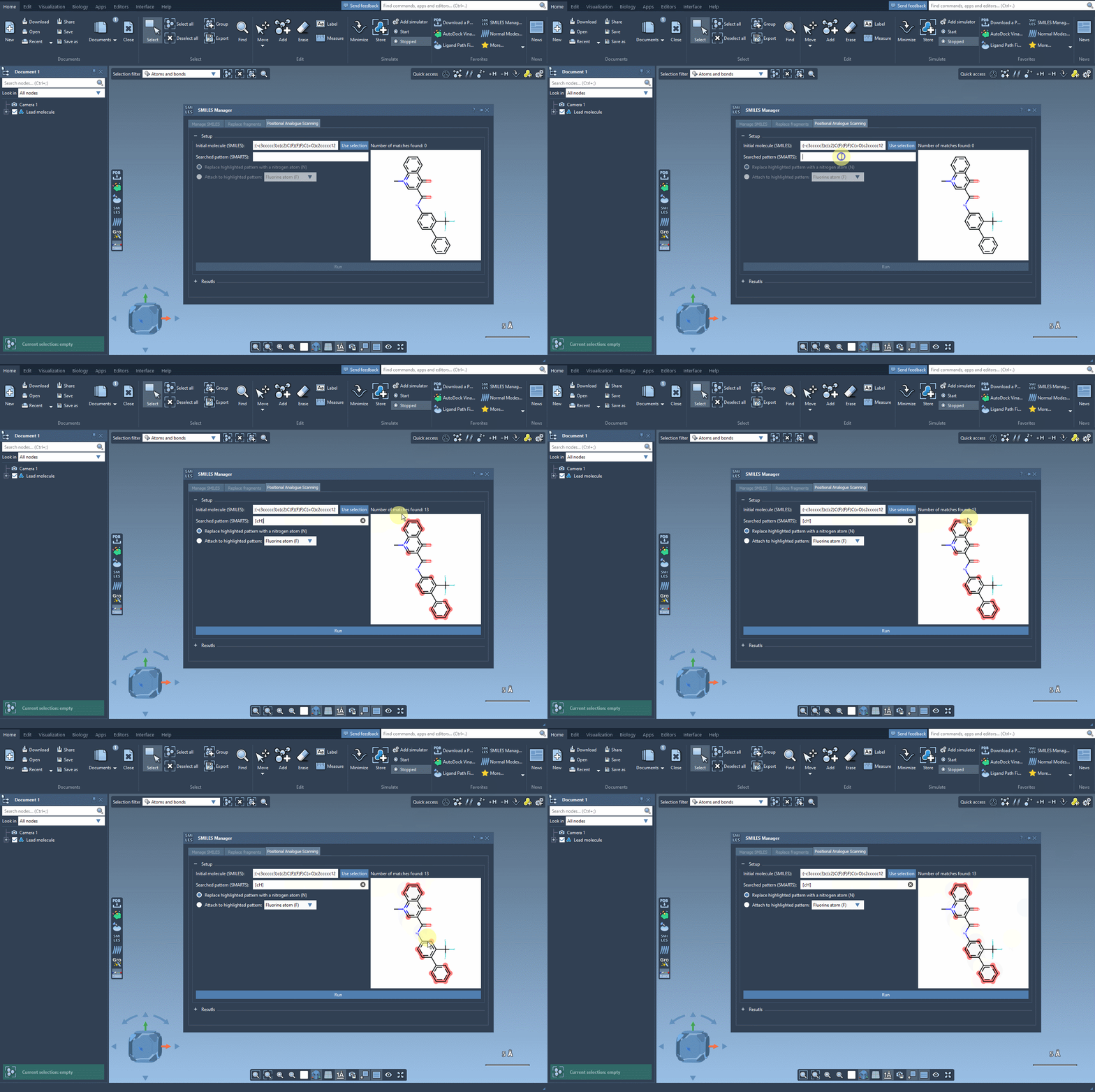
This visual check matters. A pattern that is too broad can include positions you did not mean to modify; one that is too narrow can miss positions you wanted to test. Treat the highlights as a quick review of your design rule, not just a confirmation that the input was accepted. If the highlighted atoms do not correspond to the chemical question you have in mind, revise the pattern before generating results.
Choose one kind of change at a time
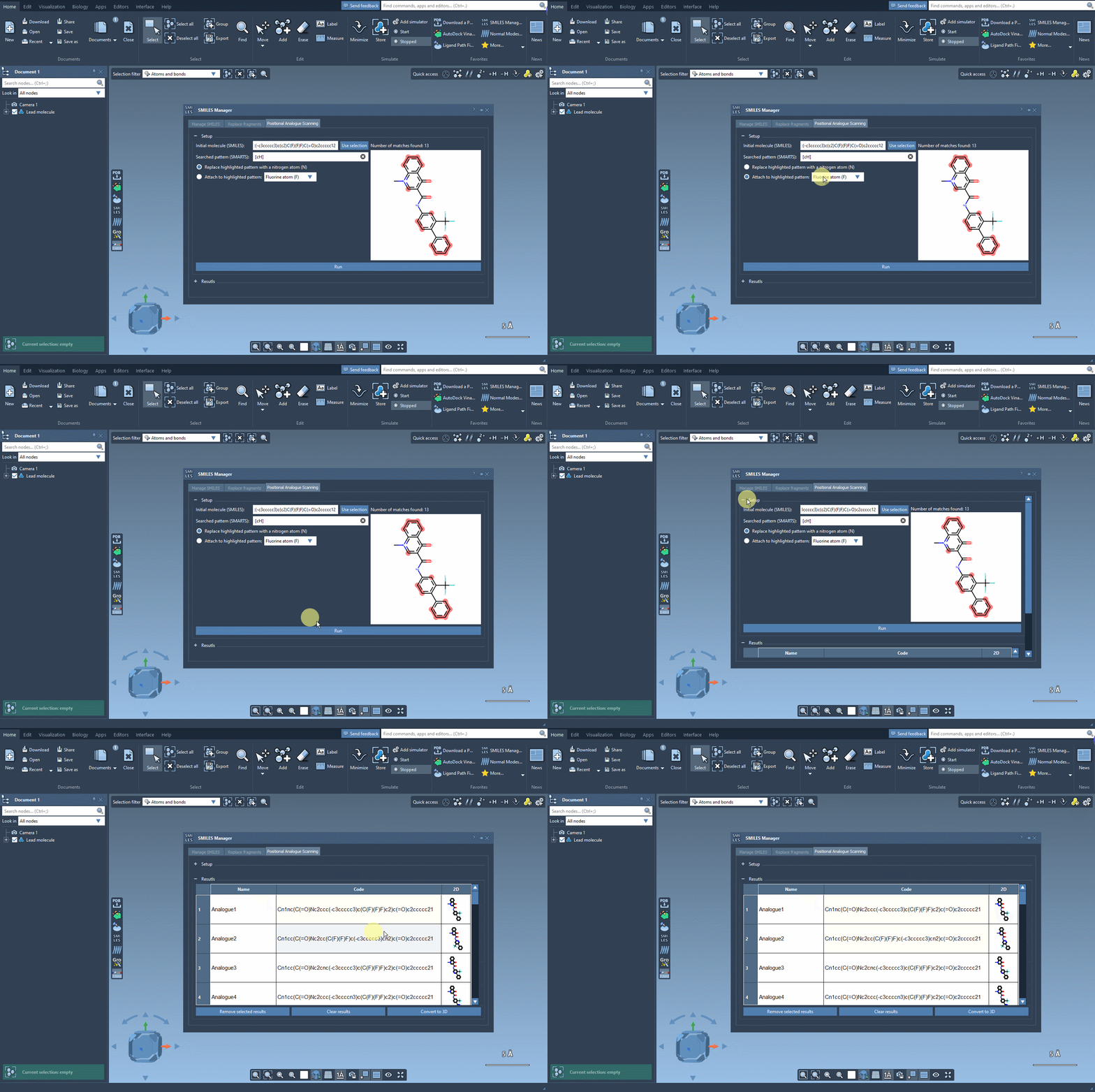
After specifying the pattern, choose whether to replace it or attach a group. The tutorial demonstrates replacing the matched aromatic carbon with nitrogen. It also shows attachment options such as fluorine or a methyl group. These are different design questions: replacement changes the matched atom, while attachment adds a substituent at the matched location.
For a useful comparison, begin with one type of modification and a clear set of positions. Click Run to generate the analogues, then review the SMILES and 2D depictions in the results table.
Review before moving to 3D
Generated structures are candidates for inspection, not conclusions about which molecule will perform best. Use the table to check the names, SMILES, and 2D depictions. You can edit a name or SMILES by double-clicking its cell, open a larger depiction by double-clicking the image, or hide and show the depictions with the table’s 2D header. You can also remove selected rows or clear the results when you want to reset the comparison.
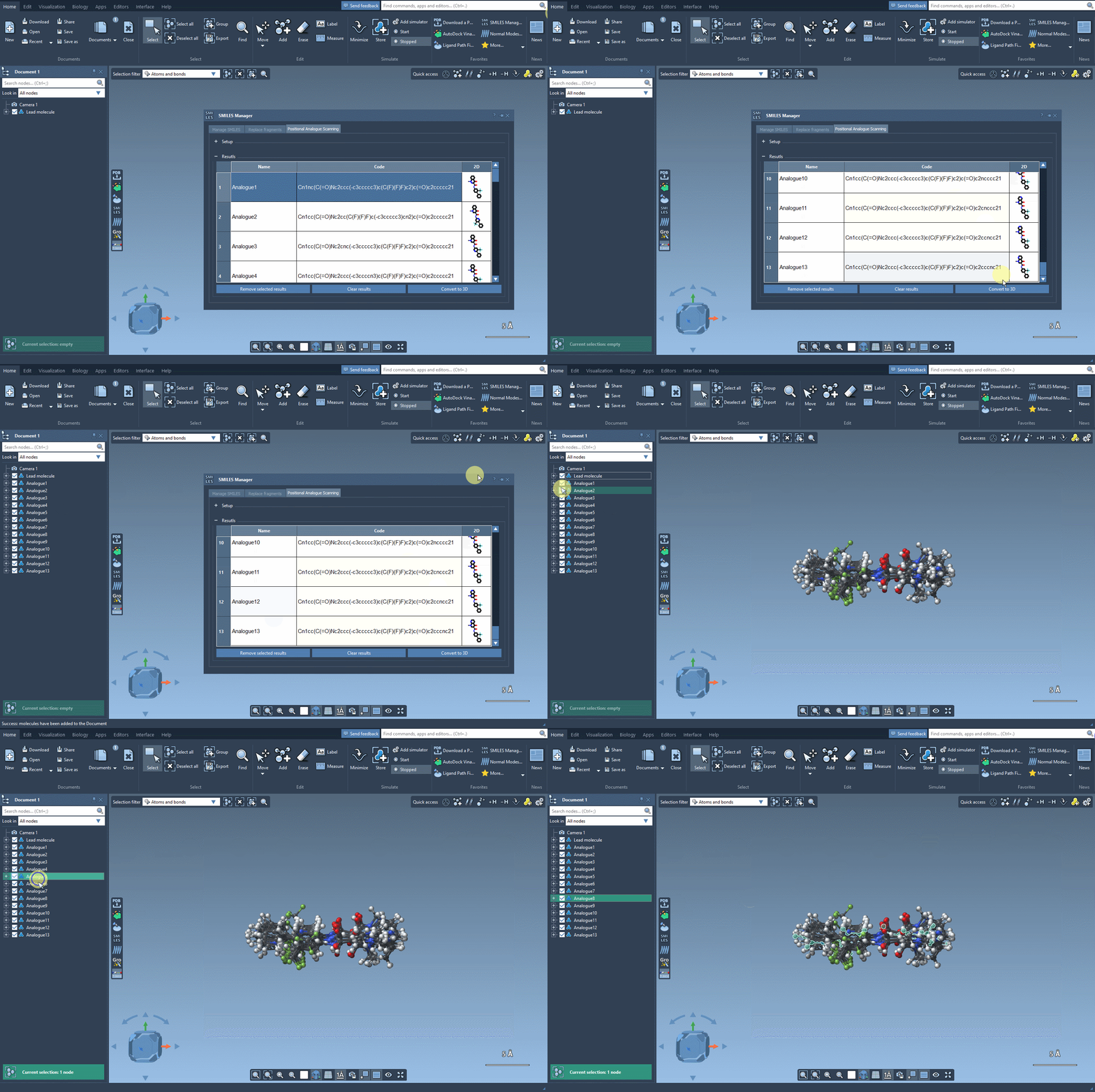
Once you have identified structures worth studying, use Convert to 3D to generate 3D structures. The resulting molecules can then be examined in a workflow suited to your goal—for example, docking with AutoDock Vina Extended. Docking and interaction analysis can help you investigate whether a change preserves or alters interactions with a target; they do not replace careful interpretation of the results.
A practical way to use the scan
Think of positional scanning as a way to organize early exploration: define a pattern that represents plausible modification sites, generate a consistent set of variants, then inspect and prioritize the structures for the next stage of analysis. Keeping the starting molecule and the modification rule clear makes the series easier to communicate and revisit. For the complete interface walkthrough, see the positional analogue scanning documentation.
Note: SAMSON and all SAMSON Extensions are free for non-commercial use. Get SAMSON.