



A molecular structure can look different from one point in a path to the next, but visual inspection alone can make it hard to tell whether the whole group is becoming more compact, expanding, or simply rearranging. The radius of gyration offers a useful first check: it tracks the overall compactness of a selected group as it moves along a path or trajectory.
This is especially helpful when you want to follow a broad structural change—such as folding, collapse, or swelling—without starting with a long list of atom-by-atom measurements. Instead of asking where every atom moved, you can first ask a simpler question: is the selected group becoming more or less spread out overall?
Set up a compactness check
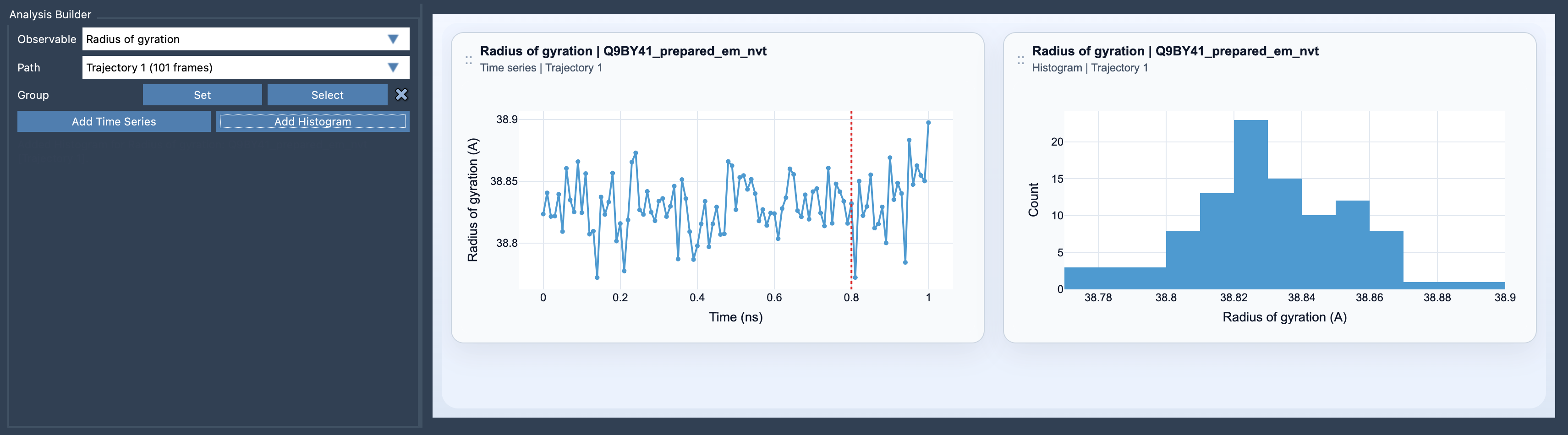
In SAMSON, open Path Analyzer, choose Radius of gyration as the observable, and select the path you want to examine. Then define the group of atoms to analyze. The group matters: the result describes the selected atoms, not automatically every component in the scene. For example, if your question concerns one molecular component, make sure your selection represents that component rather than an unintended collection of atoms.
After choosing the group, add either a time series or a histogram. The time series is useful when you want to see how compactness changes along the path and when those changes occur. A histogram gives a complementary view: it helps you inspect which compactness values are represented or preferred across the path. The measurement is reported in Å (angstroms).
Read the trend, not just the number
A rising radius of gyration indicates that the selected group is becoming more spread out overall; a falling value indicates increasing compactness. A relatively steady trace suggests that overall compactness is not changing much, even if the structure may still be moving. Look for sustained trends and transitions rather than treating every small fluctuation as a meaningful event.
It is also important not to overinterpret this one measurement. Radius of gyration summarizes overall compactness; it does not tell you exactly which region moved, what caused the change, or what the structure looks like. Different shapes can have similar overall compactness. A group could become elongated or rearrange while its radius of gyration changes little. Conversely, a change in the value tells you that the distribution of the selected group has changed, but not the full story behind that change.
Use it as a first diagnostic
A practical workflow is to start with radius of gyration to find intervals where the group expands or compacts, then inspect the corresponding structures on the path. If shape is part of the question, compare the result with asphericity or shape parameter. These observables can help you investigate how the shape changes, not only how compact it is.
This makes radius of gyration a useful screening measurement: it can quickly point you toward parts of a trajectory worth examining more closely, while keeping the interpretation appropriately focused. For setup details and the available views, learn more in the Radius of Gyration documentation.
Note: SAMSON and all SAMSON Extensions are free for non-commercial use. Get SAMSON.