



When setting up molecular docking, one challenge researchers often face is accurately accounting for the flexibility of molecular bonds. Do you make every bond flexible? How do you balance docking accuracy and computational time? If you’ve asked yourself these questions, this guide is for you. We’ll explore how to manage rotatable bonds for ligands while working with AutoDock Vina Extended in SAMSON, making your docking process smoother and more precise.
Why Rotatable Bonds Are Crucial
Rotatable bonds directly influence how your ligands interact with receptors during docking. Flexibility can improve the realism of the docking pose, but it also increases computational time. Striking the right balance involves understanding both your specific biological system and the tools at hand. Fortunately, AutoDock Vina Extended in SAMSON offers a streamlined way to adjust bond flexibility, allowing you to refine your docking setup efficiently.
Defining Rotatable Bonds
In AutoDock Vina Extended, defining rotatable bonds is visual and intuitive – all while giving you complete control:
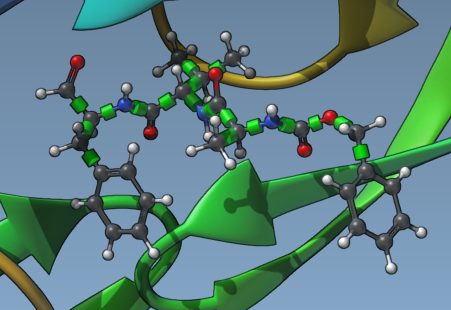
- Once a ligand is set, rotatable bond controllers appear as green cylinders superimposed on the bonds in the Viewport.
- Click the cylinders to toggle a bond between rotatable (green) and fixed (red).
- Focus on your ligand by selecting it in the Document view and pressing Shift+Space to zoom in.
Locking Specific Bond Types
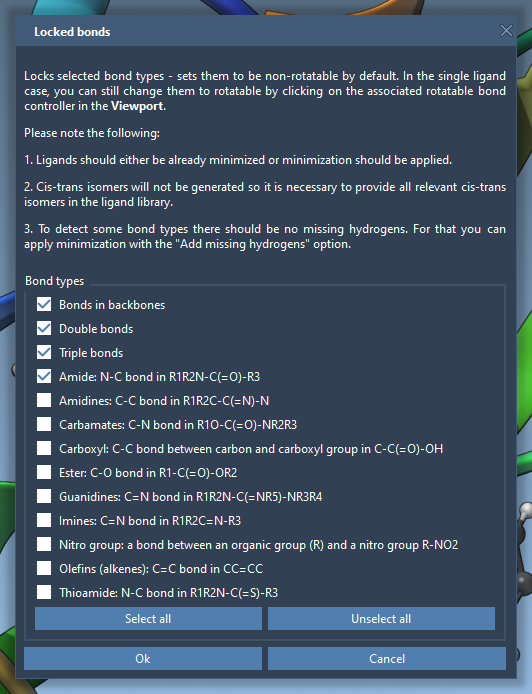
Often, not all bonds need to remain rotatable. For example, you might want to fix double bonds or aromatic rings that typically do not rotate:
- Use the Lock bonds settings option to specify bond types you want locked (non-rotatable).
- Check the Lock specific ligand bonds option to apply these settings to your ligand.
This customization ensures that bond flexibility aligns with the chemistry of your system, helping you achieve biologically realistic docking poses without unnecessary computational overhead.
Managing Computation Time
While flexibility can enhance the accuracy of docked poses, it comes at the cost of longer computation times. For large ligand libraries, careful planning is essential. Successfully setting up rotatable and fixed bonds not only saves you hours of computational effort but also ensures more reliable results.
For example, you can adjust a ligand’s rotatable bonds strategy depending on its role in your research:
- For exploratory studies, less flexibility may speed up simulations while identifying potential hits.
- For detailed studies of key compounds, greater bond flexibility is worth the computational cost.
Save Time and Refine Your Results
Now that you know how to edit rotatable bonds in AutoDock Vina Extended, you can confidently prepare ligands for docking. With a mix of interactive controls and predefined bond settings, SAMSON makes it easy to tailor docking simulations to your needs without the frustration of inefficient computation or unrealistic assumptions.
Check out the detailed guide on rotatable bonds and docking in the official AutoDock Vina Extended tutorial here.
SAMSON and all SAMSON Extensions are free for non-commercial use. Get SAMSON at SAMSON Connect.