



Protein modeling often involves understanding the conformations of a protein’s backbone, which can be daunting, especially when approaching structure refinement or detecting structural anomalies. One of the key tools to tackle this is the Ramachandran plot, a powerful visualization showing the energetically allowed regions for backbone dihedral angles, φ (phi) and ψ (psi). Fortunately, SAMSON’s Interactive Ramachandran Plot makes this process far more intuitive and interactive. Let’s dive deeper into how this tool can enable you to explore and refine protein backbone conformations effectively.
What is a Ramachandran Plot?
A Ramachandran plot is an essential tool for molecular modelers. It maps the φ (phi) and ψ (psi) dihedral angles of amino acid residues and highlights conformational preferences based on steric and energetic constraints:
- Yellow regions: Energetically favorable conformations.
- White regions: Energetically unfavorable conformations.
This simple visual distinction helps you determine whether specific residues in a structure lie in strained or favorable positions, providing the groundwork for further structural improvement.
Interactive Exploration Made Easy
SAMSON’s Interactive Ramachandran Plot app takes this concept to the next level by allowing you to not only visualize these plots but also directly interact with your 3D models. Once the app is activated through the Home > Apps > Biology tab within SAMSON, you can generate a Ramachandran plot for your protein.
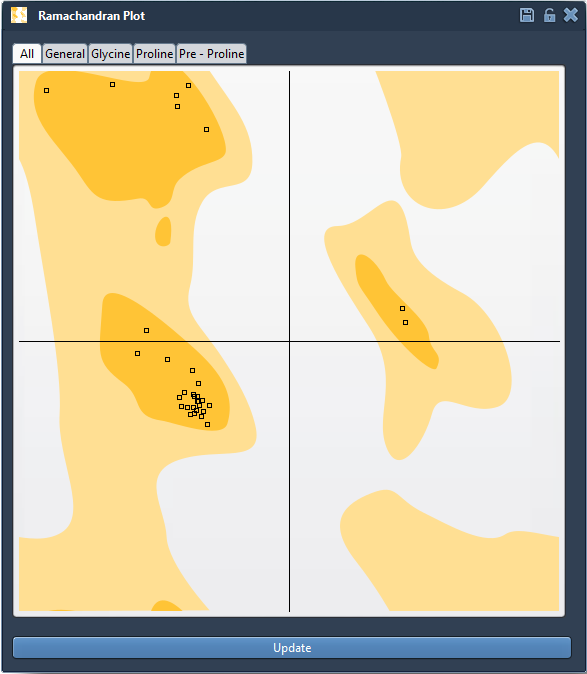
The plot dynamically connects to your 3D model. By clicking on any point (representing a residue) in the plot, the corresponding residue will be selected in your molecular view, along with its φ and ψ values displayed in the status bar. This direct visual connection provides clarity while working on residues that may require adjustments.
Filtering and Categorizing Residues
The app includes several tabs to navigate subsets of residues:
- All: View every residue in the protein.
- General: Focus on typical residues conforming to general rules.
- Glycine: Glycine residues, which are often outliers due to their flexibility.
- Proline: Proline residues with distinct conformational constraints.
- Pre-proline: Residues immediately preceding a proline in the sequence.
This categorization enables a targeted approach to analyzing specific regions of interest in your protein model.
Refining Your Protein Model
One of the standout features of SAMSON’s Interactive Ramachandran Plot is its real-time editing capabilities:
Option 1: Dragging Points in the Plot
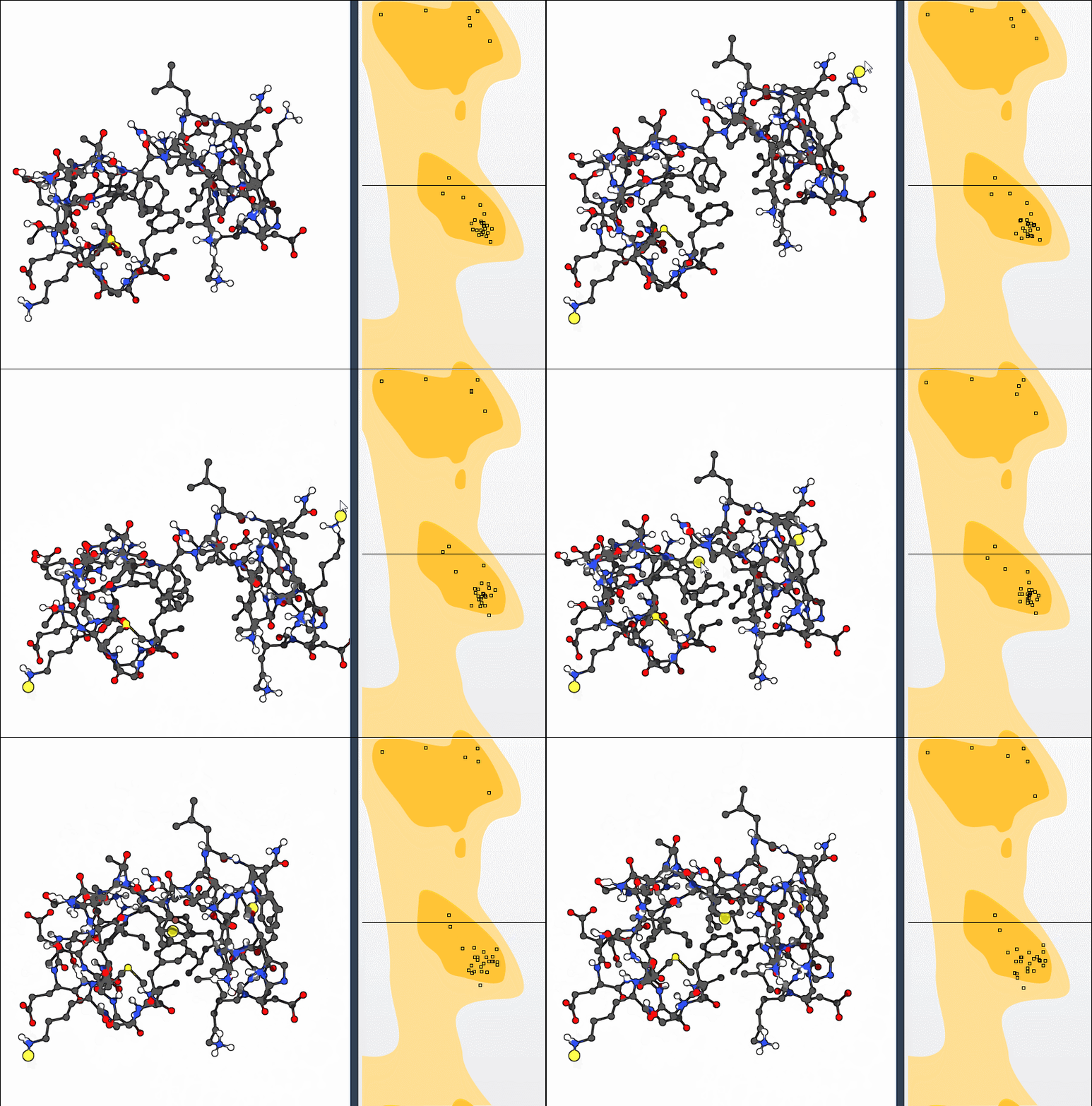
Dragging a point within the plot lets you update dihedral angles interactively. The protein’s 3D structure in the viewport updates instantly so you can immediately assess the impact of your changes. If you ever need to undo a modification, simply use Ctrl/Cmd + Z.
Option 2: Twisting with the “Twister” Editor
Selecting the Twister editor from the viewport’s left-hand menu allows you to physically twist the protein in 3D space. As you manipulate the structure, the Ramachandran plot updates in real time, providing valuable feedback on how global changes affect local conformations.
Why It’s Useful
The ability to interactively validate and refine dihedral angles with real-time feedback makes this app invaluable for:
- Detecting strained residues before simulation and resolving them.
- Refining homology models, particularly outlier residues, to achieve higher-quality structures.
- Exploring the flexibility of active and binding sites, enhancing your understanding of functional conformations.
Conclusion
For molecular modelers aiming to streamline protein backbone refinement and analysis workflows, the Interactive Ramachandran Plot app in SAMSON is a highly practical solution. By enabling seamless integration between a Ramachandran plot and live 3D editing, this tool provides greater precision and understanding during the modeling process.
To explore more features and detailed instructions, visit the original documentation page here: https://documentation.samson-connect.net/tutorials/ramachandran/ramachandran-plot/.
Note: SAMSON and all SAMSON Extensions are free for non-commercial use. You can download SAMSON at https://www.samson-connect.net.