



Molecular modelers often face the challenge of selecting specific structures or nodes based on spatial relationships. Whether it’s identifying atoms within a specific distance from a residue or pinpointing structural elements far from a certain region, precise control over proximity-based queries is vital for effective molecular design and analysis. SAMSON’s Node Specification Language (NSL) provides an elegant solution through its proximity operators. This blog post explores how you can leverage these operators to perform proximity-based selections efficiently.
What Are Proximity Operators?
Proximity operators allow users to select nodes (e.g., atoms, residues) based on their spatial distances from other nodes. These operators come in two forms:
within {distance} of(short version:w {distance} of): Selects nodes within a specified distance.beyond {distance} of(short version:b {distance} of): Selects nodes beyond a specified distance.
These operators include a wide range of length units—from femtometers (fm) to meters (m)—ensuring flexibility for users working at various scales.
Practical Examples
The following examples illustrate how to use proximity operators for common molecular modeling tasks:
C within 5A of "GLN 2"(short version:C w 5A of "GLN 2"): Matches all Carbon atoms within 5 angstroms of the residue named “GLN 2”. This is particularly useful for analyzing local chemical environments.node.type atom beyond 5A of "2AZ8-IA"(short version:n.t a b 5A of "2AZ8-IA"): Selects all atoms located farther than 5 angstroms from the node “2AZ8-IA”.
For instance, the first query can help identify carbons near an amino acid residue, while the second query could exclude atoms close to a specific molecule, focusing your analysis on distant interactions.
Tips for Better Results
When working with proximity operators, it’s important to structure your queries correctly to avoid unexpected results:
- Be specific about node types: For example,
n.t a within 5A of "GLN 2"ensures only atom nodes are selected. - Exclude self-references when needed: To select atoms near—but not part of—”GLN 2″, combine operators like this:
n.t a within 5A of "GLN 2" out of "GLN 2". This filters out atoms that belong to the residue itself.
How SAMSON Enhances Efficiency
Proximity operators dramatically streamline workflows for modelers analyzing spatial relationships. Beyond the inherent flexibility of NSL, SAMSON enhances user experience with AI-assisted features. The AI Assistant can suggest NSL expressions based on the document’s active hierarchy. To access this, simply click the  Ask AI button in the selection string field. This can be particularly helpful when dealing with complex hierarchies or unfamiliar structures.
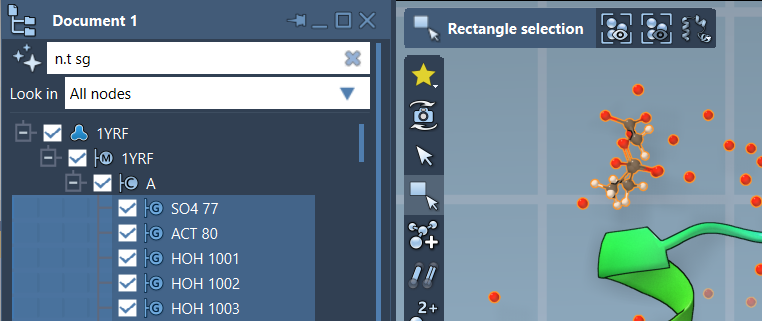
Additionally, SAMSON’s support for list and range inputs (e.g., a.c A,B,C or a.x -1nm:1nm) provides further precision, enabling you to define queries with compounded conditions.
Conclusion
Proximity operators in SAMSON’s Node Specification Language are invaluable tools for molecular modelers needing detailed spatial analyses. From inspecting amino acid environments to studying complex molecular interactions, these operators allow precise and efficient selection of nodes. To dive deeper into these capabilities, visit the original NSL documentation page.
SAMSON and all SAMSON Extensions are free for non-commercial use. Download SAMSON today at samson-connect.net.