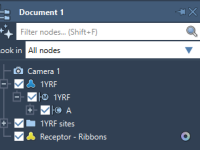
You open a molecular structure, inspect it, and prepare to send your work to a colleague. The model may be ready, but what about the script, image, paper, or data file that helped you interpret it? When those materials live…
Running molecular dynamics on several starting conformations can mean repeating the same setup steps again and again. That takes time—and makes it easier to miss a setting or handle one project differently from the others. Batch preparation in SAMSON’s GROMACS…
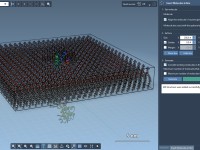
Building a membrane-like environment around a protein can be surprisingly fiddly. The protein needs a sensible orientation, lipids need to be arranged around it rather than through it, and the box must be large enough to hold the layer. Placing…
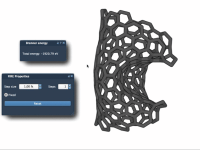
A molecular structure can look close to ready and still contain awkward geometry: atoms may be crowded, bonds or angles may be strained, or the whole structure may need to shift before a simulation. Moving atoms by hand is rarely…
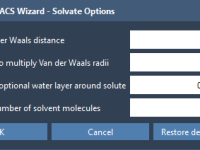
A coarse-grained system can look ready for simulation and still run into trouble during solvation. One easily missed setting is the van der Waals distance used when placing solvent. In the GROMACS Wizard workflow described here, the default distance may…
A molecular modeling session can be interrupted before it begins: the installer runs, but the application will not launch—or graphics features fail on a workstation that otherwise seems powerful enough. The useful first step is to separate three questions: is…
Preparing a coarse-grained system for molecular dynamics can look straightforward: load the model, add water, and move on to ions and simulation. But a setting that is reasonable for an atomistic system may be too small for coarse-grained beads. The…
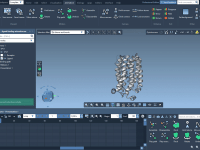
A new molecular modeling workspace can feel surprisingly disorienting. You may have installed the software, but still be unsure which page to read first, where to begin in the interface, or how to get a structure into view. Jumping between…
When a protein structure contains thousands of atoms, spotting regions that may need inspection can become a tedious search. Low occupancy or a high temperature factor can help flag atoms for review—but either value needs to be interpreted in the…
A trajectory can be difficult to understand when you only watch it move in one direction. You may want to revisit how a structure arrived at a particular conformation, compare the order of visible changes, or simply replay a transition…