



Protein-ligand docking can be a complex process, especially when accounting for receptor flexibility. Docking with rigid receptors may oversimplify interactions, leading to less realistic results. The ability to integrate flexible side chains of a receptor into docking greatly enhances the biological relevance of the predictions. Let’s explore how AutoDock Vina Extended within SAMSON helps you achieve this.
Why Flexible Side Chains Matter
In protein-ligand docking, considering flexible receptor side chains allows for a more realistic simulation of molecular interactions. Proteins are not static; side chains in the binding site can adapt to the incoming ligand, and accounting for such flexibility can significantly influence docking accuracy. Flexibility, however, introduces additional computational complexity, and SAMSON’s AutoDock Vina Extended simplifies this process with an intuitive interface.
Step-by-Step: Setting Up Flexible Side Chains
Here’s how you can set up flexible receptor side chains in SAMSON:
- Select the receptor: Navigate to the Document view and select your receptor(s). Once selected, click on the Set button in the Set receptor section. You’ll see a yellow search domain box for reference in the Viewport.
- Choose flexible residues: Select the residues you want to make flexible. You can do this in several ways:
- Use the Document view to select specific residues from the structural model.
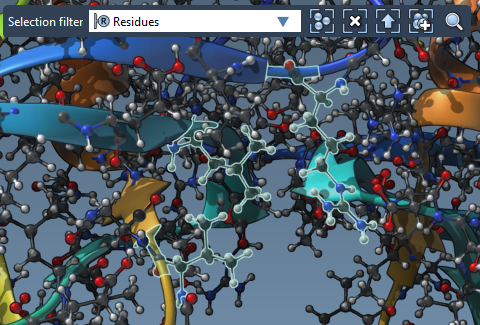
- In the Viewport, switch the Selection filter (top-left corner) to Residues and select residues by clicking directly on them. Use Ctrl or Alt to refine your selection.
- For ligands with known binding sites, select the ligand and use the menu Select > Biology > Binding sites. Define the selection parameters and confirm.
- Assign flexibility: After selecting residues, click Set in the receptor’s flexible side chains section. Green cylinders will appear in the Viewport, indicating rotatable bonds. Click these to toggle between rotatable (green) and non-rotatable (red).
Balancing Realism and Computation
Flexible side chains enhance docking realism but require more computational resources. Use discretion to focus flexibility on residues critical to ligand binding. In this way, you achieve an optimal balance between docking accuracy and computational efficiency. SAMSON’s tools for selecting residues and defining flexibility make this process straightforward.
Visual and Interactive Tools
Once flexible side chains are set, SAMSON makes it easy to visualize and adjust rotatable bonds. The green cylinders superimposed on bonds in the Viewport are interactive, allowing you to toggle bond flexibility with a simple click. This streamlined interactivity gives you precise control over your docking setup.
Next Steps
With flexible side chains set up, you can proceed with docking using the AutoDock Vina Extended extension. Analyze the resulting poses, inspect binding interactions, and refine your system as needed. To learn even more about docking with flexible receptors or to explore advanced features, visit the full documentation.
SAMSON and all SAMSON Extensions are free for non-commercial use. Get SAMSON here.