



For researchers working on molecular modeling and structural biology, understanding the structural dynamics of proteins is essential. One particularly relevant example is studying how the spike protein of SARS-CoV-2 transitions from a closed state to an open state. This transition enables the virus to bind to human cells, specifically through the Angiotensin-Converting Enzyme 2 (ACE2).
The SARS-CoV-2 spike protein plays a crucial role in viral entry into host cells, and its understanding can drive significant progress in drug and vaccine development. Let’s explore how this motion can be computed using SAMSON, an integrative molecular design platform, and how SAMSON’s modules streamline this workflow.
The Challenge: Modeling Protein Dynamics
Molecular modelers often face the challenge of accurately simulating intermediate states of a protein’s motion between experimentally known conformations. For SARS-CoV-2’s spike protein, these states include a closed form (PDB ID: 6VXX) and an open form (PDB ID: 6VYB), with differences in residues complicating the computational task. How can we computationally bridge the gap between these two states?
The SAMSON Workflow
SAMSON provides a step-by-step pipeline to address this issue and recreate a complete trajectory using its modules:
- Structural Preparation: The initial structures were post-processed to adjust the bond orders of sugar residues using a Python script. Hydrogen atoms were then added, followed by minimization steps to stabilize the structures.
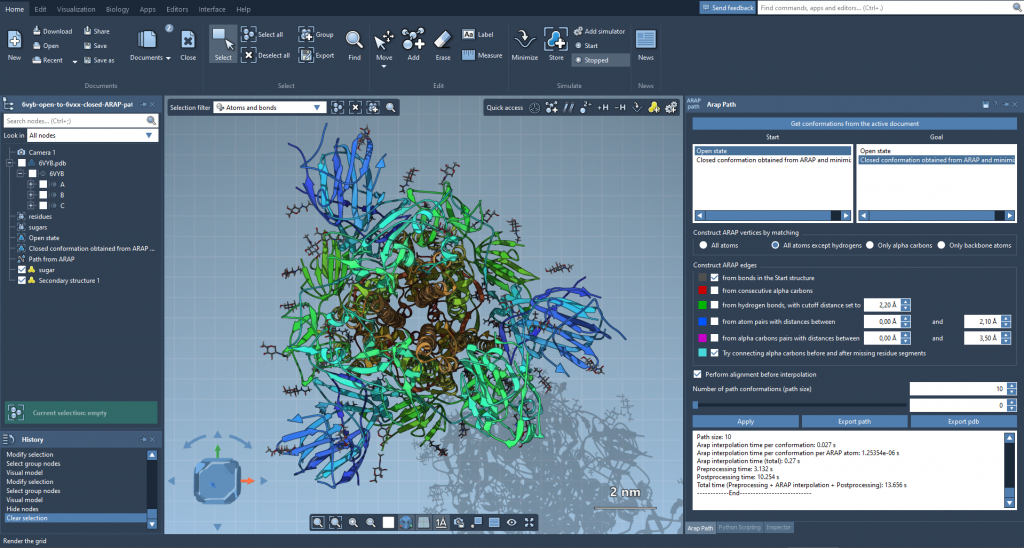
- Pathway Generation: The ARAP Interpolation Path Module was used to interpolate a motion path. This module computes a continuous transformation between two structural states. Starting with the open state as the initial conformation, the closed state was set as the goal.
- Handling Structural Differences: Since the closed and open states have different residue counts, adjustments were made to the closed state conformation obtained through ARAP for subsequent refinement.
- Pathway Optimization: The P-NEB (Parallel Nudged Elastic Band) Module was employed to optimize the interpolated path. This step enhances the physical relevance of the motion trajectory and ensures smoother transitions. The optimization process takes about 15 minutes on standard hardware.
Visualizing and Utilizing the Results
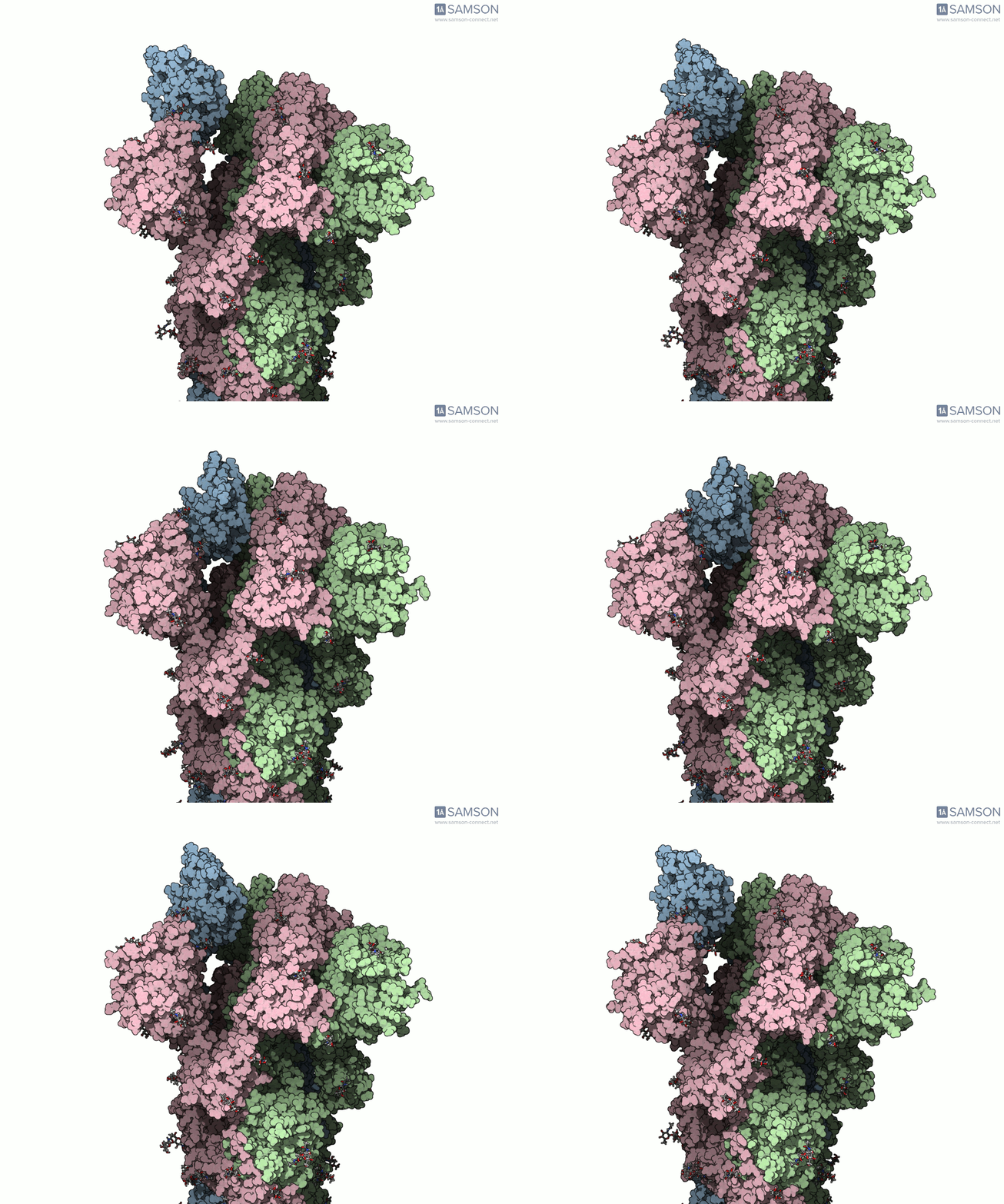
The computed trajectory can be downloaded in PDB and SAMSON-specific formats, making it accessible across different software workflows. Check out below an example visualization of the spike motion from closed to open state:
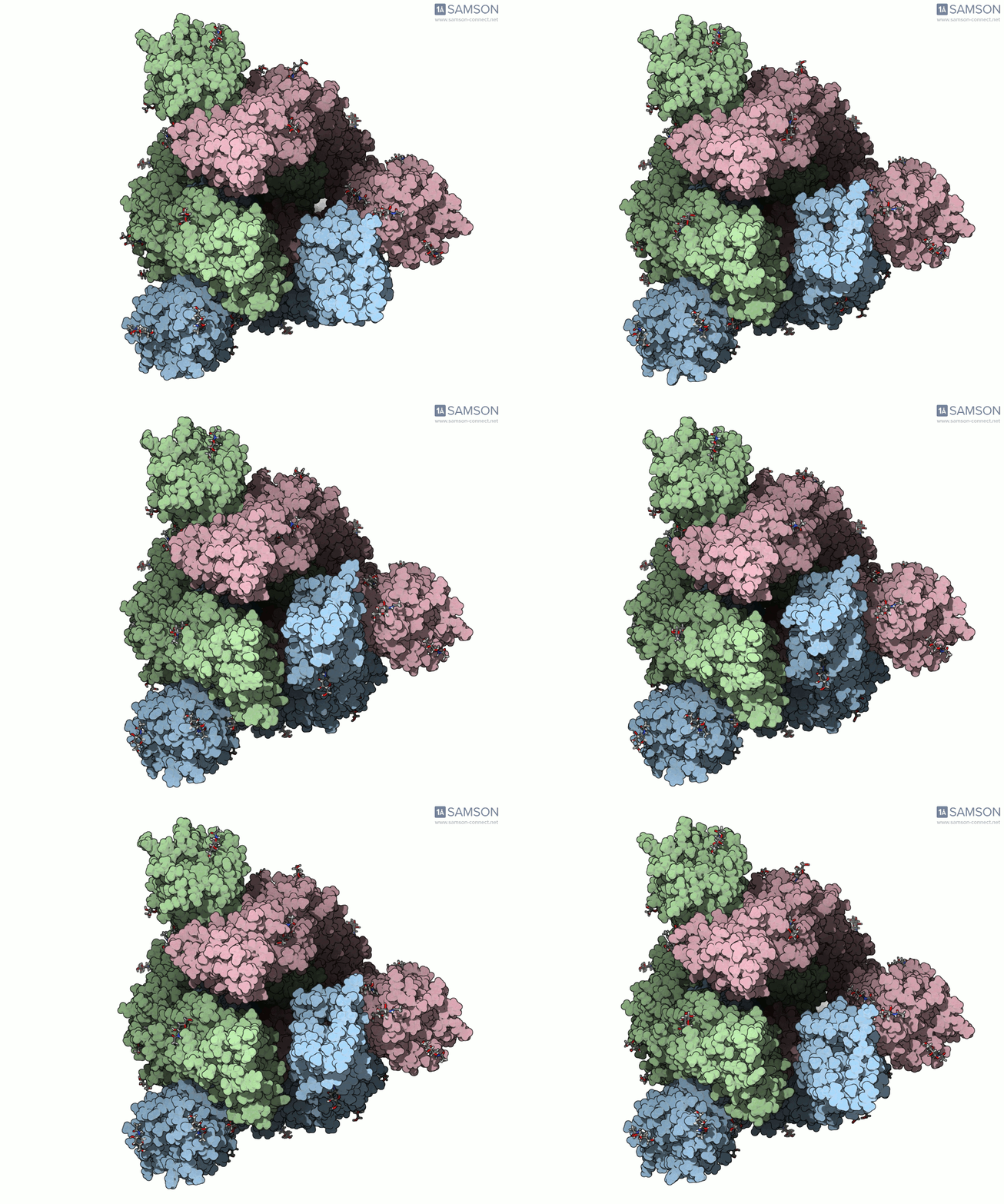
Additionally, an animated top view provides another perspective of the motion:
Applications of the Computation
The SARS-CoV-2 spike opening motion plays a pivotal role in receptor recognition and viral entry into human cells. Understanding this motion can provide insights into neutralizing antibody binding sites and assist with therapeutic design. While the trajectories generated using SAMSON modules are illustrative rather than experimentally verified, they can serve as a starting point for further validations and in-depth molecular studies.
Learn more about this workflow and explore the tools at this detailed documentation page.
SAMSON and all SAMSON Extensions are free for non-commercial use! Download SAMSON at SAMSON Connect.