



A common challenge faced by molecular modelers is monitoring the structural changes of molecules during simulations. Compaction, expansion, or large-scale shape changes can have significant impacts on molecular behavior. One useful tool to tackle this challenge is the Radius of Gyration, which measures the overall compactness of a molecule or group of atoms along a path or trajectory.
Why Monitor Radius of Gyration?
When simulating processes like folding, compaction, or swelling, understanding the level of compactness is crucial. The radius of gyration offers a straightforward metric to assess these transitions. By tracking this parameter, molecular modelers can gain insights into how molecules behave under different conditions, which is essential for protein folding studies, material science applications, and more.
How to Add a Radius of Gyration Plot in SAMSON
With SAMSON’s Path Analyzer, creating and visualizing a radius of gyration plot is simple. Follow these steps:
- Open the Path Analyzer module in SAMSON.
- Select Radius of gyration from the available observables.
- Choose the Path representing your trajectory.
- Define the Group of atoms you want to analyze.
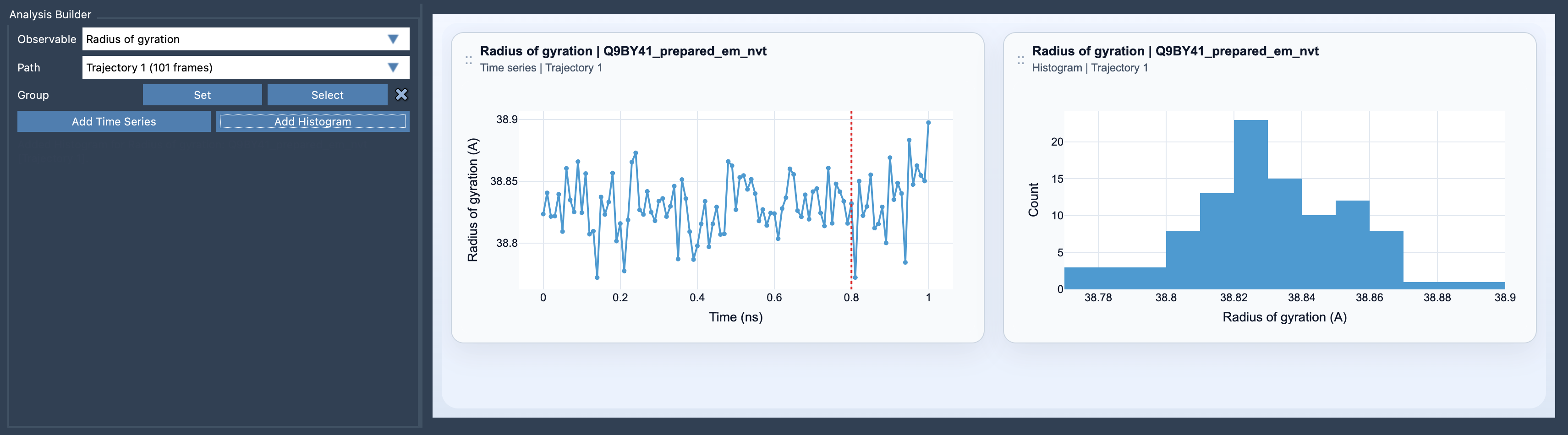
- Click on Add Time Series to generate a time-dependent plot or Add Histogram to explore the compactness distribution.
The tool outputs the radius of gyration in Angstroms (A), offering precision for interpreting structural changes.
Visualization Options
Radius of gyration visualizations can help in different ways:
- Time series: Offers a way to observe how compactness evolves along the path or trajectory.
- Histogram: Enables you to identify the preferred compactness range of the molecule or group being studied.
By coupling these visualization tools with other measurements like Asphericity or Shape Parameter, you can also analyze how the shape of the molecule changes. This adds a new layer of information beyond just monitoring compactness.
Tips for Effective Analysis
For a more nuanced understanding of molecular behavior, consider these tips:
- Start with the radius of gyration as your initial diagnostic for overall size and compactness.
- Explore complementary parameters like asphericity to examine shape changes during folding or swelling.
The radius of gyration is especially helpful for identifying key moments of conformational shifts, making it a versatile starting point for complex molecular studies.
If you are eager to dive deeper into how to leverage the radius of gyration functionality in SAMSON, check out the full documentation at this link. It provides comprehensive details on the feature and its settings.
SAMSON and all SAMSON Extensions are free for non-commercial use. Get started with SAMSON today by downloading it at this link.