



For molecular modelers, one key challenge is the ability to efficiently explore and modify molecular system topologies while relying on accurate physical simulations. The Interactive Modeling Universal Force Field (IM-UFF) offers a solution by extending the capabilities of the Universal Force Field (UFF) to support topological changes during a simulation.
The core advantage of IM-UFF lies in its ability to handle the dynamic creation and breaking of bonds, changes in bond orders, and atom typizations. This makes it ideal for workflows where molecular structures undergo significant transformations, offering flexibility not possible with static force fields. Here, we'll dive into how IM-UFF works and what you can do with it.
Why Use IM-UFF?
Unlike standard UFF, which assumes a fixed topology, IM-UFF is designed for interactive modeling. Imagine a scenario where you're building a molecular structure atom by atom, tweaking connections, or exploring how structural changes affect molecular stability and energy states—in IM-UFF, these scenarios can be seamlessly tackled in real time. It adapts automatically to the changing positions and connectivity of atoms, offering a fluid, hands-on approach to molecular modeling.
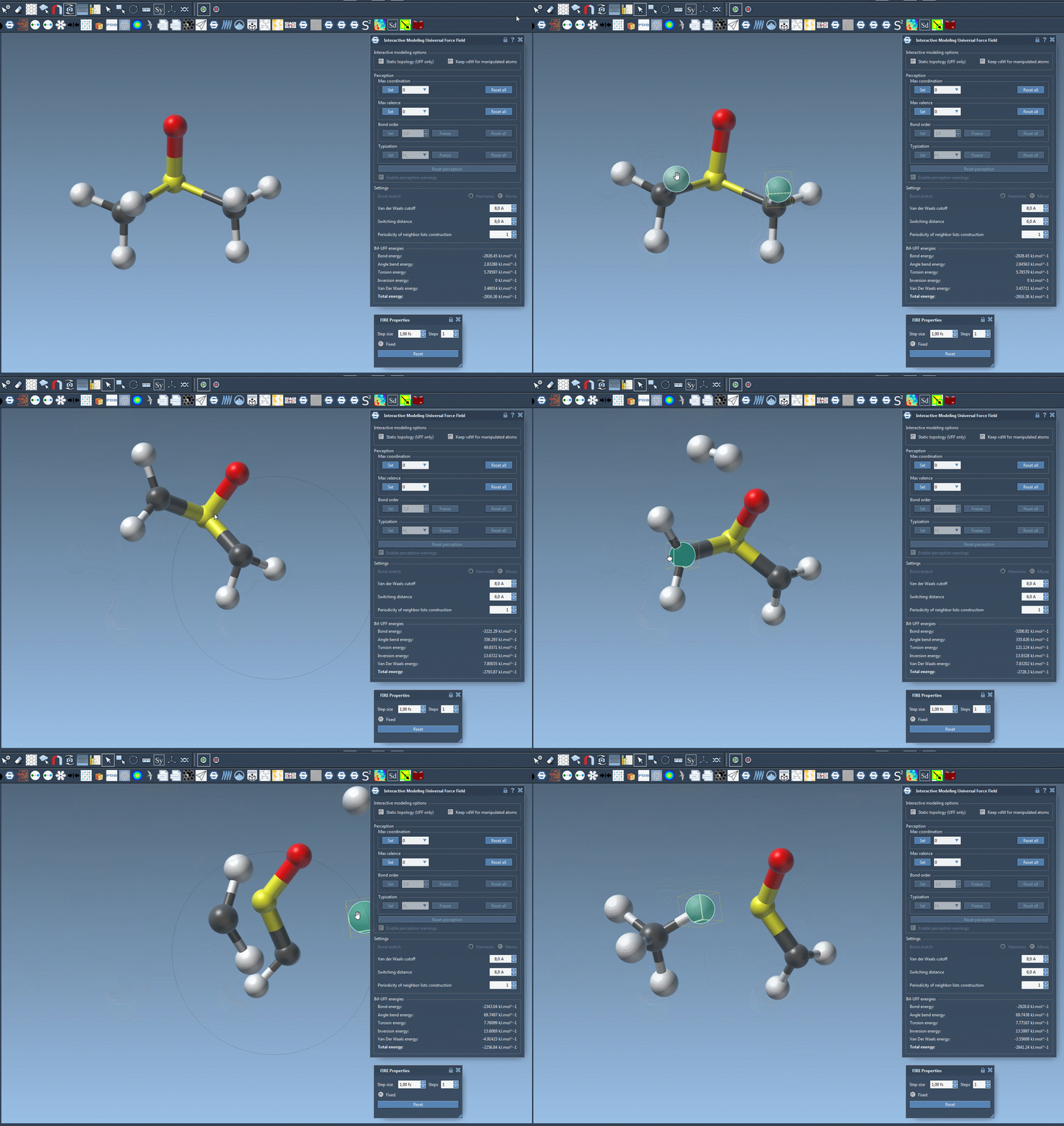
For instance, with IM-UFF, dragging an atom within a molecular system allows nearby bonds to break or form, depending on the proximity and forces involved. This lets the topology naturally adjust to reach a realistic representation of the system, guided by well-defined atomic interactions.
Getting Started with IM-UFF
Using IM-UFF in SAMSON is straightforward:
- Start by opening a molecular structure in SAMSON.
- Add a simulator using
Edit > Simulate > Add simulatoror via the shortcut (Ctrl + Shift + M on Windows/Linux, and Cmd + Shift + M on macOS). - Choose Interactive Modeling Universal Force Field from the list of available interaction models.
- Enable the desired state updater for running simulations—e.g., the FIRE (Fast Inertial Relaxation Engine).
- Start the simulation via
Edit > Simulate > Start.
The IM-UFF interface includes options to toggle between static (UFF) and dynamic (IM-UFF) topologies. This flexibility ensures you can directly compare results or switch settings based on your simulation needs. For example, unchecking the Static Topology option activates IM-UFF, allowing bond creation and breaking based on atomic movements.
Manipulations Made Easier
IM-UFF also introduces a unique option called Keep vdW for manipulated, which governs Van der Waals (vdW) interactions for manipulated atoms. If this setting is checked, all vdW interactions are calculated, enabling more precise modeling. When unchecked, vdW interactions for manipulated atoms are skipped, simplifying the manual connection of new bonds.
Customizing Parameters
IM-UFF offers customization options, such as setting vdW cutoff distances and adjusting automatic typization parameters. These options allow users to fine-tune how molecules interact and evolve during a simulation. Notably, while running IM-UFF, typization and bond orders are dynamically calculated, enabling smooth transitions between different molecular topologies.
Energy Feedback
As the simulation runs, the IM-UFF parameter window displays the system's energy state, broken down by individual energy terms. This real-time feedback is invaluable for understanding how modifications affect molecular stability. For example, pushing atoms closer together may trigger bond formations, with the energy states adjusting to reflect the new topology.
When to Use IM-UFF
IM-UFF is particularly valuable for applications like molecular assembly, structural editing, and dynamic simulations involving significant topological rearrangements. Its flexibility and ease of use make it an essential tool for researchers looking to explore molecular dynamics while maintaining realistic, physically accurate interactions.
For detailed steps and advanced configurations, visit the IM-UFF documentation.
Note: SAMSON and all SAMSON Extensions are free for non-commercial use. Get SAMSON for free at https://www.samson-connect.net.