



Protein modeling often requires validating and refining protein backbone conformations, especially when predicting structures or preparing them for simulations. One critical tool for molecular modelers is the Ramachandran plot, which offers insights into conformational preferences based on the backbone dihedral angles φ (phi) and ψ (psi). If your work involves optimizing structures or identifying strained residues in models, the Interactive Ramachandran Plot in SAMSON is an essential resource.
The Pain of Misplaced Residues
When preparing proteins for molecular simulations, misplaced or sterically unfavored residues can drastically impact energy minimizations, docking outcomes, and simulation accuracy. Detecting and correcting these residues used to be tedious—analyzing lists of data to manually correct angles or spotting errors one by one in 3D views. However, SAMSON’s Interactive Ramachandran Plot merges visualization, editing, and validation to streamline the process, providing both clarity and simplicity.
Introducing the Interactive Ramachandran Plot
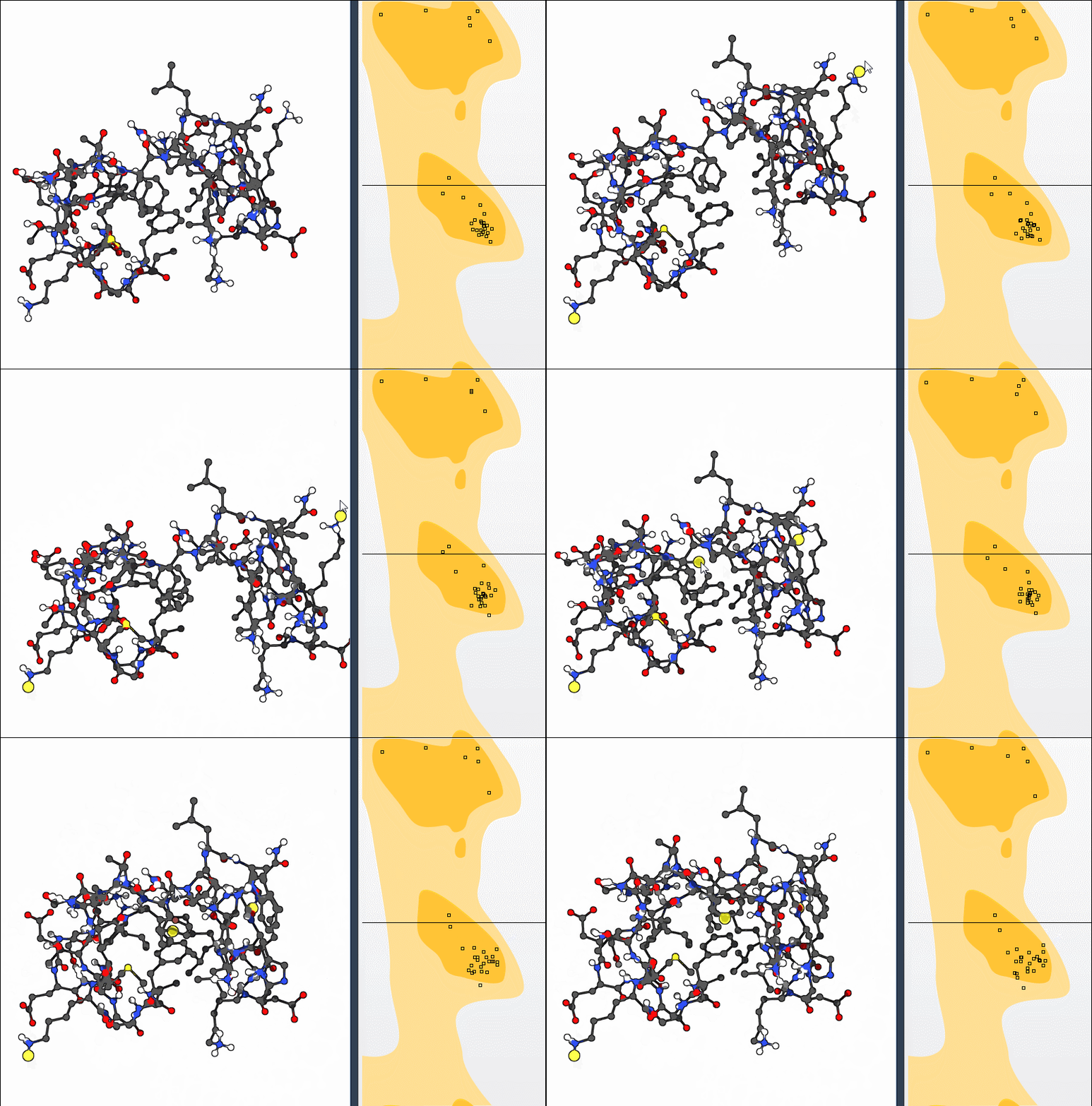
The Interactive Ramachandran Plot Extension in SAMSON allows molecular modelers to inspect and edit protein conformations dynamically. The tool visually maps residues to energetically favorable and unfavorable regions:
- Yellow areas: Energetically favorable regions for backbone dihedral angles.
- White areas: Sterically disallowed or strained conformations.
Simply click on any residue in the plot to highlight it in the 3D molecular viewer and observe its φ and ψ angles in real time. This makes it straightforward to detect, validate, and address outliers.
Transforming Visual Analysis into Action
What sets SAMSON’s tool apart is not just its visualization features but also its interactive capabilities. Below are two key ways you can modify backbone conformations directly:
Option 1: Dragging Points
- Select a point (representing a residue) directly in the Ramachandran plot.
- Drag it to a more favorable region. The protein’s 3D representation updates dynamically to reflect these changes.
- If you’re unhappy with the results, undo your action instantly with Ctrl/Cmd + Z.
Option 2: Twister Editor
For an alternate approach, leverage the Twister editor. This editor allows you to adjust residue-specific dihedral angles directly in SAMSON’s 3D molecular workspace. As you twist the protein’s backbone, the Ramachandran plot updates in real time, showing the exact impact of your edits on the residue’s position in the conformational map.
A Unified Framework for Refinement
The Interactive Ramachandran Plot simplifies protein structure refinement by integrating global and local insights. For example, after computing nonlinear normal modes to explore large-scale conformational movements, users can refine specific residues to ensure that all are in favorable regions. This combination of global exploration and local precision is powerful for molecular design and simulation readiness.
Stepping Forward in Protein Modeling
SAMSON’s Interactive Ramachandran Plot significantly shortens the time required to validate and refine protein backbone conformations. Whether you are fine-tuning homology models or inspecting active site flexibility, this tool provides an efficient, intuitive solution for bringing molecular designs closer to reality.
To dive deeper into how the Interactive Ramachandran Plot works and its broader applications, visit the full documentation page.
Note: SAMSON and all SAMSON Extensions are free for non-commercial use. Download SAMSON at https://www.samson-connect.net.