



If you’re a molecular modeler working with crystals, you’ve probably encountered this tricky challenge: intuitively understanding how small-scale atomic defects can impact the structure and properties of a material. This can be especially frustrating when everything looks fine in the model, but your simulations produce unexpected results.
Luckily, if you’re using the Crystal Creator Extension in SAMSON, there’s a practical way to visualize and explore defects in crystal structures. In this post, we’ll walk through a hands-on example: introducing an atomic defect in a diamond crystal and observing the structural consequences.
What’s the problem with perfect crystals?
In reality, materials are far from perfect. Crystals often contain defects such as missing atoms, substitutions, or dislocations that significantly influence properties like hardness, conductivity, and strength. Perfect structures in simulations might not always reflect this complexity, which makes adding and analyzing defects an important step in predictive modeling.
Getting Started: Load a Diamond Crystal
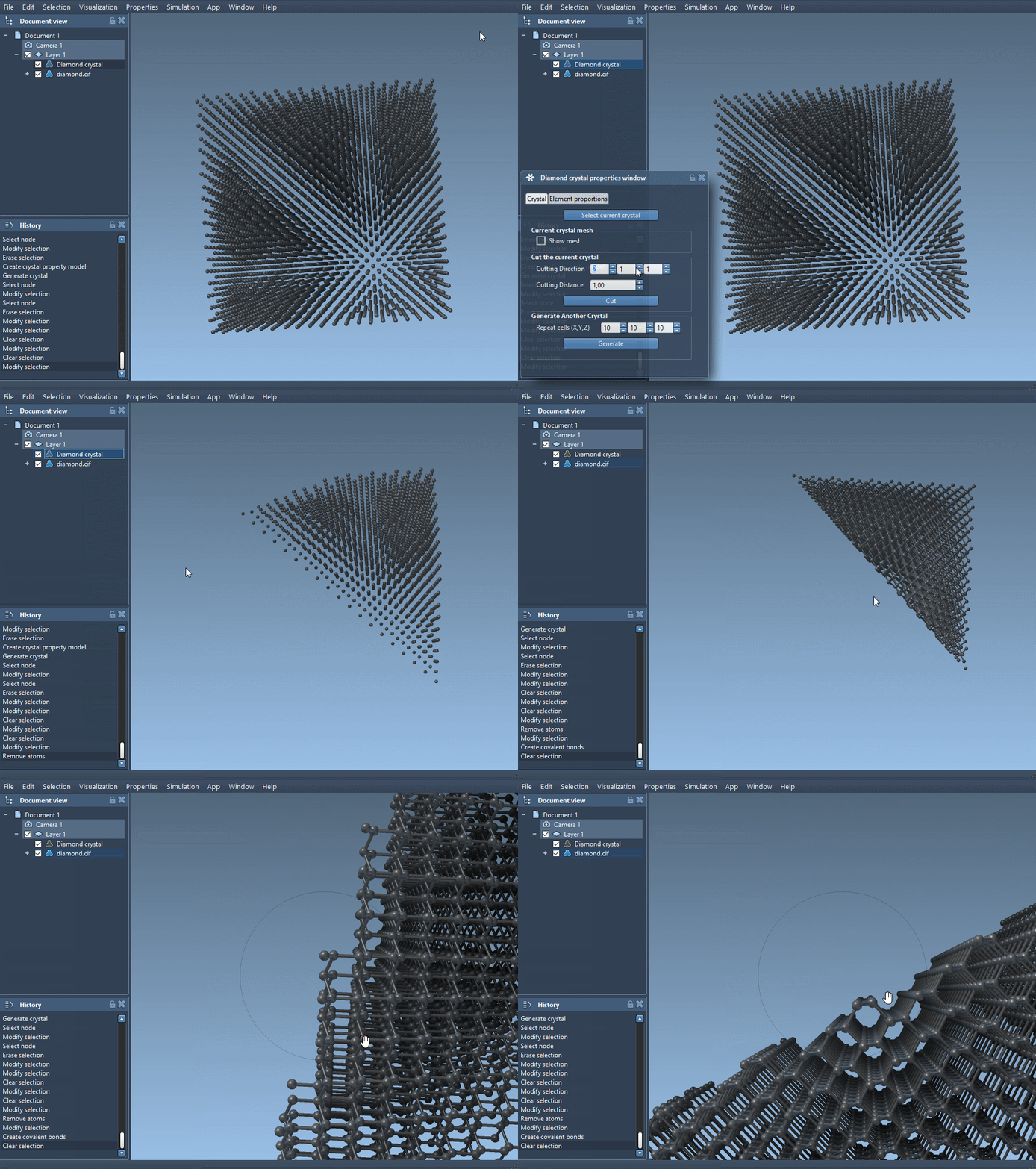
Start by opening a diamond CIF file (e.g., from the RRUFF database) using the Crystal Creator Extension in SAMSON. Once loaded, use the software’s tools to generate the bonds and visualize the diamond’s characteristic tetrahedral structure.
After loading the file, minimize its structure using the Brenner interaction model. This helps stabilize the model and reveal how the ideal diamond lattice behaves under force field constraints.
Introducing a Defect
Now, let’s add a single-point defect representing a slight probability that an atom is missing. Open a copy of your CIF file in a text editor.
Find the section starting with:
|
1 2 3 4 5 6 |
loop_ _atom_site_label _atom_site_fract_x _atom_site_fract_y _atom_site_fract_z C 0.00000 0.00000 0.00000 |
Replace it with this instead:
|
1 2 3 4 5 6 7 |
loop_ _atom_site_label _atom_site_fract_x _atom_site_fract_y _atom_site_fract_z _atom_site_occupancy C 0.00000 0.00000 0.00000 0.95 |
This simple addition—changing occupancy to 0.95—means that this carbon atom has a 95% chance of being present, simulating a lattice defect.
Reload and Compare
Load this modified CIF file back into SAMSON and generate the bonds again. Visually compare the structure to the previous pristine model. You may notice that even a small change in an atom’s presence affects surrounding bonds and the overall symmetry of the crystal.
This tool is especially useful not only for visualizing but also for preparing more realistic crystal models for simulation. Many file formats ignore defects—and that oversight can cost you simulation accuracy.
Why This Matters
Simulating real-world materials means accounting for their imperfections. Whether you’re designing new materials, studying catalysis, or exploring electronic properties, defects play a critical role. SAMSON makes it feasible to introduce these atomic-scale variations and see their impact instantly.
This kind of experimentation helps bridge the gap between theoretical models and the often messy reality of lab samples. Including defects can improve the quality of your predictions and trigger new questions that lead to useful discoveries.
To explore these capabilities in more detail, consult the full documentation: Crystal Creator – Generating Crystal Models.
SAMSON and all SAMSON Extensions are free for non-commercial use. You can download SAMSON here.