



Chemists, materials scientists, and molecular modelers often need to inspect atomic-level structures along specific crystallographic directions. Have you ever struggled with visualizing the atomic arrangement of crystals in a certain orientation, especially when exploring properties like anisotropy? Fortunately, SAMSON’s Crystal Creator Extension provides a simple and interactive way to cut crystals along Miller indices and analyze structural features with precision.
In this post, we’ll show you how to manipulate and cut a crystal—specifically a diamond structure—using Crystal Creator. This can be particularly valuable when studying surface geometries or visual properties for education and communication.
Why Cut a Crystal?
Understanding how atoms are arranged along different crystal axes is key to insights such as:
- Interpreting X-ray diffraction patterns
- Simulating surface properties
- Exploring slip planes in materials science
By cutting the crystal along specific planes, such as the [111] direction in diamond, you reveal symmetrical views—like the compact hexagonal structure—that aren’t always obvious from the full unit cell.
Step-by-Step: Cutting a Diamond Along [111]
To follow along, you need the Crystal Creator Extension. If it’s not installed yet, simply log in to SAMSON Connect and add it from the marketplace.
- Download a CIF file for the diamond crystal from the RRUFF Project Database.
- Open the CIF file in SAMSON using File > Open or drag-and-drop.
- From the data graph, right-click on the crystal’s property model and choose Properties.
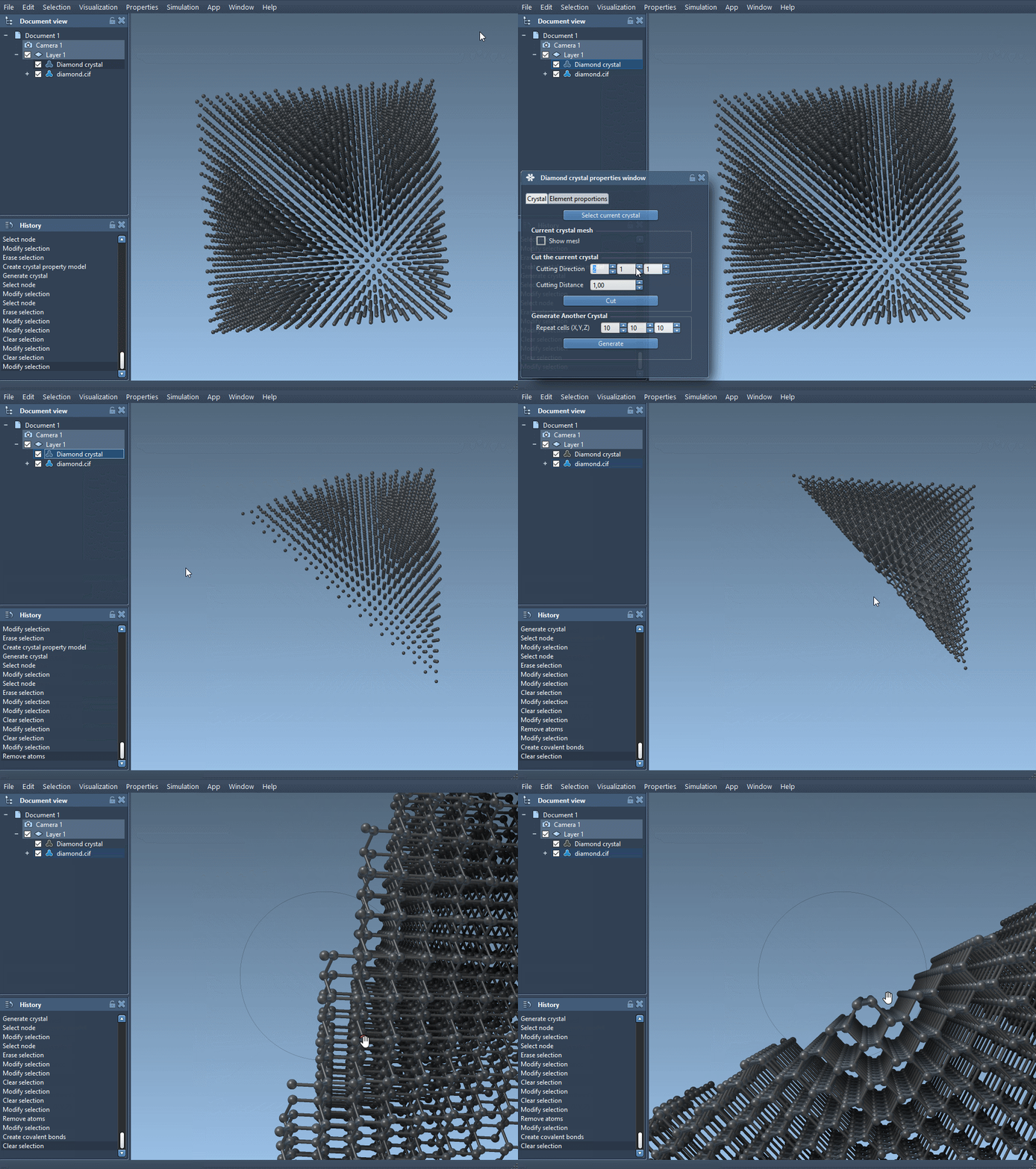
- In the first tab of the property window, locate the crystal cutting tools:
- Set the cutting direction using Miller indices, e.g.,
[111]. - Control the cut’s position using the 4th box (cutting distance).
- Enable the mesh display if needed, then click to apply the cut.
The result is an immediate visual update showing the crystal sliced along [111], revealing a tightly packed hexagonal structure—just as expected for diamonds.
What Else Can You Do?
If you’re working with crystals that contain defects or substitutions (often described directly in CIF files), you can use the second tab of the Property Window to:
- Verify presence/absence ratios at atom sites
- Ensure that statistically modeled features (e.g., vacancies) are respected
This type of validation becomes especially useful in materials defect analysis and helps ensure realistic simulations.
Summary
The ability to cut molecular crystals in specific directions brings a clearer understanding to complex structures and supports both visualization and analysis tasks. Whether you’re teaching symmetry, modeling surface behavior, or preparing input for simulations, this simple but powerful tool in SAMSON accelerates the workflow.
To learn more and see other examples (like how to create your own crystals or simulate defects), visit the full documentation page: https://documentation.samson-connect.net/tutorials/crystal-creator/generating-crystal-models/
SAMSON and all SAMSON Extensions are free for non-commercial use. You can download SAMSON from https://www.samson-connect.net.