



A common frustration in molecular modeling is having two structures that represent the states you care about, but do not line up as ready-made endpoints for a transition-path calculation. The structures may differ in residue count, and a path generated from one structure may not directly describe the other. The SARS-CoV-2 spike example offers a useful way to think through that problem: treat the endpoint mismatch as part of the workflow, not as a detail to ignore.
Start with the biological question
The spike protein can adopt a closed, or “down,” state and an open, or “up,” state. Opening exposes the receptor-binding region, allowing it to recognize ACE2. The motion is therefore more than a visual change: it connects structural states with a biological function. The animation below shows the computed opening and closing motion from the side.
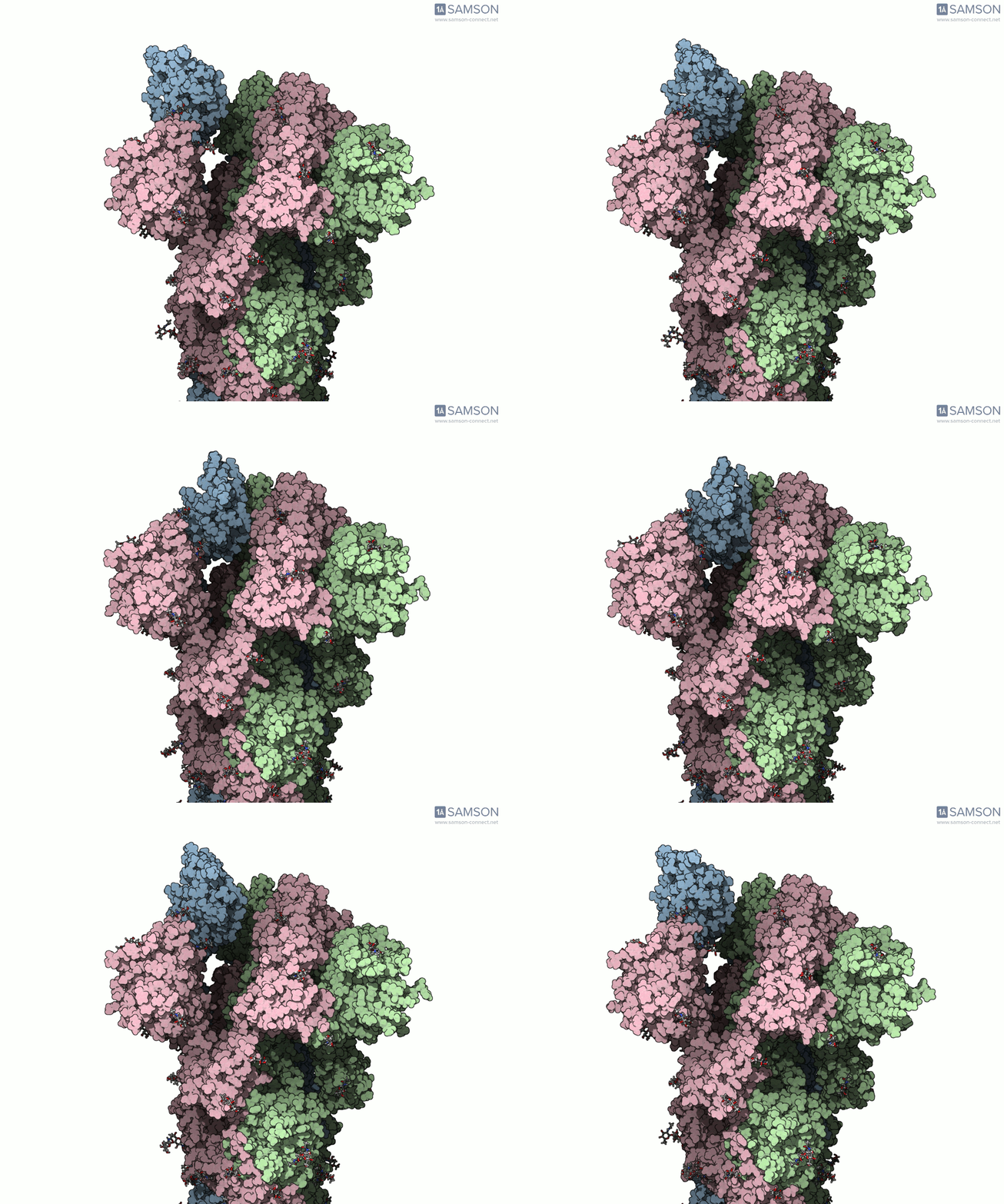
For the example, the closed structure is PDB 6VXX and the open structure is PDB 6VYB. These are experimentally determined structures, but the trajectory between them is a computational example—not an experimentally verified movie of the protein’s actual motion.
Why different residue counts matter
A path method needs a consistent molecular representation to move between conformations. Here, 6VXX and 6VYB differ in the number of residues, so simply asking for a path between the two structures would not provide a like-for-like transition for every atom. The workflow handles this by first generating a path with the open structure as the starting conformation and the closed structure as the goal. Because that path corresponds to the starting structure, the authors then take a closed-like conformation from the path and minimize it. This creates a closed endpoint represented by the open-state structure, which can be used as a compatible goal for another path calculation.
The practical lesson is to check endpoint compatibility before interpreting a trajectory. If the structures differ, identify what the path method actually moves, and be explicit about which structure supplies the atoms in the resulting path. The intermediate closed-like conformation is not a replacement for the original experimental structure; it is a computationally prepared endpoint for the next stage.
A staged workflow: prepare, interpolate, refine
- Prepare both structures. The example adjusts bond orders in the sugars with a Python script, then adds hydrogens and performs minimization. Correct bond orders are needed before adding hydrogens in this workflow.
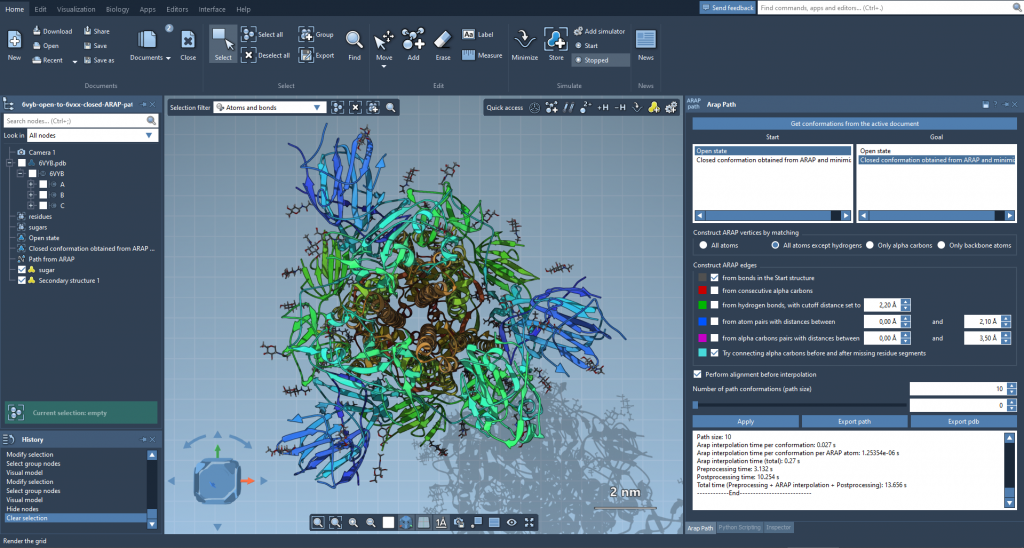
- Generate an initial path. The ARAP Interpolation Path module creates an interpolated path between the selected conformations. In the documented first calculation, the open state is the starting structure and the closed state is the goal. The path was generated in less than half a minute on a laptop.
- Make a compatible endpoint. A closed-like conformation is taken from the initial path and minimized. The path calculation is then repeated using this prepared conformation as the goal.
- Refine the path. The P-NEB (Parallel Nudged Elastic Band) module is used to improve the path. This step took about 15 minutes on a laptop in the example.

Use the trajectory with appropriate caution
The downloadable files include a set of PDB trajectory files, a single PDB file containing the trajectory, and a SAMSON-format file. The SAMSON file includes the spike structure, open and closed conformations, and paths from ARAP and P-NEB. It can be useful for inspecting the conformations and animation in the software, while the PDB options may suit other tools in your workflow.
These trajectories are provided as-is and have not been experimentally verified. Treat them as illustrative computational paths, not as proof that the protein follows this exact sequence of structures. Before using a path for further calculations, assess whether its preparation, assumptions, and level of validation meet the needs of your specific study; additional processing or validation may be necessary.
The broader takeaway for modelers is simple: a transition path is a result of both the path algorithm and the choices made to prepare its endpoints. When endpoint structures are not directly compatible, document how you created a compatible representation, distinguish interpolation from refinement, and keep the limits of the resulting trajectory visible to anyone who uses it.
Explore the original spike-opening walkthrough to learn more.
Note: SAMSON and all SAMSON Extensions are free for non-commercial use. Get SAMSON.