



A common challenge in molecular modeling is turning two known protein structures into a useful picture of the motion between them. The endpoints may be available, but they are not necessarily identical in composition or residue count. A simple interpolation can therefore be more complicated than it first appears—and the resulting path should not automatically be treated as an experimentally verified mechanism.
The SARS-CoV-2 spike provides a clear example. Its closed, or down, conformation is represented by PDB structure 6VXX, while its open, or up, conformation is represented by 6VYB. The open state exposes the receptor-binding region so it can recognize ACE2. Comparing these endpoint structures is useful, but seeing a plausible transition between them helps make the structural change easier to explore.
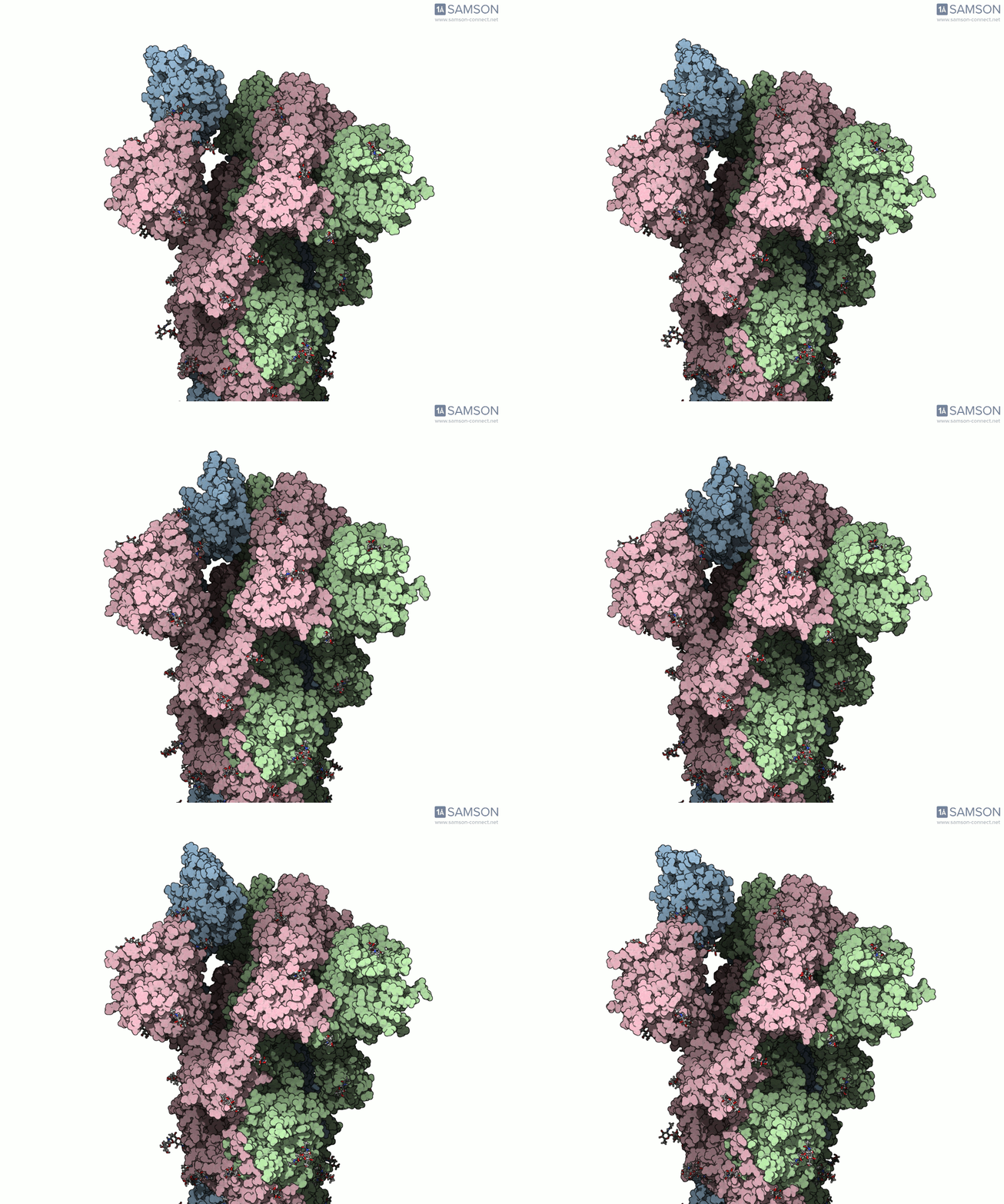
Why matching endpoints matters
In this example, 6VXX and 6VYB differ in their number of residues. That mismatch matters because an interpolation path is generated for the structure used as its starting conformation. If the endpoint structures do not contain the same residues, the path produced from one structure may not directly represent the other endpoint in the way you need.
The workflow addresses this by first preparing both structures, then using the intermediate result to create a compatible closed-state conformation. This is a practical reminder for anyone building a transition path: inspect and prepare the endpoint structures before interpreting the animation. Differences in residue content, missing atoms, or chemical details can affect what the calculation represents.
The workflow, in plain language
- Prepare the structures. The sugar bond orders in both structures were adjusted with a Python script and SAMSON’s Python scripting module. This was needed before adding hydrogens. Hydrogens were then added to both structures, followed by minimization steps.
- Generate an initial path. The ARAP Interpolation Path module was used to interpolate between the two states. In the documented setup, the open structure (6VYB) was the starting conformation and the closed structure (6VXX) was the goal. The path is therefore generated for the starting structure.
- Address the residue-count difference. A closed-state conformation was taken from the initial path, which corresponds to the open-state structure, and minimized. This provided a closed-state goal conformation compatible with the structure used for the path.
- Refine the path. The interpolation was performed again using that newly obtained closed-state conformation as the goal. The P-NEB (Parallel Nudged Elastic Band) module was then used to improve the path. The documented example reports less than half a minute for the ARAP path generation and about 15 minutes for P-NEB on a laptop.
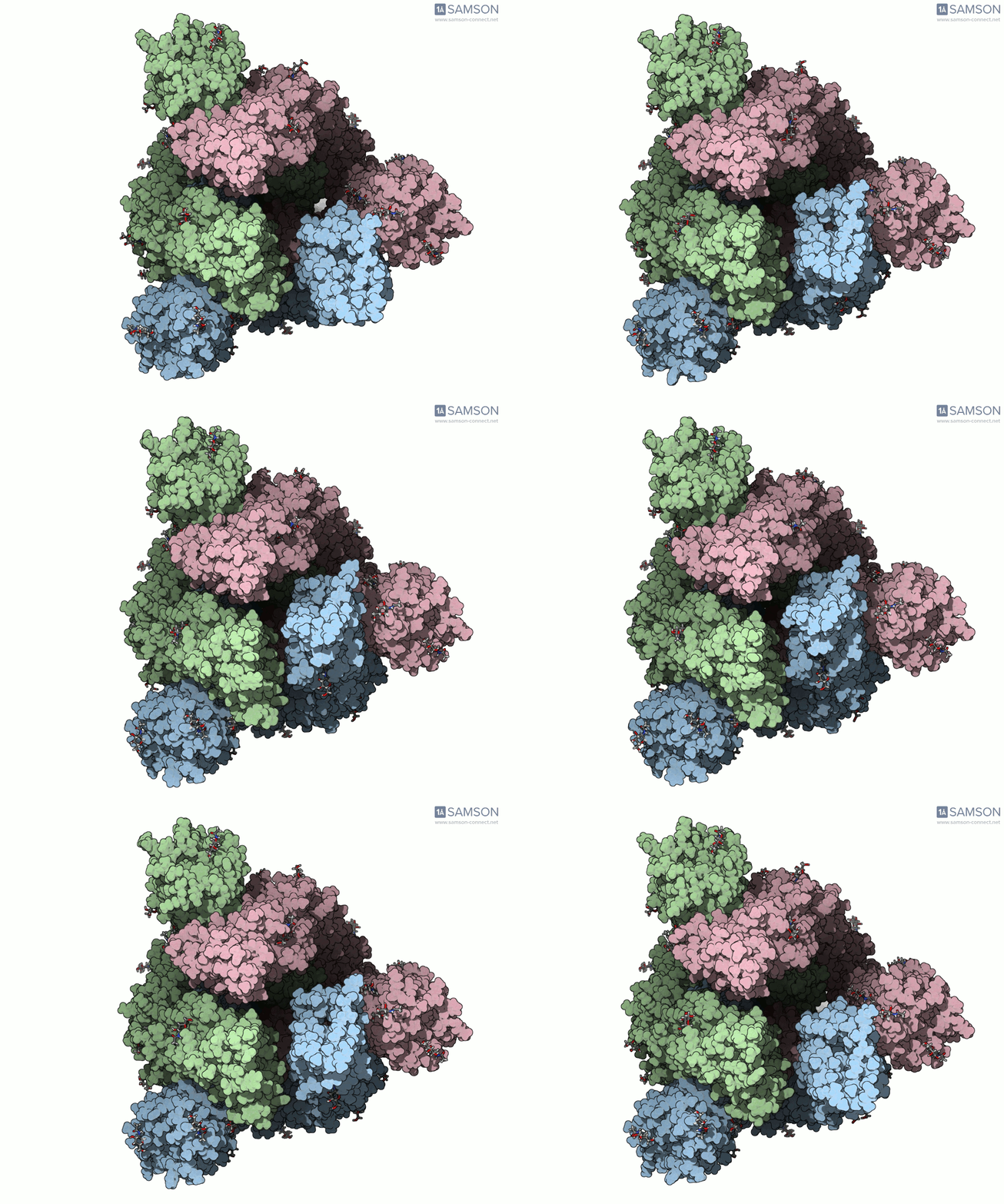
Explore the result—and keep its limits in view
The computed trajectory is available as a set of PDB trajectory files, a single PDB trajectory file, or a SAMSON-format file. The SAMSON file includes the spike structure, open and closed conformations, and paths associated with ARAP and P-NEB. These files can help you inspect the motion or use it as a starting point for further calculations.
However, the trajectory is provided as is and has not been experimentally verified. Treat it as an illustrative computed path, not as proof that the protein follows precisely this route in nature. Depending on your research question, further processing and validation may be needed before using it in additional calculations.
The broader lesson is simple: a transition path depends on both the method and the structures supplied to it. Preprocessing, endpoint compatibility, and careful interpretation are part of the modeling workflow—not details to skip once an animation looks convincing.
For the full explanation, trajectory downloads, and module links, visit the original spike-opening tutorial.
Note: SAMSON and all SAMSON Extensions are free for non-commercial use. Get SAMSON at samson-connect.net.