



Symmetry plays a crucial role in molecular modeling and design, offering insights into both structure and function. For molecular modelers working on complex biological assemblies like proteins, viral capsids, and nanoparticles, symmetry detection isn’t merely an aesthetic pursuit—it’s a practical tool that can significantly streamline workflows and enhance outcomes. But why exactly should one focus on detecting symmetry?
Key Benefits of Symmetry Detection
Here are some practical reasons why incorporating symmetry detection into your molecular modeling tasks can make a difference:
- Identify functional interfaces: Repeating structural patterns often hint at functional interfaces that occur across multiple symmetric units. Detecting symmetry helps in pinpointing these sites with higher precision.
- Validate experimental structures: For researchers working with cryo-EM or X-ray crystallography data, comparing the detected symmetry elements against expected patterns is a fast way to validate or refine complex structures.
- Reduce computational cost: Symmetry allows modelers to focus simulations on a unique asymmetric unit, bypassing the need to simulate the entire assembly. This streamlining can lead to substantial computational savings.
- Guide molecular design: Whether you’re engineering nanomaterials or exploring mutagenesis targets in protein design, symmetry provides an essential framework for leveraging natural patterns to achieve innovative designs.
Real-World Example: Icosahedral Capsid
To visualize the importance of symmetry, consider the icosahedral capsid structure with PDB entry 3NQ4. With the Symmetry Detection extension in SAMSON, you can detect the full icosahedral symmetry and map all 2-, 3-, and 5-fold axes of the capsid. Here’s why this matters:
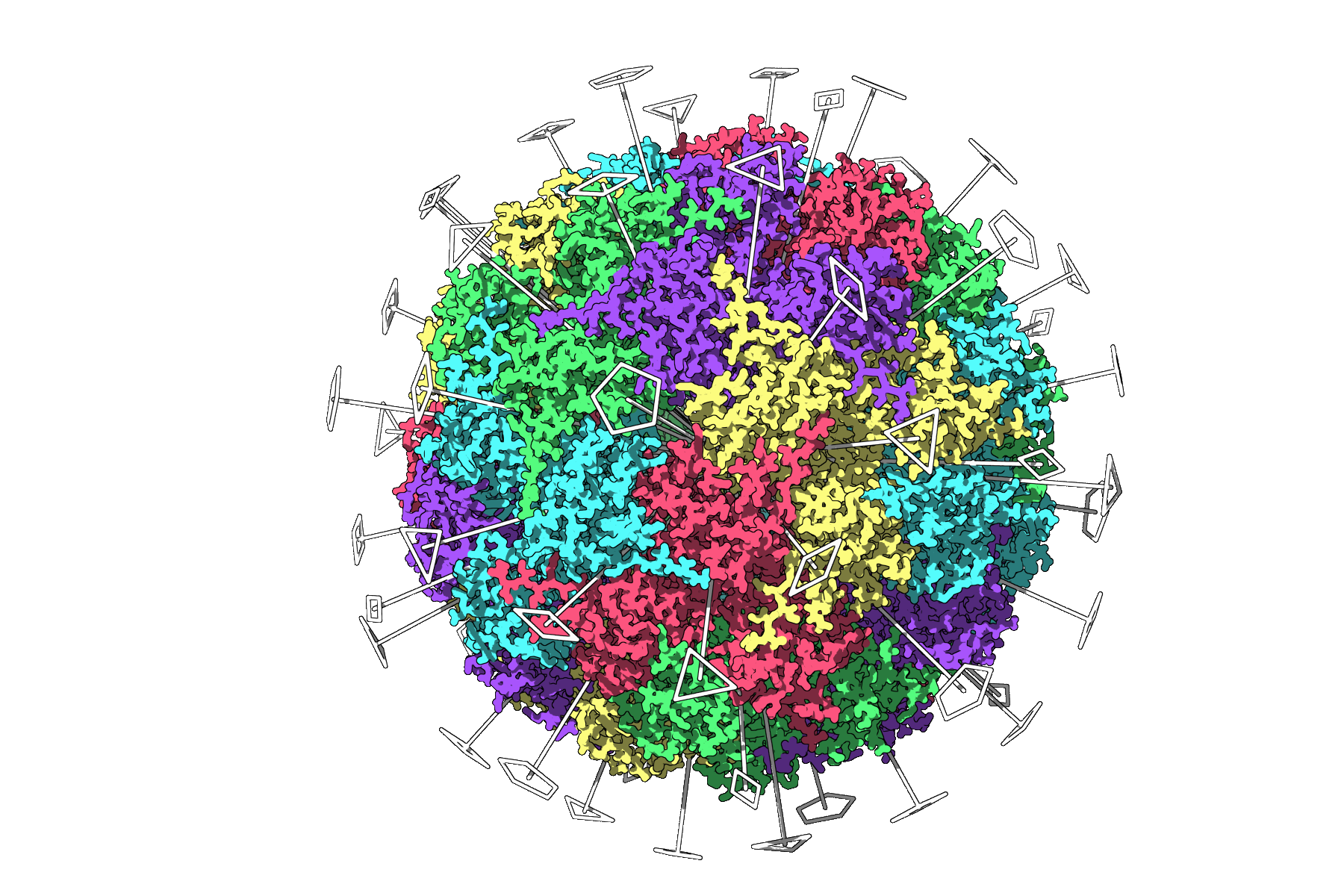
With symmetry mapped, you can select a unique asymmetric unit and limit heavy computational simulations to just that portion of the capsid. Whether you’re working on docking, dynamics, or ligand design, this approach can save time and computational power. Plus, the axes visualizations provide an intuitive representation of the structure.
How to Get Started
If you’re intrigued by the potential of symmetry detection and its applications, the SAMSON platform makes it easy to dive in. Begin by:
- Installing the Symmetry Detection Extension through SAMSON Connect.
- Opening a biological assembly in SAMSON, such as
3NQ4,1CHP, or1B4B. - Launching the extension from the SAMSON interface and clicking “Compute symmetry.”
- Reviewing the detected symmetry groups and axes to identify the ones relevant to your modeling task.
The workflow is designed for simplicity, yet it offers powerful tools like RMSD scoring to evaluate and refine detected symmetry groups. From validating experimental discoveries to designing symmetric nanostructures, users can adapt the methodology to their specific needs.
Conclusion
Symmetry detection isn’t just about finding patterns—it’s about leveraging those patterns to drive efficiency, validate designs, and open up new creative possibilities in molecular modeling. Whether you’re working with capsids, large protein assemblies, or novel nanomaterials, symmetry detection offers an invaluable strategic edge. To learn more, visit the full tutorial at this documentation page.
SAMSON and all SAMSON Extensions are free for non-commercial use. You can get SAMSON at https://www.samson-connect.net.