



In molecular modeling, one often underestimated yet critical step is to minimize ligands before initiating docking studies. If you’re tackling protein-ligand docking tasks with tools such as AutoDock Vina Extended in SAMSON, understanding why and how to prepare your ligands appropriately can make or break the accuracy of your docking results. Here’s more about how you can ensure you set up ligands correctly—minimizing errors and optimizing outcomes.
Why Is Minimization Essential?
For many ligand libraries, provided structures may not be optimized, especially if they are 2D molecular representations rather than 3D. These unoptimized structures may carry incorrect geometries, strained bonds, or unfavored conformations resulting in inaccurate docking results. Minimizing the ligands ensures their geometry is more realistic, allowing docking software to produce more meaningful and biologically plausible ligand-receptor binding poses.
Moreover, minimization is particularly necessary when ligands lack hydrogens, which are essential for accurately detecting hydrogen bonds (H-bonds) and bond types during docking. SAMSON’s AutoDock Vina Extended makes this process straightforward and integrated.
How to Perform Ligand Minimization in SAMSON
SAMSON provides a simple, user-friendly method for minimizing ligands before docking. The following steps outline how to leverage the tools embedded in AutoDock Vina Extended to optimize your workflow:
- After loading your ligand or ligand library in SAMSON, locate the “Minimize” option in the interface.
- Enable the “Minimize” checkbox. If necessary, also enable the Add missing hydrogens checkbox to ensure hydrogens are present in your ligands.
- Select a minimization preset that determines the maximum number of minimization steps and stopping criteria. Presets ensure that the ligand achieves an optimal structure quickly and efficiently without requiring user intervention.

The minimization process considers critical energy thresholds and halts when either the difference in energy converges between steps or the maximum number of steps is reached, ensuring a balanced computational effort. The software’s built-in algorithms take care of these adjustments for you!
Other Tips For Successful Ligand Preparation
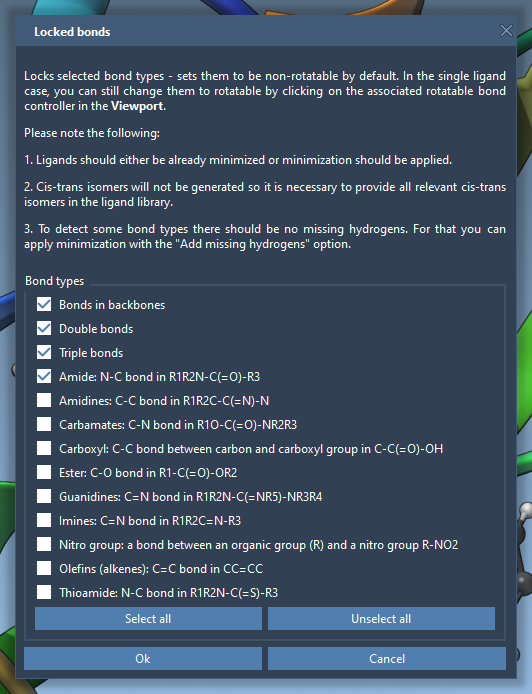
- Address bond rotatability: In SAMSON, you can control which bonds in the ligands are set as rotatable or fixed. Balancing flexibility while reducing unnecessary degrees of freedom is key to reducing docking runtime and improving accuracy.
- Lock specific bonds: Appropriately locking specific bond types helps manage ligand conformational space effectively, especially when dealing with large libraries. SAMSON allows easy toggling of rotatable bonds via its user interface.
Streamline Your Docking Workflow
Minimizing ligands before docking is straightforward yet imperative for ensuring that docking predictions are biologically meaningful. By tapping into the tools offered by SAMSON and AutoDock Vina Extended, you can easily integrate this critical step into your workflow without over-complicating the process. Proper ligand preparation not only ensures more reliable docking outcomes but also saves time during subsequent stages of analysis.
For more detailed guidance on integrating ligand minimization into your docking setup, visit the full tutorial here.
*Note: SAMSON and all SAMSON Extensions are free for non-commercial use. You can get SAMSON at https://www.samson-connect.net.