



If you’ve ever imported a crystal structure and wondered why it doesn’t reveal the atomic layout you expected, you’re not alone. Many molecular modelers load a crystal, spin it around a few times, and still struggle to see the packing or symmetry that’s supposed to be there. The problem isn’t the structure — it’s the view.
One small but powerful step can make a big difference: slicing your crystal along specific directions. In this post, we’ll show you how to use the Crystal Creator Extension in SAMSON to cut crystals and gain clarity into their internal structure.
What’s the point of cutting a crystal?
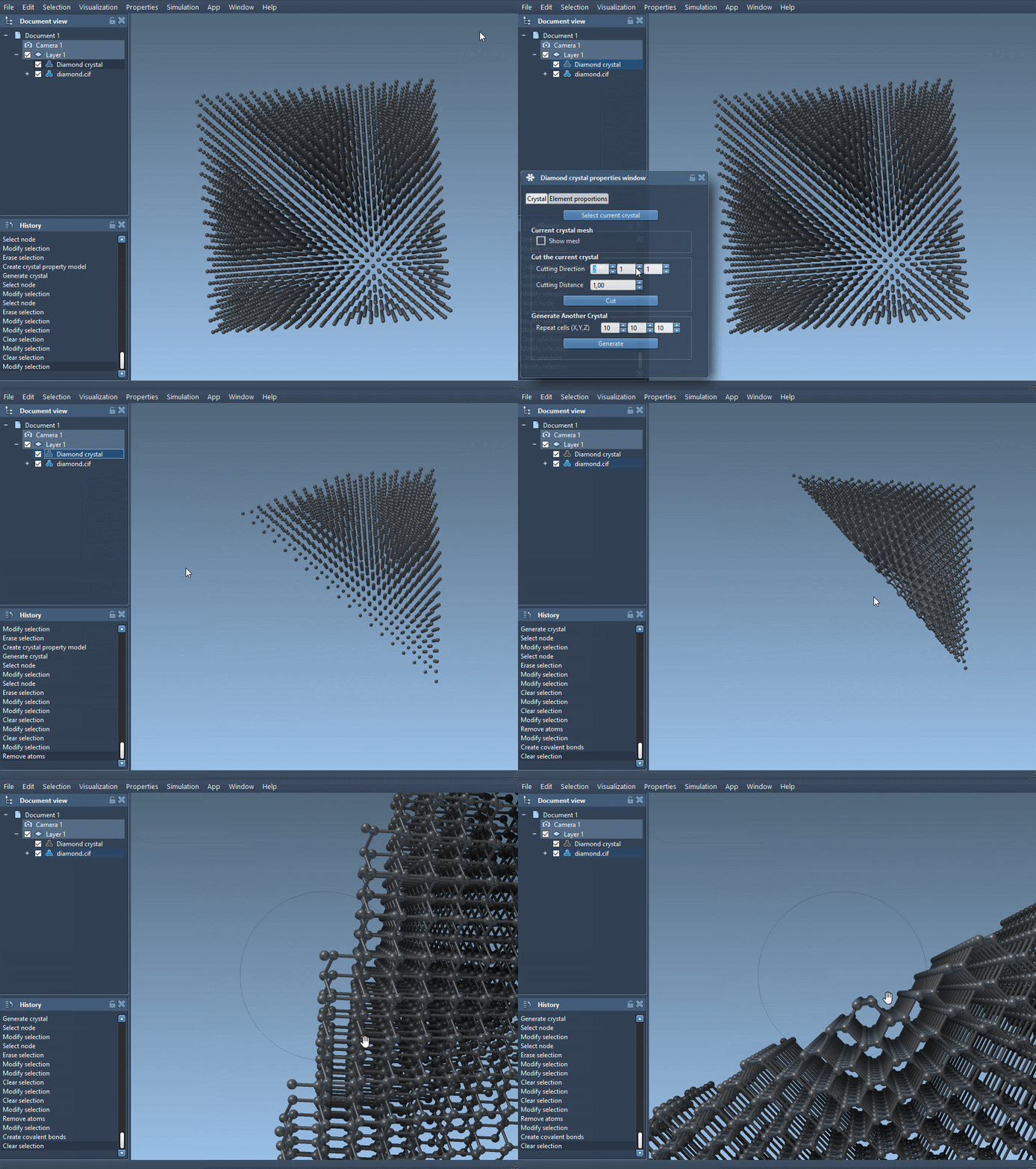
Crystals are composed of repeating units arranged in 3D, often obscuring details when visualized as a whole. Cutting a crystal along a plane — for example using Miller indices like (111) — reveals 2D cross-sections that show atomic arrangements more clearly.
This is especially useful when studying surface structures, atomic densities, cleavage planes, or when comparing polymorphs. A good example is diamond: when viewed along the [111] cut, you can easily identify the compact hexagonal arrangement that defines diamond’s strength and optical properties.
How to slice a crystal in SAMSON
In the Crystal Creator Extension:
- Load a crystal structure — try a diamond CIF file to follow along.
- Right-click on the crystal’s property model in the data graph canvas.
- Select Properties to open the settings window.
- In the first tab, find the cut toolbox.
- Enter Miller indices for the cutting plane (e.g.,
1,1,1for [111]). - Adjust the distance from origin to the cut (the fourth box).
Immediately, the mesh updates to reflect your slicing plane. This makes it easy to analyze planes with higher or lower atomic densities and inspect features like layers or potential cleavage directions — insight that’s hidden in the full bulk structure.
Bonus tip: Verify atomic ratios
Cutting isn’t just about visualization. The Crystal Creator also lets you check whether your generated crystal maintains the proper ratios of atoms, including defects and substitutions from the CIF file. If you’re modeling materials with controlled doping or missing atoms, this is a quick sanity check that can save you trouble downstream.
Why this matters
Crystals are more than just pretty lattices. Their real behavior — conductivity, hardness, reactivity — depends on what’s happening on surfaces and within defects. Cutting helps reveal those areas, guiding better hypotheses and cleaner simulations.
Instead of guessing what’s inside your loaded CIF file, try slicing it and see the structure emerge. Start with diamond. Or challenge yourself with something more complex like sphalerite or zircon. The tools are built in.
To learn more about crystal manipulation, visit the full documentation here: https://documentation.samson-connect.net/tutorials/crystal-creator/generating-crystal-models/
SAMSON and all SAMSON Extensions are free for non-commercial use. You can get SAMSON at https://www.samson-connect.net.