



Protein modeling is complex, and ensuring your protein backbone conformations align with energetically favorable regions is a critical step for accurate simulations and structure refinement. Outliers in dihedral angles, indicated by φ (phi) and ψ (psi), can lead to structural inaccuracies—and that’s where the Interactive Ramachandran Plot becomes an indispensable tool in SAMSON.
What is a Ramachandran Plot?
A Ramachandran plot visualizes the energetically allowed and disallowed dihedral angle regions of amino acid residues in a protein. The yellow areas signify favorable regions, while the white areas correspond to conformations that are either sterically disallowed or energetically costly.
Using this plot allows molecular modelers to pinpoint strained residues, refine structures, and improve their overall accuracy—a crucial step for tasks like homology modeling, active site analysis, or simulation preparation.
Exploring Protein Conformations
The Interactive Ramachandran Plot Extension in SAMSON simplifies navigating the conformational landscape of proteins. Here are some of its key features and benefits:
Visualizing Residues
The app provides a clear visualization of the protein by mapping residues directly onto the plot:
- Clicking a point on the plot selects the corresponding residue in the 3D viewport.
- You can filter residues based on their properties: All, General, Glycine, Proline, and Pre-proline (those preceding a proline in the sequence).
Select a residue and see its dihedral angles (φ and ψ values) displayed in the status bar for quick reference:

Interactive Editing Capabilities
The Ramachandran Plot app isn’t just a visualization tool; it’s an editing powerhouse:
1. Dragging Points on the Plot
By simply dragging a point representing a residue on the plot:
- The dihedral angles change in real-time.
- The protein structure updates instantly in the viewport.
- Undo actions easily with
Ctrl/Cmd+Z, enabling risk-free experimentation.
2. Twister Editor for 3D Manipulation
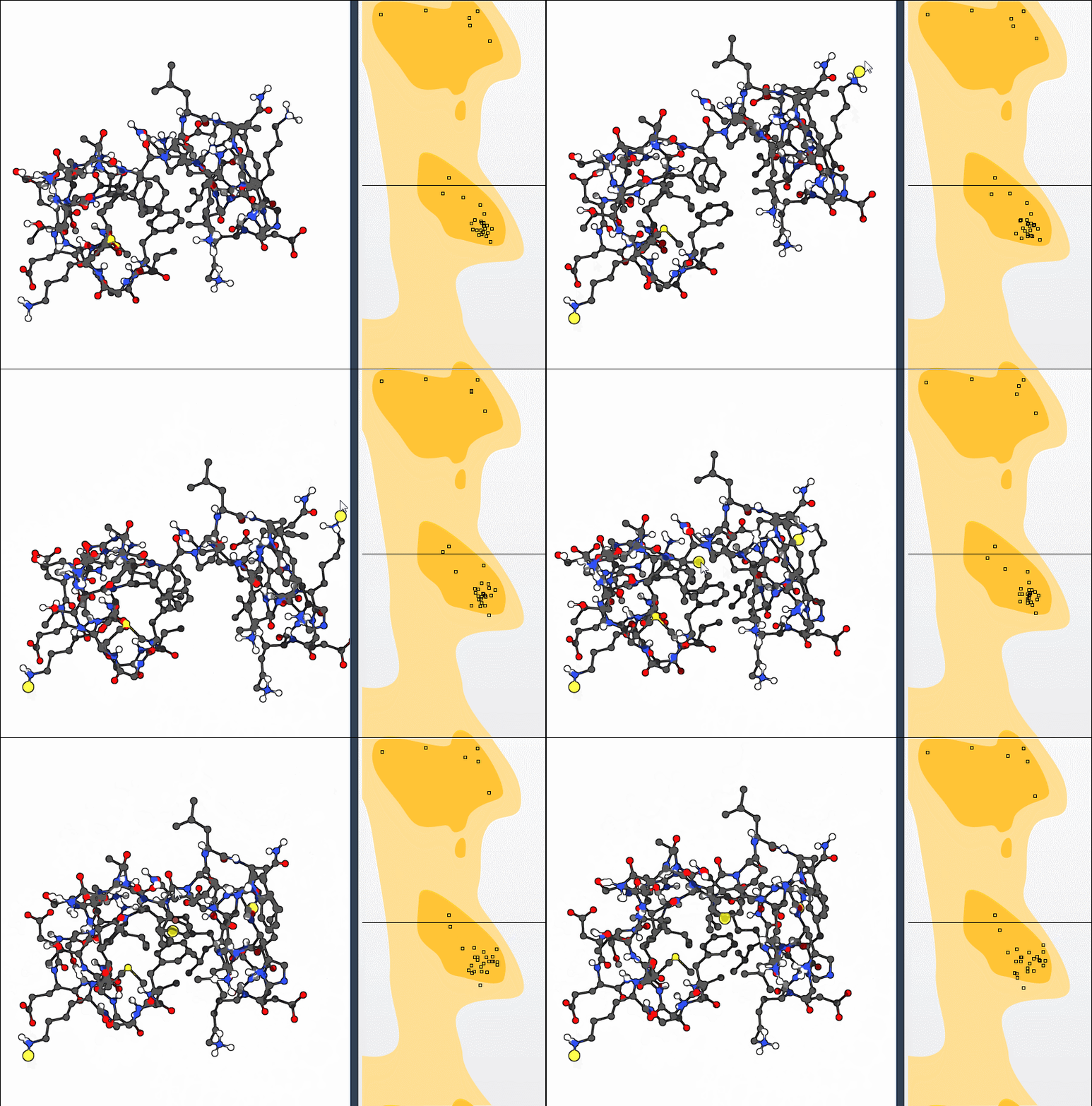
The Twister Editor allows dynamic manipulation in 3D space. Select the Twister Editor tool in the viewport, twist the protein directly, and watch as the Ramachandran plot updates in real time:
Going Beyond Refinement: A Bonus Challenge
For advanced users, the Ramachandran Plot can be used in combination with nonlinear normal modes analysis to fine-tune global and local conformations:
- Reload a protein structure (e.g.,
1YRF). - Calculate the first 10 nonlinear normal modes.
- Set the scaling factor for the first mode and shift it completely—then adjust residue positions with the Ramachandran Plot to ensure all reside in favorable regions:
This technique combines global motion analysis with local refinement for molecular design and readiness in simulations.
Powerful Applications
The Interactive Ramachandran Plot addresses several critical needs in protein modeling workflows:
- Identifying and correcting strained residues prior to simulation.
- Improving homology models by eliminating outliers.
- Understanding conformational flexibility in active or binding sites for drug design.
To learn more about how the Interactive Ramachandran Plot can enhance your molecular modeling, visit the complete tutorial at SAMSON’s documentation.
Note: SAMSON and all SAMSON Extensions are free for non-commercial use. Download SAMSON now at samson-connect.net.