



Defects in crystals play a crucial role in determining their properties and applications. As a molecular modeler or materials scientist, you might encounter the need to study how these imperfections influence structure and behavior. If you are working with diamond crystals, SAMSON offers an intuitive way to explore defects and their impact using its Crystal Creator extension. Here, we will guide you through a step-by-step process to simulate and analyze defects in diamond crystals.
Why Explore Defects in Crystals?
Defects influence many properties of a material, including its mechanical strength, electronic properties, and thermal conductivity. In diamond, for instance, introducing defects can reveal how impurities, atom vacancies, or substitutions change its structural integrity or behavior. This insight can lead to optimized design for various applications, from optics to semiconductors.
Simulating Defects in Diamond Crystals
Let’s dive into how you can simulate defects in diamond using SAMSON and the Crystal Creator extension.
1. Load Your Diamond Crystal
Start by loading a diamond crystal file (.cif format) in SAMSON. Once loaded, create bonds using the Crystal Creator App. The structural model, complete with bonds, provides a realistic visualization of your crystal.
2. Minimize the Structure
To achieve a stable configuration, minimize the diamond structure using the Brenner interaction model available in SAMSON. This lays a solid foundation for analyzing effects once defects are introduced.
3. Modify the Structure to Introduce Defects
To introduce defects, save a copy of your diamond file and open it in a text editor. Look for the section that resembles:
|
1 2 3 4 5 6 7 8 9 10 |
<span></span> <nav class="md-code__nav"> <button class="md-code__button" title="Copy to clipboard" data-clipboard-target="#__code_3 > code" data-md-type="copy"></button> </nav><code>loop_ _atom_site_label _atom_site_fract_x _atom_site_fract_y _atom_site_fract_z C 0.00000 0.00000 0.00000 |
Copy and replace this section with:
|
1 2 3 4 5 6 7 8 9 10 11 |
<span></span> <nav class="md-code__nav"> <button class="md-code__button" title="Copy to clipboard" data-clipboard-target="#__code_4 > code" data-md-type="copy"></button> </nav><code>loop_ _atom_site_label _atom_site_fract_x _atom_site_fract_y _atom_site_fract_z _atom_site_occupancy C 0.00000 0.00000 0.00000 0.95 |
The additional _atom_site_occupancy column specifies that the carbon atom has a 95% probability of being present, simulating a defect.
4. Analyze Your Defective Crystal
Reload the modified CIF file in SAMSON and use the Crystal Creator to recreate bonds. Observe how the crystal structure adapts to the introduced defects. You can cross-check atom presence ratios with the app’s tools to ensure defect probabilities are correctly applied. Try adding multiple defect types to simulate realistic conditions in your research.
Visualizing the Impact
Below is an example of a diamond crystal with a cut along the [111] direction before introducing defects:
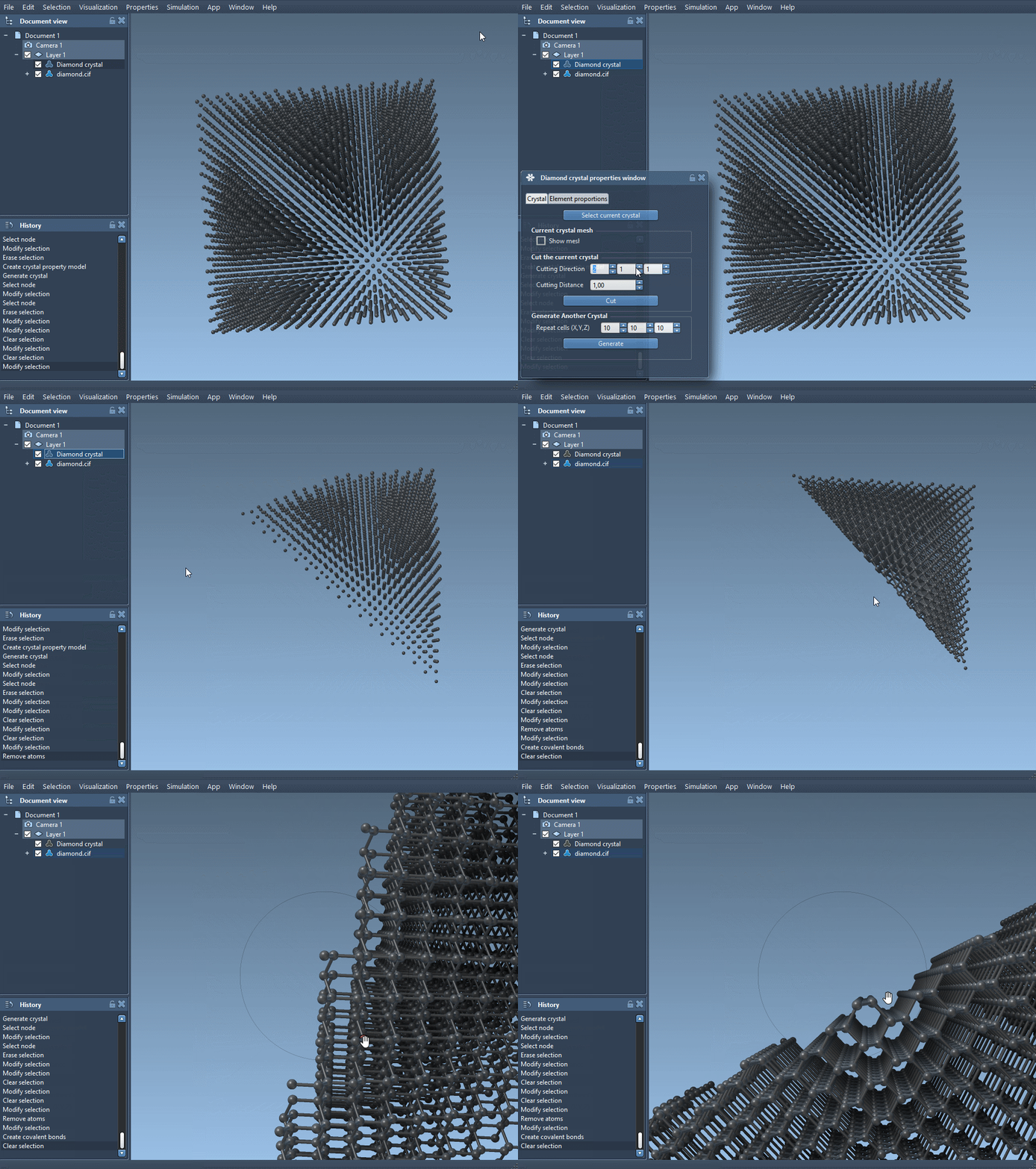
Now, observe how introducing controlled defects alters the structural order. Such visualizations help bridge the gap between raw data and meaningful insights.
Start Exploring Now
Defect analysis, although intricate, is made highly accessible with SAMSON’s tools. Take advantage of the flexibility provided by Crystal Creator to simulate real-world conditions and push the boundaries of molecular modeling.
To learn more about crystal modeling and defect analysis, visit the full documentation page.
SAMSON and all SAMSON Extensions are free for non-commercial use. Download SAMSON today from SAMSON Connect.