



Molecular modelers often encounter challenges when attempting to simulate real-world crystals. Among these challenges, accounting for crystal defects—such as atom vacancies—is essential for accurately representing materials. The Crystal Creator Extension in SAMSON offers an intuitive way to explore and model such defects using CIF files. In this blog post, we’ll walk you through how to investigate the effects of defects in diamonds and simulate their impact on structure.
Why study crystal defects?
Imperfections in crystals significantly affect their physical and chemical properties, from hardness and conductivity to reactivity. For example, defects in diamonds influence their durability and even their optical properties. Modeling these defects can help predict material behavior under various conditions. SAMSON’s Crystal Creator makes this process both accessible and straightforward.
Step 1: Load a diamond crystal
Start by downloading a CIF (Crystallographic Information File) for diamond, such as from the American Mineralogist Crystal Structure Database, and load it into SAMSON via the Crystal Creator Extension. Once loaded, use the app to create bonds within the structure. At this stage, you’ll see how the atoms in a perfect diamond lattice are organized into a repeating pattern.
Step 2: Introduce defects
To simulate defects, copy the CIF file and open it in any text editor. Scroll to the end of the file, where you’ll find the section describing atomic positions. Typically, it appears as follows:
|
1 2 3 4 5 6 7 |
loop_ _atom_site_label _atom_site_fract_x _atom_site_fract_y _atom_site_fract_z C 0.00000 0.00000 0.00000 |
To introduce a vacancy, modify this section by adding an occupancy factor, which indicates the probability of the atom being present. For example:
|
1 2 3 4 5 6 7 8 |
loop_ _atom_site_label _atom_site_fract_x _atom_site_fract_y _atom_site_fract_z _atom_site_occupancy C 0.00000 0.00000 0.00000 0.95 |
Here, the carbon atom has a 95% probability of occupying the given position.
Step 3: Visualize the impact
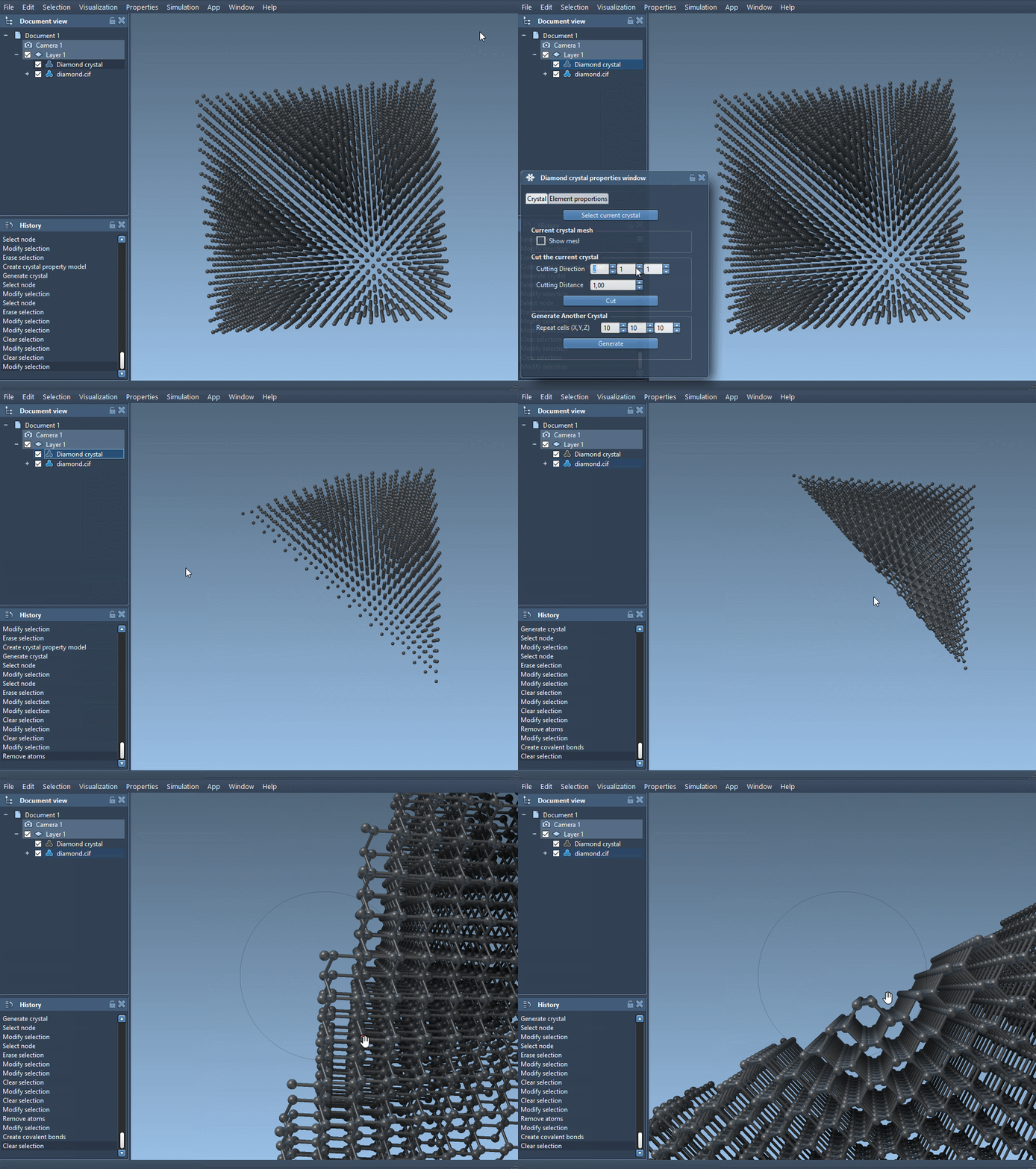
Once you’ve saved the edited CIF file, reload it into Crystal Creator and recreate the bonds. You’ll immediately notice structural variations due to the introduced vacancies. These variations can be critical for exploring how defects affect material properties.
Optional: Minimize and refine the structure
To fine-tune the model, minimize the structure using an appropriate interaction model, such as the Brenner interaction model available in SAMSON. This step ensures that the simulated crystal reflects a realistic physical state for further studies.
Applications and next steps
With the defect-laden crystal modeled, you’re ready to analyze its properties or run simulations under different conditions. Whether you’re designing materials for electronics, studying geological formations, or exploring optical properties, SAMSON provides the tools you need.
To dive deeper into crystal modeling using SAMSON’s Crystal Creator, explore the full tutorial here.
SAMSON and all SAMSON Extensions are free for non-commercial use. Download SAMSON at https://www.samson-connect.net.